
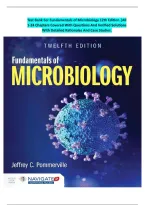
Test Bank For Fundamentals of Microbiology 12th Edition |All
1-24 Chapters Covered With Questions And Verified Solutions
With Detailed Rationales And Case Studies.
, TABLE OF CONTENT
Chapter 1 Introduction to Microbiology: Then and Now
Chapter 2 The Chemical Building Blocks of Life
Chapter 3 Naming, Observing, and Cataloging the Microbial World
Chapter 4 Structure and Organization of Prokaryotic Cells
Chapter 5 Eukaryotic Microbial Cells and Parasites
Chapter 6 The Viruses and Other Infectious Agents
Chapter 7 Microbial Growth and Nutrition
Chapter 8 Microbial Metabolism
Chapter 9 Microbial Genetics
Chapter 10 Gene Transfer, Genetic Engineering, and Genomics
Chapter 11 Control of Microorganisms: Physical Methods and Chemical Agents
Chapter 12 Control of Microorganisms: Antimicrobial Drugs and Superbugs
Chapter 13 Diagnosing Infections
Chapter 14 Infectious Diseases of the Respiratory System
Chapter 15 Infectious Diseases of the Digestive System
Chapter 16 Infectious Diseases Affecting the Skin, Soft Tissues, and Eyes
Chapter 17 Infectious Diseases of the Nervous System
Chapter 18 Systemic Infectious Diseases
Chapter 19 Infectious Diseases of the Urinary and Reproductive Systems
Chapter 20 The Host–Microbe Relationship and Infectious Disease Epidemiology
Chapter 21 The Immune Response to Infection: Innate Immunity
Chapter 22 The Immune Response to Infection: Adaptive Immunity and Vaccination
Chapter 23 Infectious Disease and Immune Disorders
Chapter 24 Applied and Industrial Microbiology
,Chapter 1: Introduction to Microbiology: Then and Now
Multiple-Choice Questions
1. The theory that living organisms could arise spontaneously from non-living matter is known as:
A) Biogenesis
B) Spontaneous generation
C) Germ theory
D) Cell theory
Answer: B
Rationale: Spontaneous generation (also called abiogenesis) was the ancient belief that life could
emerge from non-living material, such as maggots from rotting meat or microbes from broth. This
theory was widely accepted for centuries before being disproven by Redi, Spallanzani, and Pasteur .
Why the other options are incorrect:
• A: Biogenesis is the opposite theory — that life arises only from pre-existing life.
• C: Germ theory states that specific microorganisms cause specific diseases, a later
development.
• D: Cell theory states that cells are the basic unit of all living things, established after Hooke's
observations.
2. Who first promulgated the theory of abiogenesis?
A) Aristotle
B) Pasteur
C) Needham
D) Spallanzani
Answer: A
Rationale: Aristotle, the ancient Greek philosopher, was among the first to propose that life could
arise spontaneously from non-living materials like mud or decaying matter. His views dominated
scientific thought for centuries .
Why the other options are incorrect:
• B: Pasteur definitively disproved spontaneous generation.
• C: Needham conducted experiments that appeared to support spontaneous generation, but
he did not originate the theory.
• D: Spallanzani challenged spontaneous generation through experiments.
3. Which scientist is credited with first observing and describing live microorganisms using simple
microscopes?
A) Robert Hooke
, B) Antonie van Leeuwenhoek
C) Louis Pasteur
D) Francesco Redi
Answer: B
Rationale: Van Leeuwenhoek used handcrafted single-lens microscopes to observe bacteria,
protozoa, and other microorganisms, which he called "animalcules." He is considered the "Father of
Microbiology" .
Why the other options are incorrect:
• A: Hooke observed cells in cork and coined the term "cellulae," but did not first observe live
microorganisms.
• C: Pasteur disproved spontaneous generation and developed pasteurization, not the first
microbial observations.
• D: Redi disproved spontaneous generation of maggots from meat.
4. Louis Pasteur's swan-neck flask experiment was critical because it:
A) Sealed the broth completely from air
B) Allowed air to enter but trapped microbes in the curved neck
C) Used a cotton plug to filter microorganisms
D) Relied on boiling vegetable broth
Answer: B
Rationale: Pasteur's swan-neck flask allowed free passage of air while trapping dust and microbes in
the bend of the neck. The broth remained sterile until the flask was tilted, allowing trapped microbes
to contact the broth. This disproved spontaneous generation by showing that air alone does not
generate life .
Why the other options are incorrect:
• A: Sealing the flask would have invited the criticism that air (or a "vital force") was necessary
for spontaneous generation.
• C: A cotton plug was not the critical design feature of Pasteur's experiment.
• D: Pasteur used meat broth, which contains fewer heat-resistant endospores than vegetable
broths.
5. Which scientist's experiments appeared to support spontaneous generation?
A) Spallanzani
B) Needham
C) Pasteur
D) Koch
Answer: B
1-24 Chapters Covered With Questions And Verified Solutions
With Detailed Rationales And Case Studies.
, TABLE OF CONTENT
Chapter 1 Introduction to Microbiology: Then and Now
Chapter 2 The Chemical Building Blocks of Life
Chapter 3 Naming, Observing, and Cataloging the Microbial World
Chapter 4 Structure and Organization of Prokaryotic Cells
Chapter 5 Eukaryotic Microbial Cells and Parasites
Chapter 6 The Viruses and Other Infectious Agents
Chapter 7 Microbial Growth and Nutrition
Chapter 8 Microbial Metabolism
Chapter 9 Microbial Genetics
Chapter 10 Gene Transfer, Genetic Engineering, and Genomics
Chapter 11 Control of Microorganisms: Physical Methods and Chemical Agents
Chapter 12 Control of Microorganisms: Antimicrobial Drugs and Superbugs
Chapter 13 Diagnosing Infections
Chapter 14 Infectious Diseases of the Respiratory System
Chapter 15 Infectious Diseases of the Digestive System
Chapter 16 Infectious Diseases Affecting the Skin, Soft Tissues, and Eyes
Chapter 17 Infectious Diseases of the Nervous System
Chapter 18 Systemic Infectious Diseases
Chapter 19 Infectious Diseases of the Urinary and Reproductive Systems
Chapter 20 The Host–Microbe Relationship and Infectious Disease Epidemiology
Chapter 21 The Immune Response to Infection: Innate Immunity
Chapter 22 The Immune Response to Infection: Adaptive Immunity and Vaccination
Chapter 23 Infectious Disease and Immune Disorders
Chapter 24 Applied and Industrial Microbiology
,Chapter 1: Introduction to Microbiology: Then and Now
Multiple-Choice Questions
1. The theory that living organisms could arise spontaneously from non-living matter is known as:
A) Biogenesis
B) Spontaneous generation
C) Germ theory
D) Cell theory
Answer: B
Rationale: Spontaneous generation (also called abiogenesis) was the ancient belief that life could
emerge from non-living material, such as maggots from rotting meat or microbes from broth. This
theory was widely accepted for centuries before being disproven by Redi, Spallanzani, and Pasteur .
Why the other options are incorrect:
• A: Biogenesis is the opposite theory — that life arises only from pre-existing life.
• C: Germ theory states that specific microorganisms cause specific diseases, a later
development.
• D: Cell theory states that cells are the basic unit of all living things, established after Hooke's
observations.
2. Who first promulgated the theory of abiogenesis?
A) Aristotle
B) Pasteur
C) Needham
D) Spallanzani
Answer: A
Rationale: Aristotle, the ancient Greek philosopher, was among the first to propose that life could
arise spontaneously from non-living materials like mud or decaying matter. His views dominated
scientific thought for centuries .
Why the other options are incorrect:
• B: Pasteur definitively disproved spontaneous generation.
• C: Needham conducted experiments that appeared to support spontaneous generation, but
he did not originate the theory.
• D: Spallanzani challenged spontaneous generation through experiments.
3. Which scientist is credited with first observing and describing live microorganisms using simple
microscopes?
A) Robert Hooke
, B) Antonie van Leeuwenhoek
C) Louis Pasteur
D) Francesco Redi
Answer: B
Rationale: Van Leeuwenhoek used handcrafted single-lens microscopes to observe bacteria,
protozoa, and other microorganisms, which he called "animalcules." He is considered the "Father of
Microbiology" .
Why the other options are incorrect:
• A: Hooke observed cells in cork and coined the term "cellulae," but did not first observe live
microorganisms.
• C: Pasteur disproved spontaneous generation and developed pasteurization, not the first
microbial observations.
• D: Redi disproved spontaneous generation of maggots from meat.
4. Louis Pasteur's swan-neck flask experiment was critical because it:
A) Sealed the broth completely from air
B) Allowed air to enter but trapped microbes in the curved neck
C) Used a cotton plug to filter microorganisms
D) Relied on boiling vegetable broth
Answer: B
Rationale: Pasteur's swan-neck flask allowed free passage of air while trapping dust and microbes in
the bend of the neck. The broth remained sterile until the flask was tilted, allowing trapped microbes
to contact the broth. This disproved spontaneous generation by showing that air alone does not
generate life .
Why the other options are incorrect:
• A: Sealing the flask would have invited the criticism that air (or a "vital force") was necessary
for spontaneous generation.
• C: A cotton plug was not the critical design feature of Pasteur's experiment.
• D: Pasteur used meat broth, which contains fewer heat-resistant endospores than vegetable
broths.
5. Which scientist's experiments appeared to support spontaneous generation?
A) Spallanzani
B) Needham
C) Pasteur
D) Koch
Answer: B

