Unit 5: International Business
Learning Aim E: Examine the strategic and operational approaches to developing international
trade
E.P8: Explain how products and processes have to be adapted for international markets by a
selected business
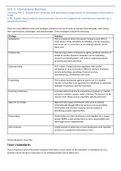
There are many different ways and strategies a business can use in order to operate internationally, each having
their own features, advantages, and disadvantages. These strategies include the following:
Strategy Features
Subsidiaries This is a business where the parent company owns 50% or
more shares of the subsidiary. A subsidiary can be a business
can be set up in a new place or an existing business can be
taken over.
Outsourcing Outsourcing is when a business or agency performs services on
behalf of another business. Examples can be marketing,
research and development, call centres, organising payroll,
producing accounts and more.
Subcontracting This is when a large business negotiates with smaller
companies to carry out work or different services. Examples
include technology consulting, financial services,
manufacturing, construction and more.
Franchising This is where businesses agree to pay to run a in another
country. A franchise is an agreement to distribute or sell goods
between a franchisor and the franchisee.
Licensing to business Licensing allows business to manufacture products or market
services in another country under a license. The license can be
used to cover things such as copyright, patents and more.
Agencies to change Agencies help support businesses who want to expand
internationally though different services such as providing
information and contacts, keeping control of good or
identifying possible opportunities.
Partnerships Partnerships are when businesses work together for a longer
period. Within a partnership there is more responsibility and
more legal factors implemented
Joint ventures A joint venture is when two or more businesses work together
to focus on a particular transaction or deal.
Chosen Business: Tesco PLC
Tesco’s Subsidiaries
This is a business where the parent company owns 50% or more shares of the subsidiary. A subsidiary can be a
business can be set up in a new place or an existing business can be taken over.
, F&F (Florence and Fred) - Originally launched in 2001, F&F was implemented in Tesco’s stores around the UK and
Ireland. During the 2010s, the company opened F&F stores in and out of London, began operating online and
expanding to more countries. Unfortunately, F&F was deemed unsuccessful as it lost its online presence. This led to
the business partnering with Next PLC, which offers a wide selection of clothes for women, men, and kids in approx.
607 stores.
Tesco Bank - Tesco bank was introduced
in 2008, the bank is a joint venture with
Tesco and the royal bank of Scotland. The
bank offers different service such as
savings, travel, loans, credit cards and
much more. Tesco Bank’s USP is that they
are able to cross sell products and service
to its large consumer base.
Tesco Mobile - Started in May 2003,
Tesco mobile operates in the UK, Czech
Republic, Ireland, Hungary, and Slovakia.
In 2004, the company launched its
telephone and broadband services in
partnerships with an ADSL-based service
and BT phone lines. This subsidiary has
been very successful, Tesco has stated
that the service now has over 5 million
users.
Tesco’s Partnerships
A partnership is a form of business or where two or more people/ companies who share ownership and
responsibility for managing a business, including the income and loses generated by the business. The different types
of partnerships are general partnership, limited partnership, and joint venture. Tesco’s most popular partnership is
the following:
‘ Little Helps for healthier living ‘ Partnership.
This partnership includes Diabetes UK, Cancer Research UK, the British Heart Foundation and Tesco PLC. The aim of
this partnership is to raise awareness of these diseases, reach more people and lower the risk factors. The aim of the
partnership is to reach more people who are at risk of developing type 2 diabetes and spread awareness. They are
working together to help more people understand the risks factors and causes to reduce the number of type 2
diabetes cases. The partnership was signed in 2018 and the organisations agreed to work together over the next five
years.
Tesco’s Joint Ventures
In 2014, as Tesco was having difficulties expanding into the Chinese market, the business instead launched the Gain
Land Venture with CRH (Chinese Resources Holdings). In February 2020, Tesco had sold its 20% share in the venture
for £275million.
Adaptations that Tesco has made in their international markets.
Learning Aim E: Examine the strategic and operational approaches to developing international
trade
E.P8: Explain how products and processes have to be adapted for international markets by a
selected business
There are many different ways and strategies a business can use in order to operate internationally, each having
their own features, advantages, and disadvantages. These strategies include the following:
Strategy Features
Subsidiaries This is a business where the parent company owns 50% or
more shares of the subsidiary. A subsidiary can be a business
can be set up in a new place or an existing business can be
taken over.
Outsourcing Outsourcing is when a business or agency performs services on
behalf of another business. Examples can be marketing,
research and development, call centres, organising payroll,
producing accounts and more.
Subcontracting This is when a large business negotiates with smaller
companies to carry out work or different services. Examples
include technology consulting, financial services,
manufacturing, construction and more.
Franchising This is where businesses agree to pay to run a in another
country. A franchise is an agreement to distribute or sell goods
between a franchisor and the franchisee.
Licensing to business Licensing allows business to manufacture products or market
services in another country under a license. The license can be
used to cover things such as copyright, patents and more.
Agencies to change Agencies help support businesses who want to expand
internationally though different services such as providing
information and contacts, keeping control of good or
identifying possible opportunities.
Partnerships Partnerships are when businesses work together for a longer
period. Within a partnership there is more responsibility and
more legal factors implemented
Joint ventures A joint venture is when two or more businesses work together
to focus on a particular transaction or deal.
Chosen Business: Tesco PLC
Tesco’s Subsidiaries
This is a business where the parent company owns 50% or more shares of the subsidiary. A subsidiary can be a
business can be set up in a new place or an existing business can be taken over.
, F&F (Florence and Fred) - Originally launched in 2001, F&F was implemented in Tesco’s stores around the UK and
Ireland. During the 2010s, the company opened F&F stores in and out of London, began operating online and
expanding to more countries. Unfortunately, F&F was deemed unsuccessful as it lost its online presence. This led to
the business partnering with Next PLC, which offers a wide selection of clothes for women, men, and kids in approx.
607 stores.
Tesco Bank - Tesco bank was introduced
in 2008, the bank is a joint venture with
Tesco and the royal bank of Scotland. The
bank offers different service such as
savings, travel, loans, credit cards and
much more. Tesco Bank’s USP is that they
are able to cross sell products and service
to its large consumer base.
Tesco Mobile - Started in May 2003,
Tesco mobile operates in the UK, Czech
Republic, Ireland, Hungary, and Slovakia.
In 2004, the company launched its
telephone and broadband services in
partnerships with an ADSL-based service
and BT phone lines. This subsidiary has
been very successful, Tesco has stated
that the service now has over 5 million
users.
Tesco’s Partnerships
A partnership is a form of business or where two or more people/ companies who share ownership and
responsibility for managing a business, including the income and loses generated by the business. The different types
of partnerships are general partnership, limited partnership, and joint venture. Tesco’s most popular partnership is
the following:
‘ Little Helps for healthier living ‘ Partnership.
This partnership includes Diabetes UK, Cancer Research UK, the British Heart Foundation and Tesco PLC. The aim of
this partnership is to raise awareness of these diseases, reach more people and lower the risk factors. The aim of the
partnership is to reach more people who are at risk of developing type 2 diabetes and spread awareness. They are
working together to help more people understand the risks factors and causes to reduce the number of type 2
diabetes cases. The partnership was signed in 2018 and the organisations agreed to work together over the next five
years.
Tesco’s Joint Ventures
In 2014, as Tesco was having difficulties expanding into the Chinese market, the business instead launched the Gain
Land Venture with CRH (Chinese Resources Holdings). In February 2020, Tesco had sold its 20% share in the venture
for £275million.
Adaptations that Tesco has made in their international markets.