
NR6998 Pre-Predictor - Study Guide Questions & Verified Answers
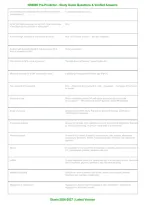
Which element of malpractice links the NP's breach to the Causation (proximate cause).
patient's injury?
An NP bills Medicare under her own NPI. What percentage 85%.
of the physician fee schedule is reimbursed?
A test with high sensitivity is best used to do what? Rule OUT disease (SnOut) — few false negatives.
A patient with diabetes attends a foot-care class. What Tertiary prevention.
level of prevention is this?
Who defines an NP's scope of practice? The state Board of Nursing / Nurse Practice Act.
Medicare coverage for a SNF stay requires what? A qualifying 3-day inpatient hospital stay (Part A).
Four elements of malpractice Duty → Breach of duty (standard of care) → Causation → Damages. All four must
be proven.
Standard of care What a reasonably prudent NP with similar training would do in similar
circumstances — NPs are held to the NP standard, not the RN standard.
Scope of practice Defined by the STATE Nurse Practice Act (Board of Nursing). Certification
(ANCC/AANP) ≠ licensure.
Prescriptive authority Granted by the state; DEA registration required for controlled substances. Exercised
by writing, e-prescribing, or giving a verbal order to a pharmacist.
Informed consent Provider's duty: explain diagnosis, the procedure, risks, benefits, alternatives
(including no treatment). Patient must have capacity. The nurse may witness the
signature.
Minors Emancipated minors consent for themselves; most states allow minors to consent to
STI, contraception, prenatal, substance use care.
HIPAA Protects identifiable health info; patient has right to access/copy records. Disclosure
OK for treatment, payment, operations, and mandated reporting.
Mandated reporting Child abuse, elder/vulnerable adult abuse, certain communicable diseases.
Reporting duty overrides confidentiality.
Negligence vs. malpractice Negligence = general failure of reasonable care; malpractice = professional
negligence by a licensed provider.
Stuvia 2026-2027 | Latest Version
, NR6998 Pre-Predictor - Study Guide Questions & Verified Answers
Autonomy Right to self-determination — competent patient refuses treatment.
Beneficence Do good — act in the patient's best interest.
Nonmaleficence Do no harm — weigh risks of a medication or procedure.
Justice Fair distribution of resources — equal care regardless of insurance.
Veracity Truth-telling — disclosing a diagnosis honestly.
Fidelity Keeping promises / loyalty to the patient.
Medicare Part A Hospital inpatient, SNF (after a qualifying 3-day inpatient stay), hospice, some
home health.
Medicare Part B Outpatient/provider visits, preventive services, DME. NP services billed here.
Medicare Part C / D C = Medicare Advantage (private plan). D = outpatient prescription drugs.
NP direct billing NP bills under own NPI → reimbursed at 85% of the physician fee schedule.
Incident-to billing Billed under the physician at 100%; requires physician's established plan of care,
physician on-site (direct supervision), and NOT a new problem/new patient.
Medicaid Joint federal-state; eligibility is income-based and varies by state.
Hospice eligibility Terminal illness with prognosis ≤6 months if the disease runs its normal course; two
certifications.
CPT vs. ICD-10 CPT = what you DID (procedure/visit). ICD-10 = WHY (diagnosis).
Sensitivity True positive rate — ability to correctly identify those WITH disease. High sensitivity
rules OUT (SnOut).
Stuvia 2026-2027 | Latest Version
, NR6998 Pre-Predictor - Study Guide Questions & Verified Answers
Specificity True negative rate — ability to correctly identify those WITHOUT disease. High
specificity rules IN (SpIn).
Positive predictive value Probability a positive test = true disease; rises with disease prevalence.
Incidence vs. prevalence Incidence = NEW cases over a period. Prevalence = ALL existing cases at a point in
time.
Primary prevention Prevent disease before it occurs: immunizations, seat belts, counseling.
Secondary prevention Early detection: screening (mammogram, Pap, BP, colonoscopy).
Tertiary prevention Limit disability/complications in existing disease: cardiac rehab, PT after stroke,
diabetic foot care.
Levels of evidence (highest) Systematic review/meta-analysis of RCTs → RCT → cohort → case-control → case
series → expert opinion.
Type I vs. Type II error (Research & Epidemiology) Type I = false positive (reject a true null). Type II = false negative (miss a real
difference).
Clinical pearl — Professional Role, Legal & Ethical Issues Prevention level trap: screening a HEALTHY person is secondary prevention
(detecting disease early), not primary. Teaching a diabetic about foot care is tertiary.
A 52-year-old woman smoked 1 ppd for 25 years and quit Yes — age 50-80, ≥20 pack-years, quit within 15 years. Annual low-dose CT.
10 years ago. Does she qualify for lung cancer screening?
Which men get a one-time AAA ultrasound? Men 65-75 who have ever smoked.
At what age does USPSTF now start biennial Age 40 (through 74).
mammography?
A 58-year-old had shingles 3 years ago. Should she get Yes — 2 doses, 2-6 months apart; prior shingles is not a reason to skip.
Shingrix?
USPSTF colorectal screening begins at what age? 45.
Tdap is recommended at what point in every pregnancy? 27-36 weeks gestation.
Stuvia 2026-2027 | Latest Version
, NR6998 Pre-Predictor - Study Guide Questions & Verified Answers
Hypertension All adults ≥18. Annually if ≥40 or at increased risk; every 3-5 yr if 18-39 with normal
BP and no risk factors.
Lipids / statin use Statin for adults 40-75 with ≥1 CVD risk factor and 10-yr ASCVD risk ≥10% (Grade
B); selective if 7.5-<10% (C).
Prediabetes / type 2 DM Adults 35-70 who are overweight or obese; repeat every 3 yr if normal.
Colorectal cancer Ages 45-75 (45-49 Grade B, 50-75 Grade A). 76-85 individualized. Colonoscopy
q10y, FIT annually, stool DNA-FIT q1-3y, CT colonography q5y.
Breast cancer Biennial mammography, women 40-74 (2024 update).
Cervical cancer 21-29: cytology q3y. 30-65: cytology q3y OR hrHPV alone q5y OR co-test q5y. Stop
>65 with adequate prior normal screening or after hysterectomy for benign reasons.
Lung cancer Annual low-dose CT, ages 50-80, ≥20 pack-years, currently smoke or quit within the
past 15 years.
AAA One-time abdominal ultrasound, men 65-75 who have EVER smoked (≥100
cigarettes).
Osteoporosis DXA for women ≥65, and postmenopausal women <65 at increased risk. Evidence
insufficient for men.
Prostate cancer Men 55-69: individual shared decision about PSA (Grade C). ≥70: do not screen
(D).
Hepatitis C One-time screening, all adults 18-79.
HIV Ages 15-65 at least once; all pregnant women; younger/older if at risk.
Hepatitis B Adolescents/adults at increased risk; all pregnant women at first prenatal visit.
(CDC: screen all adults ≥18 at least once.)
Depression / Anxiety Depression: all adults and adolescents 12-18. Anxiety: adults ≤64 and children 8-18.
Chlamydia / Gonorrhea Sexually active women ≤24, and older women at increased risk.
Stuvia 2026-2027 | Latest Version

