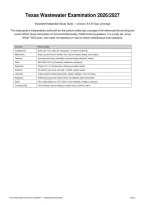
Texas Wastewater Examination 2026/2027
Expanded Independent Study Guide — Versions A & B Topic Coverage
This study guide is independently authored from the publicly visible topic coverage of the referenced Stuvia listing and
current official Texas Commission on Environmental Quality (TCEQ) licensing guidance. It is a study aid, not an
official TCEQ exam, and it does not reproduce or claim to contain leaked/actual exam questions.
Core area What to master
Fundamentals BOD, COD, TSS, solids, pH, temperature, I/I, treatment objectives
Mathematics lb/day, percent removal, detention time, hydraulic/organic loading, mass balance
Treatment Screening, grit, primary clarification, activated sludge, nitrification, settling
Solids RAS, WAS, SRT, SVI, thickening, stabilization, dewatering
Disinfection Chlorine, CT, UV, dechlorination, sampling and effluent quality
Collection Lift stations, force mains, wet wells, I/I, SSOs, confined spaces
Laboratory Grab/composite samples, preservation, QA/QC, calibration, chain of custody
Regulation TCEQ licensing, permits, design criteria, self-reporting, facility classification
Safety H2S, oxygen deficiency, LOTO, SDS, chemical handling, emergency response
Troubleshooting Data verification, process diagnosis, clarifier issues, ammonia, alarms
Texas Wastewater Examination 2026/2027 — Independent Study Guide Page 1
, 1. Wastewater Fundamentals & Characteristics
Q1. What does BOD5 represent in wastewater treatment?
Answer: The oxygen consumed by microorganisms while biologically degrading biodegradable organic matter under the test conditions.
Rationale / exam cue: BOD is a key indicator of biodegradable organic strength and treatment performance.
Q2. What does COD measure?
Answer: The oxygen equivalent of chemically oxidizable material in a wastewater sample.
Rationale / exam cue: COD is generally faster to obtain than BOD and often exceeds BOD because it includes more oxidizable compounds.
Q3. Why is TSS important to an operator?
Answer: It quantifies suspended particulate matter and is commonly used to evaluate clarification and effluent solids performance.
Rationale / exam cue: A rising effluent TSS can indicate poor settling, hydraulic overload, solids washout, or mechanical problems.
Q4. What is the relationship among total solids, suspended solids, and dissolved solids?
Answer: Total solids are the combined dissolved and suspended fractions.
Rationale / exam cue: Therefore, dissolved solids can be estimated as total solids minus suspended solids when measurements are
compatible.
Q5. What does pH indicate?
Answer: The acidity or alkalinity of the wastewater.
Rationale / exam cue: pH affects biological activity, chemical reactions, corrosion, and disinfection performance.
Q6. Why can temperature affect biological treatment?
Answer: Microbial growth and reaction rates are temperature dependent.
Rationale / exam cue: Cold wastewater generally slows biological reactions; operators must interpret process data in that context.
Q7. What is septicity?
Answer: A condition in which wastewater becomes depleted of oxygen and develops anaerobic conditions, often producing sulfides and
odors.
Rationale / exam cue: Long detention times, warm conditions, and stagnant zones can promote septic conditions.
Q8. Why is wastewater flow monitoring essential?
Answer: Flow provides the hydraulic basis for loading calculations, process control, compliance reporting, and capacity evaluation.
Rationale / exam cue: Many operating calculations use flow in MGD together with concentration in mg/L.
Q9. What is infiltration?
Answer: Groundwater entering a sewer system through defects such as cracked pipes or faulty joints.
Rationale / exam cue: Infiltration is typically groundwater related and may persist during dry weather.
Q10. What is inflow?
Answer: Relatively rapid entry of surface or stormwater into a collection system through improper connections or openings.
Rationale / exam cue: Inflow often rises quickly during rainfall events.
Q11. Why are excessive I/I rates a treatment concern?
Answer: They can hydraulically overload collection and treatment facilities, shorten detention time, and reduce process stability.
Rationale / exam cue: I/I control can protect both collection capacity and treatment performance.
Q12. What is a point-source discharge?
Answer: A discharge from a discernible, confined, discrete conveyance such as a pipe or outfall.
Rationale / exam cue: Point-source discharges are central to the NPDES regulatory framework.
Q13. What is the purpose of preliminary treatment?
Answer: To remove or reduce large debris, grit, and other materials that can damage equipment or interfere with downstream
processes.
Rationale / exam cue: Screening and grit removal protect pumps and process equipment.
Q14. What is the main purpose of primary clarification?
Texas Wastewater Examination 2026/2027 — Independent Study Guide Page 2
, Answer: To remove settleable solids and a portion of suspended and organic material by gravity.
Rationale / exam cue: Primary treatment reduces the load presented to secondary biological processes.
Q15. What is secondary treatment designed to accomplish?
Answer: Biological removal of biodegradable organic matter and associated suspended solids, subject to the applicable permit and
regulatory requirements.
Rationale / exam cue: Secondary treatment depends on healthy process biology and effective solids separation.
Q16. Application check: What does BOD5 represent in wastewater treatment?
Answer: The oxygen consumed by microorganisms while biologically degrading biodegradable organic matter under the test conditions.
Rationale / exam cue: Exam cue: BOD is a key indicator of biodegradable organic strength and treatment performance.
Q17. Operator decision: What does COD measure?
Answer: The oxygen equivalent of chemically oxidizable material in a wastewater sample.
Rationale / exam cue: Reasoning cue: COD is generally faster to obtain than BOD and often exceeds BOD because it includes more
oxidizable compounds.
Q18. Application check: Why is TSS important to an operator?
Answer: It quantifies suspended particulate matter and is commonly used to evaluate clarification and effluent solids performance.
Rationale / exam cue: Exam cue: A rising effluent TSS can indicate poor settling, hydraulic overload, solids washout, or mechanical
problems.
Q19. Operator decision: What is the relationship among total solids, suspended solids, and dissolved solids?
Answer: Total solids are the combined dissolved and suspended fractions.
Rationale / exam cue: Reasoning cue: Therefore, dissolved solids can be estimated as total solids minus suspended solids when
measurements are compatible.
Q20. Application check: What does pH indicate?
Answer: The acidity or alkalinity of the wastewater.
Rationale / exam cue: Exam cue: pH affects biological activity, chemical reactions, corrosion, and disinfection performance.
Q21. Operator decision: Why can temperature affect biological treatment?
Answer: Microbial growth and reaction rates are temperature dependent.
Rationale / exam cue: Reasoning cue: Cold wastewater generally slows biological reactions; operators must interpret process data in that
context.
Q22. Application check: What is septicity?
Answer: A condition in which wastewater becomes depleted of oxygen and develops anaerobic conditions, often producing sulfides and
odors.
Rationale / exam cue: Exam cue: Long detention times, warm conditions, and stagnant zones can promote septic conditions.
Q23. Operator decision: Why is wastewater flow monitoring essential?
Answer: Flow provides the hydraulic basis for loading calculations, process control, compliance reporting, and capacity evaluation.
Rationale / exam cue: Reasoning cue: Many operating calculations use flow in MGD together with concentration in mg/L.
Q24. Application check: What is infiltration?
Answer: Groundwater entering a sewer system through defects such as cracked pipes or faulty joints.
Rationale / exam cue: Exam cue: Infiltration is typically groundwater related and may persist during dry weather.
Q25. Operator decision: What is inflow?
Answer: Relatively rapid entry of surface or stormwater into a collection system through improper connections or openings.
Rationale / exam cue: Reasoning cue: Inflow often rises quickly during rainfall events.
Q26. Application check: Why are excessive I/I rates a treatment concern?
Answer: They can hydraulically overload collection and treatment facilities, shorten detention time, and reduce process stability.
Rationale / exam cue: Exam cue: I/I control can protect both collection capacity and treatment performance.
Q27. Operator decision: What is a point-source discharge?
Answer: A discharge from a discernible, confined, discrete conveyance such as a pipe or outfall.
Texas Wastewater Examination 2026/2027 — Independent Study Guide Page 3
, Rationale / exam cue: Reasoning cue: Point-source discharges are central to the NPDES regulatory framework.
Q28. Application check: What is the purpose of preliminary treatment?
Answer: To remove or reduce large debris, grit, and other materials that can damage equipment or interfere with downstream
processes.
Rationale / exam cue: Exam cue: Screening and grit removal protect pumps and process equipment.
Q29. Operator decision: What is the main purpose of primary clarification?
Answer: To remove settleable solids and a portion of suspended and organic material by gravity.
Rationale / exam cue: Reasoning cue: Primary treatment reduces the load presented to secondary biological processes.
Q30. Application check: What is secondary treatment designed to accomplish?
Answer: Biological removal of biodegradable organic matter and associated suspended solids, subject to the applicable permit and
regulatory requirements.
Rationale / exam cue: Exam cue: Secondary treatment depends on healthy process biology and effective solids separation.
Texas Wastewater Examination 2026/2027 — Independent Study Guide Page 4
Expanded Independent Study Guide — Versions A & B Topic Coverage
This study guide is independently authored from the publicly visible topic coverage of the referenced Stuvia listing and
current official Texas Commission on Environmental Quality (TCEQ) licensing guidance. It is a study aid, not an
official TCEQ exam, and it does not reproduce or claim to contain leaked/actual exam questions.
Core area What to master
Fundamentals BOD, COD, TSS, solids, pH, temperature, I/I, treatment objectives
Mathematics lb/day, percent removal, detention time, hydraulic/organic loading, mass balance
Treatment Screening, grit, primary clarification, activated sludge, nitrification, settling
Solids RAS, WAS, SRT, SVI, thickening, stabilization, dewatering
Disinfection Chlorine, CT, UV, dechlorination, sampling and effluent quality
Collection Lift stations, force mains, wet wells, I/I, SSOs, confined spaces
Laboratory Grab/composite samples, preservation, QA/QC, calibration, chain of custody
Regulation TCEQ licensing, permits, design criteria, self-reporting, facility classification
Safety H2S, oxygen deficiency, LOTO, SDS, chemical handling, emergency response
Troubleshooting Data verification, process diagnosis, clarifier issues, ammonia, alarms
Texas Wastewater Examination 2026/2027 — Independent Study Guide Page 1
, 1. Wastewater Fundamentals & Characteristics
Q1. What does BOD5 represent in wastewater treatment?
Answer: The oxygen consumed by microorganisms while biologically degrading biodegradable organic matter under the test conditions.
Rationale / exam cue: BOD is a key indicator of biodegradable organic strength and treatment performance.
Q2. What does COD measure?
Answer: The oxygen equivalent of chemically oxidizable material in a wastewater sample.
Rationale / exam cue: COD is generally faster to obtain than BOD and often exceeds BOD because it includes more oxidizable compounds.
Q3. Why is TSS important to an operator?
Answer: It quantifies suspended particulate matter and is commonly used to evaluate clarification and effluent solids performance.
Rationale / exam cue: A rising effluent TSS can indicate poor settling, hydraulic overload, solids washout, or mechanical problems.
Q4. What is the relationship among total solids, suspended solids, and dissolved solids?
Answer: Total solids are the combined dissolved and suspended fractions.
Rationale / exam cue: Therefore, dissolved solids can be estimated as total solids minus suspended solids when measurements are
compatible.
Q5. What does pH indicate?
Answer: The acidity or alkalinity of the wastewater.
Rationale / exam cue: pH affects biological activity, chemical reactions, corrosion, and disinfection performance.
Q6. Why can temperature affect biological treatment?
Answer: Microbial growth and reaction rates are temperature dependent.
Rationale / exam cue: Cold wastewater generally slows biological reactions; operators must interpret process data in that context.
Q7. What is septicity?
Answer: A condition in which wastewater becomes depleted of oxygen and develops anaerobic conditions, often producing sulfides and
odors.
Rationale / exam cue: Long detention times, warm conditions, and stagnant zones can promote septic conditions.
Q8. Why is wastewater flow monitoring essential?
Answer: Flow provides the hydraulic basis for loading calculations, process control, compliance reporting, and capacity evaluation.
Rationale / exam cue: Many operating calculations use flow in MGD together with concentration in mg/L.
Q9. What is infiltration?
Answer: Groundwater entering a sewer system through defects such as cracked pipes or faulty joints.
Rationale / exam cue: Infiltration is typically groundwater related and may persist during dry weather.
Q10. What is inflow?
Answer: Relatively rapid entry of surface or stormwater into a collection system through improper connections or openings.
Rationale / exam cue: Inflow often rises quickly during rainfall events.
Q11. Why are excessive I/I rates a treatment concern?
Answer: They can hydraulically overload collection and treatment facilities, shorten detention time, and reduce process stability.
Rationale / exam cue: I/I control can protect both collection capacity and treatment performance.
Q12. What is a point-source discharge?
Answer: A discharge from a discernible, confined, discrete conveyance such as a pipe or outfall.
Rationale / exam cue: Point-source discharges are central to the NPDES regulatory framework.
Q13. What is the purpose of preliminary treatment?
Answer: To remove or reduce large debris, grit, and other materials that can damage equipment or interfere with downstream
processes.
Rationale / exam cue: Screening and grit removal protect pumps and process equipment.
Q14. What is the main purpose of primary clarification?
Texas Wastewater Examination 2026/2027 — Independent Study Guide Page 2
, Answer: To remove settleable solids and a portion of suspended and organic material by gravity.
Rationale / exam cue: Primary treatment reduces the load presented to secondary biological processes.
Q15. What is secondary treatment designed to accomplish?
Answer: Biological removal of biodegradable organic matter and associated suspended solids, subject to the applicable permit and
regulatory requirements.
Rationale / exam cue: Secondary treatment depends on healthy process biology and effective solids separation.
Q16. Application check: What does BOD5 represent in wastewater treatment?
Answer: The oxygen consumed by microorganisms while biologically degrading biodegradable organic matter under the test conditions.
Rationale / exam cue: Exam cue: BOD is a key indicator of biodegradable organic strength and treatment performance.
Q17. Operator decision: What does COD measure?
Answer: The oxygen equivalent of chemically oxidizable material in a wastewater sample.
Rationale / exam cue: Reasoning cue: COD is generally faster to obtain than BOD and often exceeds BOD because it includes more
oxidizable compounds.
Q18. Application check: Why is TSS important to an operator?
Answer: It quantifies suspended particulate matter and is commonly used to evaluate clarification and effluent solids performance.
Rationale / exam cue: Exam cue: A rising effluent TSS can indicate poor settling, hydraulic overload, solids washout, or mechanical
problems.
Q19. Operator decision: What is the relationship among total solids, suspended solids, and dissolved solids?
Answer: Total solids are the combined dissolved and suspended fractions.
Rationale / exam cue: Reasoning cue: Therefore, dissolved solids can be estimated as total solids minus suspended solids when
measurements are compatible.
Q20. Application check: What does pH indicate?
Answer: The acidity or alkalinity of the wastewater.
Rationale / exam cue: Exam cue: pH affects biological activity, chemical reactions, corrosion, and disinfection performance.
Q21. Operator decision: Why can temperature affect biological treatment?
Answer: Microbial growth and reaction rates are temperature dependent.
Rationale / exam cue: Reasoning cue: Cold wastewater generally slows biological reactions; operators must interpret process data in that
context.
Q22. Application check: What is septicity?
Answer: A condition in which wastewater becomes depleted of oxygen and develops anaerobic conditions, often producing sulfides and
odors.
Rationale / exam cue: Exam cue: Long detention times, warm conditions, and stagnant zones can promote septic conditions.
Q23. Operator decision: Why is wastewater flow monitoring essential?
Answer: Flow provides the hydraulic basis for loading calculations, process control, compliance reporting, and capacity evaluation.
Rationale / exam cue: Reasoning cue: Many operating calculations use flow in MGD together with concentration in mg/L.
Q24. Application check: What is infiltration?
Answer: Groundwater entering a sewer system through defects such as cracked pipes or faulty joints.
Rationale / exam cue: Exam cue: Infiltration is typically groundwater related and may persist during dry weather.
Q25. Operator decision: What is inflow?
Answer: Relatively rapid entry of surface or stormwater into a collection system through improper connections or openings.
Rationale / exam cue: Reasoning cue: Inflow often rises quickly during rainfall events.
Q26. Application check: Why are excessive I/I rates a treatment concern?
Answer: They can hydraulically overload collection and treatment facilities, shorten detention time, and reduce process stability.
Rationale / exam cue: Exam cue: I/I control can protect both collection capacity and treatment performance.
Q27. Operator decision: What is a point-source discharge?
Answer: A discharge from a discernible, confined, discrete conveyance such as a pipe or outfall.
Texas Wastewater Examination 2026/2027 — Independent Study Guide Page 3
, Rationale / exam cue: Reasoning cue: Point-source discharges are central to the NPDES regulatory framework.
Q28. Application check: What is the purpose of preliminary treatment?
Answer: To remove or reduce large debris, grit, and other materials that can damage equipment or interfere with downstream
processes.
Rationale / exam cue: Exam cue: Screening and grit removal protect pumps and process equipment.
Q29. Operator decision: What is the main purpose of primary clarification?
Answer: To remove settleable solids and a portion of suspended and organic material by gravity.
Rationale / exam cue: Reasoning cue: Primary treatment reduces the load presented to secondary biological processes.
Q30. Application check: What is secondary treatment designed to accomplish?
Answer: Biological removal of biodegradable organic matter and associated suspended solids, subject to the applicable permit and
regulatory requirements.
Rationale / exam cue: Exam cue: Secondary treatment depends on healthy process biology and effective solids separation.
Texas Wastewater Examination 2026/2027 — Independent Study Guide Page 4