
Tmc Exam 2 Actual 2025/2026 Questions And 100% Correct Answers
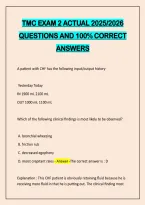
TMC EXAM 2 ACTUAL 2025/2026 QUESTIONS AND 100% CORRECT ANSWERS A patient with CHF has the following input/output history Yesterday Today IN 1900 mL 2100 mL OUT 1000 mL 1100 mL Which of the following clinical findings is most likely to be observed? A. bronchial wheezing B. friction rub C. decreased egophony D. moist crepitant rales - Answer -The correct answer is : D Explanation : This CHF patient is obviously retaining fluid because he is receiving more fluid in that he is putting out. The clinical finding mostassociated with fluid retention is moist crepitant rales. Fine rales are associated with atelectasis but moist rales is associated with fluid retention, especially congestive heart failure (CHF). An infant born 24 hours prior is experiencing frequent periods of apnea lasting more than 60 seconds. Which of the following medications would be helpful in stimulating the infant's respiratory drive? A. Aminophylline B. Fluticasone C. hormone D. Exosurf - Answer -The correct answer is : A Explanation : An infant who experiences apnea periods greater than 60 seconds may need respiratory stimulation. This may be accomplished by administering the medication Aminophylline. Aminophlylline is only intended for ventilatory stimulation in infants. The same medication is used for long-term bronchodilation in adults. A respiratory therapist is having difficulty advancing a suction catheter down a fenestrated tracheostomy tube while the inner cannula is removed. The cannula appears to meet resistance within a few inches from insertion. The therapist should A. remove the tracheostomy tubeB. twist the catheter while attempting to advance C. inflate the cuff D. obtain a smaller suction catheter - Answer -The correct answer is : B Explanation : When suctioning somebody with a fenestrated tracheostomy tube, it must be remembered that the suction catheters can sometimes get stuck on the fenestration hole inside the tube. The best remedy for this is to twist the suction catheter until the end is clear of the hole. The following flow volume loop (loop is tall and skinny) is obtained from a 62-year-old factory worker. Which of the following could represent the patient's diagnosis? A. pulmonary fibrosis B. emphysema C. cystic fibrosis D. chronic bronchitis - Answer -The correct answer is : A Explanation : The flow volume loop is tall and skinny, indicating normal flows but abnormal volumes. This is consistent with a restrictive lung defect. The best answer is the disease that is restrictive in nature. In this case, only pulmonary fibrosis qualifies.Which of the following should be monitored for a ventilator-dependent newborn with IRDS? A. gas distribution (SBN2) in the lungs B. urine specific gravity C. pH D. fluid input and output - Answer -The correct answer is : D Explanation : All choices are indicated while monitoring a critically ill neonate receiving mechanical ventilation. I & O fluid monitoring is essential. Managing acid-base balance and the artificial airway are also essential. Which of the following is an important element of instruction to a home care patient who will be receiving continuous oxygen therapy at 2 L/min by nasal cannula? A. check oxygen concentrator flow rate once a week B. run a flow calibration check once monthly C. do not change flow rate without a physician order D. increase flow rate during exercise - Answer -The correct answer is : CExplanation : When instructing a home care patient on the use of their oxygen concentrator, and using oxygen in general, the respiratory therapist must include those things that are appropriate for the patient. In this question no open flames, use of grounded plugs only, and a restriction on changing the flow rate without a physician order are appropriate instructions. It is inappropriate to ask the patient to check or calibrate the concentrator's flow rate once a week. This sort of maintenance should be done by a respiratory therapist. Which of the following parameters is NOT consistent with weaning from mechanical ventilation? A. A-aDO2 of 320 mmHg B. VT to 500 mL C. VD/VT of 0.50 D. RSBI of 86 - Answer -The correct answer is : A Explanation : In order to wean from a ventilator, the patient's dead space-tidal volume ratio must be below 60% or .60. The rapid shallow breathing index must be below 106. Spontaneous tidal volume must be greater than 5 mL per kilogram. The alveoli-arterial oxygen difference (A-a gradient) must be less than 300 mmHg. In this case, the dead space-tidal volume ratio is too high and the alveoli-arterial oxygen difference is too wide. These are the two criteria that indicate the patient is not ready to wean from the ventilator.
Información del documento
- Subido en
- 1 de octubre de 2026
- Número de páginas
- 100
- Escrito en
- 2026/2027
- Tipo
- Examen
- Contiene
- Preguntas y respuestas

