
Intermediate Accounting | Comprehensive Year 2 Review
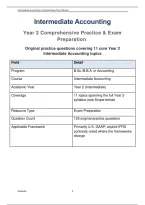
Intermediate Accounting
Year 2 Comprehensive Practice & Exam
Preparation.
Original practice questions covering 11 core Year 2
Intermediate Accounting topics
Field Detail
Program B.Sc./B.B.A. in Accounting
Course Intermediate Accounting
Academic Year Year 2 (Intermediate)
Coverage 11 topics spanning the full Year 2
syllabus (see Scope below)
Resource Type Exam Preparation
Question Count 125 original practice questions
Applicable Framework Primarily U.S. GAAP; explicit IFRS
contrasts noted where the frameworks
diverge
Quesvia 1
,Intermediate Accounting | Comprehensive Year 2 Review
Learning Objectives
By the end of this resource, you should be able to:
Apply the five-step model under ASC 606/IFRS 15 to determine the
timing and amount of revenue recognized.
Distinguish revenue recognized at a point in time from revenue
recognized over time, and allocate a transaction price to multiple
performance obligations.
Estimate and record expected credit losses on receivables under ASC
326 and compute their net realizable value.
Apply the lower-of-cost-or-net-realizable-value rule and estimate
ending inventory using the gross profit and retail inventory methods.
Determine the initial cost of property, plant, and equipment and
distinguish capital expenditures from revenue expenditures.
Apply depreciation methods, test long-lived assets for impairment, and
account for asset disposals and exchanges.
Account for the acquisition and amortization of intangible assets and
explain the treatment of goodwill.
Apply the recognition criteria that distinguish a liability, a provision, and
a contingent liability.
Compute the issue price of bonds payable and apply the effective-
interest method to amortize a discount or premium.
Classify leases under ASC 842/IFRS 16 and measure the initial right-
of-use asset and lease liability.
Account for share issuances and treasury stock transactions and
compute basic earnings per share.
Prepare the operating activities section of the statement of cash flows
using the indirect method, and classify cash flow transactions correctly.
Quesvia 2
,Intermediate Accounting | Comprehensive Year 2 Review
How to Use This Resource
This resource assumes a working knowledge of Year 1 material (the
accounting cycle, basic adjusting entries, and introductory inventory
and depreciation methods) and builds on it - review your Year 1
resource first if any of that feels unfamiliar.
Work through the High-Yield Concept Review for each topic before
attempting that topic's questions.
Attempt every question yourself before checking the answer key.
Read the full rationale for every question, including the analysis of
every incorrect option, not only the ones you got wrong.
For calculation questions, re-perform the calculation independently
rather than only checking the final figure - many Year 2 calculations
involve multiple steps.
Use the Student Answer Sheet to simulate timed conditions, then
check your results against the Suggested Score Interpretation.
Use the Final Revision Checklist a few days before your assessment
as a topic-by-topic self-check.
Quesvia 3
, Intermediate Accounting | Comprehensive Year 2 Review
Key Terms
Term Definition
Performance Obligation A promise in a contract with a customer
to transfer a distinct good or service.
Transaction Price The amount of consideration an entity
expects to be entitled to in exchange for
transferring promised goods or services.
Standalone Selling Price The price at which an entity would sell a
promised good or service separately to a
customer.
Expected Credit Loss Model Under ASC 326, a model requiring an
entity to estimate and recognize credit
losses expected over the entire life of a
financial asset, rather than waiting until a
loss is probable.
Allowance for Credit Losses A contra-asset account representing the
estimated amount of receivables that will
not be collected.
Net Realizable Value (Receivables) Accounts receivable less the allowance
for credit losses, representing the
amount expected to be collected in
cash.
Lower of Cost or Net Realizable Value The rule requiring inventory to be
reported at the lower of its cost or net
realizable value, applied under FIFO and
weighted-average costing.
Quesvia 4
Intermediate Accounting
Year 2 Comprehensive Practice & Exam
Preparation.
Original practice questions covering 11 core Year 2
Intermediate Accounting topics
Field Detail
Program B.Sc./B.B.A. in Accounting
Course Intermediate Accounting
Academic Year Year 2 (Intermediate)
Coverage 11 topics spanning the full Year 2
syllabus (see Scope below)
Resource Type Exam Preparation
Question Count 125 original practice questions
Applicable Framework Primarily U.S. GAAP; explicit IFRS
contrasts noted where the frameworks
diverge
Quesvia 1
,Intermediate Accounting | Comprehensive Year 2 Review
Learning Objectives
By the end of this resource, you should be able to:
Apply the five-step model under ASC 606/IFRS 15 to determine the
timing and amount of revenue recognized.
Distinguish revenue recognized at a point in time from revenue
recognized over time, and allocate a transaction price to multiple
performance obligations.
Estimate and record expected credit losses on receivables under ASC
326 and compute their net realizable value.
Apply the lower-of-cost-or-net-realizable-value rule and estimate
ending inventory using the gross profit and retail inventory methods.
Determine the initial cost of property, plant, and equipment and
distinguish capital expenditures from revenue expenditures.
Apply depreciation methods, test long-lived assets for impairment, and
account for asset disposals and exchanges.
Account for the acquisition and amortization of intangible assets and
explain the treatment of goodwill.
Apply the recognition criteria that distinguish a liability, a provision, and
a contingent liability.
Compute the issue price of bonds payable and apply the effective-
interest method to amortize a discount or premium.
Classify leases under ASC 842/IFRS 16 and measure the initial right-
of-use asset and lease liability.
Account for share issuances and treasury stock transactions and
compute basic earnings per share.
Prepare the operating activities section of the statement of cash flows
using the indirect method, and classify cash flow transactions correctly.
Quesvia 2
,Intermediate Accounting | Comprehensive Year 2 Review
How to Use This Resource
This resource assumes a working knowledge of Year 1 material (the
accounting cycle, basic adjusting entries, and introductory inventory
and depreciation methods) and builds on it - review your Year 1
resource first if any of that feels unfamiliar.
Work through the High-Yield Concept Review for each topic before
attempting that topic's questions.
Attempt every question yourself before checking the answer key.
Read the full rationale for every question, including the analysis of
every incorrect option, not only the ones you got wrong.
For calculation questions, re-perform the calculation independently
rather than only checking the final figure - many Year 2 calculations
involve multiple steps.
Use the Student Answer Sheet to simulate timed conditions, then
check your results against the Suggested Score Interpretation.
Use the Final Revision Checklist a few days before your assessment
as a topic-by-topic self-check.
Quesvia 3
, Intermediate Accounting | Comprehensive Year 2 Review
Key Terms
Term Definition
Performance Obligation A promise in a contract with a customer
to transfer a distinct good or service.
Transaction Price The amount of consideration an entity
expects to be entitled to in exchange for
transferring promised goods or services.
Standalone Selling Price The price at which an entity would sell a
promised good or service separately to a
customer.
Expected Credit Loss Model Under ASC 326, a model requiring an
entity to estimate and recognize credit
losses expected over the entire life of a
financial asset, rather than waiting until a
loss is probable.
Allowance for Credit Losses A contra-asset account representing the
estimated amount of receivables that will
not be collected.
Net Realizable Value (Receivables) Accounts receivable less the allowance
for credit losses, representing the
amount expected to be collected in
cash.
Lower of Cost or Net Realizable Value The rule requiring inventory to be
reported at the lower of its cost or net
realizable value, applied under FIFO and
weighted-average costing.
Quesvia 4

