
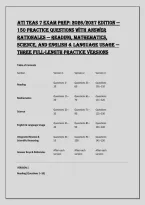
ATI TEAS 7 Exam Prep: 2026/2027 Edition —
150 Practice Questions with Answer
Rationales — Reading, Mathematics,
Science, and English & Language Usage —
Three Full-Length Practice Versions
Table of Contents
Section Version 1 Version 2 Version 3
Questions 1– Questions 51– Questions
Reading
10 60 101–110
Questions 11– Questions 61– Questions
Mathematics
20 70 111–120
Questions 21– Questions 71– Questions
Science
30 80 121–130
Questions 31– Questions 81– Questions
English & Language Usage
40 90 131–140
Integrated Review & Questions 41– Questions 91– Questions
Scientific Reasoning 50 100 141–150
After each After each After each
Answer Keys & Rationales
version version version
VERSION 1
Reading (Questions 1–10)
,🟢 1. Read the following passage and answer the question: "The nurse carefully measured the medication,
double-checked the dosage, and administered it to the patient. The patient's vital signs improved within
30 minutes." What is the main idea of this passage?
A. The nurse measured medication.
B. The nurse was careful and the patient improved.
C. The patient's vital signs improved.
D. Medication should be measured carefully.
🔴🔴 Correct Answer: B
Rationale: The passage describes the nurse's careful actions and the patient's improvement, making B
the main idea that encompasses the full sequence of events. Options A and C are supporting details,
while D is a general inference not explicitly stated.
🟢 2. Read the passage and answer the question: "Hypertension is a common condition that affects
millions of people worldwide. It is often called the 'silent killer' because it has no symptoms. Regular
blood pressure screening is essential for early detection." According to the passage, why is hypertension
called the "silent killer"?
A. Because it causes sudden death.
B. Because it has no symptoms.
C. Because it affects millions of people.
D. Because it is not detectable.
🔴🔴 Correct Answer: B
Rationale: The passage directly states that hypertension is called the "silent killer" because it has no
symptoms. While A, C, and D contain partially related ideas, only B is explicitly supported by the text.
🟢 3. A nurse is reading a patient's discharge instructions. Which of the following is the main idea?
A. Take all medications as prescribed and follow up with your primary care provider in one week.
B. The patient was admitted for chest pain.
C. Blood pressure should be checked daily.
D. A low-sodium diet is recommended.
🔴🔴 Correct Answer: A
Rationale: Discharge instructions typically focus on the primary action items the patient must follow
after leaving care. Option A provides the most comprehensive main idea, while B is background
information and C and D are only partial instructions.
🟢 4. Read the passage: "The patient was diagnosed with type 2 diabetes. The doctor recommended
lifestyle changes, including diet modification and exercise. The patient was also prescribed metformin."
Which of the following are recommended treatments based on the passage? (Select all that apply.)
,A. Diet modification
B. Exercise
C. Metformin
D. Insulin
E. Surgery
🔴🔴 Correct Answers: A, B, C
Rationale: The passage explicitly mentions diet modification, exercise, and metformin. Insulin and
surgery are not referenced in the text and therefore are not correct selections.
🟢 5. Read the passage: "The nurse assessed the patient's pain level using a 0–10 pain scale. The patient
rated their pain as 7 out of 10. The nurse administered morphine 2 mg IV." What did the nurse do
immediately after assessing the pain?
A. Called the doctor.
B. Administered morphine.
C. Asked the patient to rate the pain.
D. Documented the pain score.
🔴🔴 Correct Answer: B
Rationale: The passage states the nurse assessed the pain, then administered morphine 2 mg IV. The
other options are not supported by the text.
🟢 6. Read the passage: "The medication should be taken with food to reduce the risk of stomach upset. It
should be taken at the same time each day for best results. Do not crush or chew the tablet." What
should the patient avoid doing with the tablet?
A. Taking it with food.
B. Taking it at the same time each day.
C. Crushing or chewing it.
D. Taking it with water.
🔴🔴 Correct Answer: C
Rationale: The passage explicitly instructs: "Do not crush or chew the tablet." The other options are
either recommended or not mentioned as prohibitions.
🟢 7. Read the passage: "Immunizations are an important part of preventive healthcare. They help protect
against serious diseases such as measles, mumps, rubella, and hepatitis B. The Centers for Disease
Control and Prevention (CDC) recommends a specific immunization schedule for children and adults."
Which diseases are mentioned in the passage? (Select all that apply.)
A. Measles
B. Mumps
, C. Rubella
D. Hepatitis B
E. Influenza
🔴🔴 Correct Answers: A, B, C, D
Rationale: The passage lists measles, mumps, rubella, and hepatitis B. Influenza is not mentioned, so E is
incorrect.
🟢 8. Read the passage: "Although honeybees are famous for producing honey, their greatest economic
value lies in pollination. Approximately one-third of the food crops consumed by humans rely on
pollination by bees and other insects." What is the author's primary point?
A. Honeybees produce honey.
B. Honeybees are the most important insects.
C. Pollination by bees is economically and agriculturally vital.
D. One-third of food crops are consumed by humans.
🔴🔴 Correct Answer: C
Rationale: The passage uses "although" to shift emphasis from honey production to pollination,
highlighting its economic and agricultural importance. Options A and D are details, while B is an
overstatement not supported by the text.
🟢 9. A student is writing a research paper on the American Revolution. Which of the following would be
considered a primary source?
A. A textbook chapter about the Revolutionary War.
B. A diary entry written by a colonial soldier in 1777.
C. An encyclopedia article about George Washington.
D. A documentary film produced in 2020.
🔴🔴 Correct Answer: B
Rationale: A primary source is a firsthand account or original document from the time period. A diary
entry from 1777 qualifies. Textbooks, encyclopedia articles, and modern documentaries are secondary
sources.
🟢 10. Read the following sentence: "The patient's condition was precarious, requiring constant
monitoring." What is the meaning of the word "precarious" as used in this sentence?
A. Stable and improving.
B. Dangerous and uncertain.
C. Mild and manageable.
D. Chronic and long-term.
150 Practice Questions with Answer
Rationales — Reading, Mathematics,
Science, and English & Language Usage —
Three Full-Length Practice Versions
Table of Contents
Section Version 1 Version 2 Version 3
Questions 1– Questions 51– Questions
Reading
10 60 101–110
Questions 11– Questions 61– Questions
Mathematics
20 70 111–120
Questions 21– Questions 71– Questions
Science
30 80 121–130
Questions 31– Questions 81– Questions
English & Language Usage
40 90 131–140
Integrated Review & Questions 41– Questions 91– Questions
Scientific Reasoning 50 100 141–150
After each After each After each
Answer Keys & Rationales
version version version
VERSION 1
Reading (Questions 1–10)
,🟢 1. Read the following passage and answer the question: "The nurse carefully measured the medication,
double-checked the dosage, and administered it to the patient. The patient's vital signs improved within
30 minutes." What is the main idea of this passage?
A. The nurse measured medication.
B. The nurse was careful and the patient improved.
C. The patient's vital signs improved.
D. Medication should be measured carefully.
🔴🔴 Correct Answer: B
Rationale: The passage describes the nurse's careful actions and the patient's improvement, making B
the main idea that encompasses the full sequence of events. Options A and C are supporting details,
while D is a general inference not explicitly stated.
🟢 2. Read the passage and answer the question: "Hypertension is a common condition that affects
millions of people worldwide. It is often called the 'silent killer' because it has no symptoms. Regular
blood pressure screening is essential for early detection." According to the passage, why is hypertension
called the "silent killer"?
A. Because it causes sudden death.
B. Because it has no symptoms.
C. Because it affects millions of people.
D. Because it is not detectable.
🔴🔴 Correct Answer: B
Rationale: The passage directly states that hypertension is called the "silent killer" because it has no
symptoms. While A, C, and D contain partially related ideas, only B is explicitly supported by the text.
🟢 3. A nurse is reading a patient's discharge instructions. Which of the following is the main idea?
A. Take all medications as prescribed and follow up with your primary care provider in one week.
B. The patient was admitted for chest pain.
C. Blood pressure should be checked daily.
D. A low-sodium diet is recommended.
🔴🔴 Correct Answer: A
Rationale: Discharge instructions typically focus on the primary action items the patient must follow
after leaving care. Option A provides the most comprehensive main idea, while B is background
information and C and D are only partial instructions.
🟢 4. Read the passage: "The patient was diagnosed with type 2 diabetes. The doctor recommended
lifestyle changes, including diet modification and exercise. The patient was also prescribed metformin."
Which of the following are recommended treatments based on the passage? (Select all that apply.)
,A. Diet modification
B. Exercise
C. Metformin
D. Insulin
E. Surgery
🔴🔴 Correct Answers: A, B, C
Rationale: The passage explicitly mentions diet modification, exercise, and metformin. Insulin and
surgery are not referenced in the text and therefore are not correct selections.
🟢 5. Read the passage: "The nurse assessed the patient's pain level using a 0–10 pain scale. The patient
rated their pain as 7 out of 10. The nurse administered morphine 2 mg IV." What did the nurse do
immediately after assessing the pain?
A. Called the doctor.
B. Administered morphine.
C. Asked the patient to rate the pain.
D. Documented the pain score.
🔴🔴 Correct Answer: B
Rationale: The passage states the nurse assessed the pain, then administered morphine 2 mg IV. The
other options are not supported by the text.
🟢 6. Read the passage: "The medication should be taken with food to reduce the risk of stomach upset. It
should be taken at the same time each day for best results. Do not crush or chew the tablet." What
should the patient avoid doing with the tablet?
A. Taking it with food.
B. Taking it at the same time each day.
C. Crushing or chewing it.
D. Taking it with water.
🔴🔴 Correct Answer: C
Rationale: The passage explicitly instructs: "Do not crush or chew the tablet." The other options are
either recommended or not mentioned as prohibitions.
🟢 7. Read the passage: "Immunizations are an important part of preventive healthcare. They help protect
against serious diseases such as measles, mumps, rubella, and hepatitis B. The Centers for Disease
Control and Prevention (CDC) recommends a specific immunization schedule for children and adults."
Which diseases are mentioned in the passage? (Select all that apply.)
A. Measles
B. Mumps
, C. Rubella
D. Hepatitis B
E. Influenza
🔴🔴 Correct Answers: A, B, C, D
Rationale: The passage lists measles, mumps, rubella, and hepatitis B. Influenza is not mentioned, so E is
incorrect.
🟢 8. Read the passage: "Although honeybees are famous for producing honey, their greatest economic
value lies in pollination. Approximately one-third of the food crops consumed by humans rely on
pollination by bees and other insects." What is the author's primary point?
A. Honeybees produce honey.
B. Honeybees are the most important insects.
C. Pollination by bees is economically and agriculturally vital.
D. One-third of food crops are consumed by humans.
🔴🔴 Correct Answer: C
Rationale: The passage uses "although" to shift emphasis from honey production to pollination,
highlighting its economic and agricultural importance. Options A and D are details, while B is an
overstatement not supported by the text.
🟢 9. A student is writing a research paper on the American Revolution. Which of the following would be
considered a primary source?
A. A textbook chapter about the Revolutionary War.
B. A diary entry written by a colonial soldier in 1777.
C. An encyclopedia article about George Washington.
D. A documentary film produced in 2020.
🔴🔴 Correct Answer: B
Rationale: A primary source is a firsthand account or original document from the time period. A diary
entry from 1777 qualifies. Textbooks, encyclopedia articles, and modern documentaries are secondary
sources.
🟢 10. Read the following sentence: "The patient's condition was precarious, requiring constant
monitoring." What is the meaning of the word "precarious" as used in this sentence?
A. Stable and improving.
B. Dangerous and uncertain.
C. Mild and manageable.
D. Chronic and long-term.

