
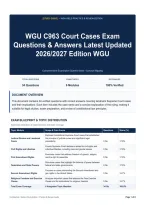
[STUDY GUIDE] • HIGH-YIELD PRACTICE & REVIEW EDITION
WGU C963 Court Cases Exam
Questions & Answers Latest Updated
2026/2027 Edition WGU
Comprehensive Examination Question Bank • Concept Mapping
TOTAL QUESTIONS EXAM TOPICS RATIONALES
34 Questions 6 Modules 100% Verified
DOCUMENT OVERVIEW
This document contains 34 verified questions with correct answers covering landmark Supreme Court cases
and their implications. Each item includes the case name and a concise explanation of the ruling, making it
suitable for legal studies, exam preparation, and review of constitutional law principles.
EXAM BLUEPRINT & TOPIC DISTRIBUTION
Systematic breakdown of subject domains and exam coverage.
Topic Module Scope & Core Focus Questions Share (%)
Explores foundational Supreme Court cases that established
Judicial Review and Landmark the principle of judicial review and significant legal
Cases precedents. 6 Qs 17.6%
Covers Supreme Court decisions related to civil rights and
Civil Rights and Liberties individual liberties, including race and gender issues. 6 Qs 17.6%
Examines cases that address freedom of speech, religion,
First Amendment Rights and the right to assemble. 6 Qs 17.6%
Discusses cases that highlight the balance of power between
Federalism and State Powers federal and state governments. 6 Qs 17.6%
Focuses on cases interpreting the Second Amendment and
Second Amendment Rights gun rights in the United States. 5 Qs 14.7%
Religious Freedom and Exercise Analyzes important cases that address the Free Exercise
Clause Clause and its implications for religious freedom. 5 Qs 14.7%
Total Exam Coverage 6 Integrated Topic Modules 34 Qs 100.0%
Confidential • Student Study Edition • Practice & Review Guide Page 1 of 8
, STUDENT STUDY & MASTERY EDITION PRACTICE & REVIEW GUIDE
TOPIC 1: JUDICIAL REVIEW AND LANDMARK CASES
6 Questions • 17.6% of Exam • Explores foundational Supreme Court cases that established the principle of judicial review and
significant legal precedents.
QUESTION 1
Marbury v. Madison
Answer: This case involved the Judiciary Act of 1789. The Supreme Court declared that the law conflicted
with the U.S. Constitution, and the case established the principle of judicial review wherein the Supreme
Court has the power to declare laws passed by Congress and signed by the president to be unconstitutional.
QUESTION 2
Dred Scott v. Sanford
Answer: Supreme Court case that decided US Congress did not have the power to prohibit slavery in federal
territories and slaves, as private property, could not be taken away without due process
- basically slaves would remain slaves in non-slave states and slaves could not sue because they were not
citizens.
QUESTION 3
Brown v Board ofEducation of Topeka (1954)
Answer: Supreme Court ruling that overturned the Plessy v. Ferguson Supreme Court Case of 1896.
"Separate but equal" is Unconstitutional in the field of public education.
QUESTION 4
Mapp v. Ohio
Answer: Established the exclusionary rule was applicable to the states (evidence seized illegally cannot be
used in court)
QUESTION 5
Gibbons v. Ogden
Answer: Regulating interstate commerce is a power reserved to the federal government.
Confidential • Student Study Edition • Practice & Review Guide Page 2 of 8
WGU C963 Court Cases Exam
Questions & Answers Latest Updated
2026/2027 Edition WGU
Comprehensive Examination Question Bank • Concept Mapping
TOTAL QUESTIONS EXAM TOPICS RATIONALES
34 Questions 6 Modules 100% Verified
DOCUMENT OVERVIEW
This document contains 34 verified questions with correct answers covering landmark Supreme Court cases
and their implications. Each item includes the case name and a concise explanation of the ruling, making it
suitable for legal studies, exam preparation, and review of constitutional law principles.
EXAM BLUEPRINT & TOPIC DISTRIBUTION
Systematic breakdown of subject domains and exam coverage.
Topic Module Scope & Core Focus Questions Share (%)
Explores foundational Supreme Court cases that established
Judicial Review and Landmark the principle of judicial review and significant legal
Cases precedents. 6 Qs 17.6%
Covers Supreme Court decisions related to civil rights and
Civil Rights and Liberties individual liberties, including race and gender issues. 6 Qs 17.6%
Examines cases that address freedom of speech, religion,
First Amendment Rights and the right to assemble. 6 Qs 17.6%
Discusses cases that highlight the balance of power between
Federalism and State Powers federal and state governments. 6 Qs 17.6%
Focuses on cases interpreting the Second Amendment and
Second Amendment Rights gun rights in the United States. 5 Qs 14.7%
Religious Freedom and Exercise Analyzes important cases that address the Free Exercise
Clause Clause and its implications for religious freedom. 5 Qs 14.7%
Total Exam Coverage 6 Integrated Topic Modules 34 Qs 100.0%
Confidential • Student Study Edition • Practice & Review Guide Page 1 of 8
, STUDENT STUDY & MASTERY EDITION PRACTICE & REVIEW GUIDE
TOPIC 1: JUDICIAL REVIEW AND LANDMARK CASES
6 Questions • 17.6% of Exam • Explores foundational Supreme Court cases that established the principle of judicial review and
significant legal precedents.
QUESTION 1
Marbury v. Madison
Answer: This case involved the Judiciary Act of 1789. The Supreme Court declared that the law conflicted
with the U.S. Constitution, and the case established the principle of judicial review wherein the Supreme
Court has the power to declare laws passed by Congress and signed by the president to be unconstitutional.
QUESTION 2
Dred Scott v. Sanford
Answer: Supreme Court case that decided US Congress did not have the power to prohibit slavery in federal
territories and slaves, as private property, could not be taken away without due process
- basically slaves would remain slaves in non-slave states and slaves could not sue because they were not
citizens.
QUESTION 3
Brown v Board ofEducation of Topeka (1954)
Answer: Supreme Court ruling that overturned the Plessy v. Ferguson Supreme Court Case of 1896.
"Separate but equal" is Unconstitutional in the field of public education.
QUESTION 4
Mapp v. Ohio
Answer: Established the exclusionary rule was applicable to the states (evidence seized illegally cannot be
used in court)
QUESTION 5
Gibbons v. Ogden
Answer: Regulating interstate commerce is a power reserved to the federal government.
Confidential • Student Study Edition • Practice & Review Guide Page 2 of 8

