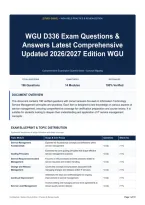
[STUDY GUIDE] • HIGH-YIELD PRACTICE & REVIEW EDITION
WGU D336 Exam Questions &
Answers Latest Comprehensive
Updated 2026/2027 Edition WGU
Comprehensive Examination Question Bank • Concept Mapping
TOTAL QUESTIONS EXAM TOPICS RATIONALES
196 Questions 14 Modules 100% Verified
DOCUMENT OVERVIEW
This document contains 196 verified questions with correct answers focused on Information Technology
Service Management principles and practices. Each item is designed to test knowledge on various aspects of
service management, ensuring comprehensive coverage for certification preparation and course review. It is
suitable for students looking to deepen their understanding and application of IT service management
concepts.
EXAM BLUEPRINT & TOPIC DISTRIBUTION
Systematic breakdown of subject domains and exam coverage.
Topic Module Scope & Core Focus Questions Share (%)
Service Management Explores the foundational concepts and definitions within
Fundamentals service management. 14 Qs 7.1%
Examines the core guiding principles that shape effective
Guiding Principles service management practices. 14 Qs 7.1%
Service Request and Incident Focuses on the processes and best practices related to
Management service requests and incident handling. 14 Qs 7.1%
Change and Release Covers the concepts and processes associated with
Management managing changes and releases within IT services. 14 Qs 7.1%
Addresses the steps and methodologies for ongoing
Continual Improvement improvement in service management. 14 Qs 7.1%
Involves setting and managing service level agreements to
Service Level Management ensure quality service delivery. 14 Qs 7.1%
Confidential • Student Study Edition • Practice & Review Guide Page 1 of 51
,STUDENT STUDY & MASTERY EDITION PRACTICE & REVIEW GUIDE
Configuration and Asset Focuses on managing configuration items and IT assets
Management throughout their lifecycle. 14 Qs 7.1%
Supplier and Vendor Examines the management of external suppliers and vendor
Management relationships. 14 Qs 7.1%
Covers the identification and management of security
Security and Risk Management incidents and risks. 14 Qs 7.1%
Monitoring and Event Focuses on practices for monitoring services and managing
Management events effectively. 14 Qs 7.1%
Workforce and Resource Involves planning and managing human resources and
Management workforce strategies. 14 Qs 7.1%
Ensures the availability and performance of services during
Service Continuity Management interruptions. 14 Qs 7.1%
Describes how all components of service management work
Service Value System together to deliver value. 14 Qs 7.1%
Focuses on identifying and managing the root causes of
Problem Management incidents. 14 Qs 7.1%
Total Exam Coverage 14 Integrated Topic Modules 196 Qs 100.0%
Confidential • Student Study Edition • Practice & Review Guide Page 2 of 51
,STUDENT STUDY & MASTERY EDITION PRACTICE & REVIEW GUIDE
TOPIC 1: SERVICE MANAGEMENT FUNDAMENTALS
14 Questions • 7.1% of Exam • Explores the foundational concepts and definitions within service management.
QUESTION 1
Service management
Answer: A set of specialized orgnaizational capabilities for enabling value to customers in the form of
services.
QUESTION 2
Cost
Answer: Can be removed from the customer and can be imposed on the customer.
QUESTION 3
Organization
Answer: A group of people that has its own functions, responsibilities, and authorities to achieve specific
objectives.
QUESTION 4
Sponsor
Answer: Authorizes budgets for services.
QUESTION 5
Service Relationship Management
Answer: Joint activities performed by providers and consumer;
EX:WGU tells MSFT that that they are not using x a part of a service. What would it cost MSFT to stop
providing that part of the service to users.
- this is different from relationship management practice.
Confidential • Student Study Edition • Practice & Review Guide Page 3 of 51
, STUDENT STUDY & MASTERY EDITION PRACTICE & REVIEW GUIDE
QUESTION 6
Who are stakeholders?
Answer: Sponsor
- customer
- users.
QUESTION 7
SVC: Engage
Answer: Salesman.
QUESTION 8
Guiding Principal: Think and work holistically(application)
Answer: Address al 4 dimensions and SVC
- Recognize the complexity of the systems.
- Collaboration is key to thinking and working holistically.
- Where possible, look for patterns of interactions between system elements.
- To make something simple, you have to understand its complexity, and then proceed to some simple
representation
- Automation can facilitate working holistically.
QUESTION 9
Project Management
Answer: Ensure that all projects in the organization are successfully delivered
-design and transition
- obtain and build.
QUESTION 10
Who can resolve incidents?
Answer: Service desk, users, support team.
Confidential • Student Study Edition • Practice & Review Guide Page 4 of 51
WGU D336 Exam Questions &
Answers Latest Comprehensive
Updated 2026/2027 Edition WGU
Comprehensive Examination Question Bank • Concept Mapping
TOTAL QUESTIONS EXAM TOPICS RATIONALES
196 Questions 14 Modules 100% Verified
DOCUMENT OVERVIEW
This document contains 196 verified questions with correct answers focused on Information Technology
Service Management principles and practices. Each item is designed to test knowledge on various aspects of
service management, ensuring comprehensive coverage for certification preparation and course review. It is
suitable for students looking to deepen their understanding and application of IT service management
concepts.
EXAM BLUEPRINT & TOPIC DISTRIBUTION
Systematic breakdown of subject domains and exam coverage.
Topic Module Scope & Core Focus Questions Share (%)
Service Management Explores the foundational concepts and definitions within
Fundamentals service management. 14 Qs 7.1%
Examines the core guiding principles that shape effective
Guiding Principles service management practices. 14 Qs 7.1%
Service Request and Incident Focuses on the processes and best practices related to
Management service requests and incident handling. 14 Qs 7.1%
Change and Release Covers the concepts and processes associated with
Management managing changes and releases within IT services. 14 Qs 7.1%
Addresses the steps and methodologies for ongoing
Continual Improvement improvement in service management. 14 Qs 7.1%
Involves setting and managing service level agreements to
Service Level Management ensure quality service delivery. 14 Qs 7.1%
Confidential • Student Study Edition • Practice & Review Guide Page 1 of 51
,STUDENT STUDY & MASTERY EDITION PRACTICE & REVIEW GUIDE
Configuration and Asset Focuses on managing configuration items and IT assets
Management throughout their lifecycle. 14 Qs 7.1%
Supplier and Vendor Examines the management of external suppliers and vendor
Management relationships. 14 Qs 7.1%
Covers the identification and management of security
Security and Risk Management incidents and risks. 14 Qs 7.1%
Monitoring and Event Focuses on practices for monitoring services and managing
Management events effectively. 14 Qs 7.1%
Workforce and Resource Involves planning and managing human resources and
Management workforce strategies. 14 Qs 7.1%
Ensures the availability and performance of services during
Service Continuity Management interruptions. 14 Qs 7.1%
Describes how all components of service management work
Service Value System together to deliver value. 14 Qs 7.1%
Focuses on identifying and managing the root causes of
Problem Management incidents. 14 Qs 7.1%
Total Exam Coverage 14 Integrated Topic Modules 196 Qs 100.0%
Confidential • Student Study Edition • Practice & Review Guide Page 2 of 51
,STUDENT STUDY & MASTERY EDITION PRACTICE & REVIEW GUIDE
TOPIC 1: SERVICE MANAGEMENT FUNDAMENTALS
14 Questions • 7.1% of Exam • Explores the foundational concepts and definitions within service management.
QUESTION 1
Service management
Answer: A set of specialized orgnaizational capabilities for enabling value to customers in the form of
services.
QUESTION 2
Cost
Answer: Can be removed from the customer and can be imposed on the customer.
QUESTION 3
Organization
Answer: A group of people that has its own functions, responsibilities, and authorities to achieve specific
objectives.
QUESTION 4
Sponsor
Answer: Authorizes budgets for services.
QUESTION 5
Service Relationship Management
Answer: Joint activities performed by providers and consumer;
EX:WGU tells MSFT that that they are not using x a part of a service. What would it cost MSFT to stop
providing that part of the service to users.
- this is different from relationship management practice.
Confidential • Student Study Edition • Practice & Review Guide Page 3 of 51
, STUDENT STUDY & MASTERY EDITION PRACTICE & REVIEW GUIDE
QUESTION 6
Who are stakeholders?
Answer: Sponsor
- customer
- users.
QUESTION 7
SVC: Engage
Answer: Salesman.
QUESTION 8
Guiding Principal: Think and work holistically(application)
Answer: Address al 4 dimensions and SVC
- Recognize the complexity of the systems.
- Collaboration is key to thinking and working holistically.
- Where possible, look for patterns of interactions between system elements.
- To make something simple, you have to understand its complexity, and then proceed to some simple
representation
- Automation can facilitate working holistically.
QUESTION 9
Project Management
Answer: Ensure that all projects in the organization are successfully delivered
-design and transition
- obtain and build.
QUESTION 10
Who can resolve incidents?
Answer: Service desk, users, support team.
Confidential • Student Study Edition • Practice & Review Guide Page 4 of 51