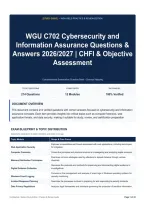
[STUDY GUIDE] • HIGH-YIELD PRACTICE & REVIEW EDITION
WGU C702 Cybersecurity and
Information Assurance Questions &
Answers 2026/2027 | CHFI & Objective
Assessment
Comprehensive Examination Question Bank • Concept Mapping
TOTAL QUESTIONS EXAM TOPICS RATIONALES
214 Questions 12 Modules 100% Verified
DOCUMENT OVERVIEW
This document contains 214 verified questions with correct answers focused on cybersecurity and information
assurance concepts. Each item provides insights into critical topics such as computer forensics, web
application threats, and data security, making it suitable for study, review, and certification preparation.
EXAM BLUEPRINT & TOPIC DISTRIBUTION
Systematic breakdown of subject domains and exam coverage.
Topic Module Scope & Core Focus
Explores vulnerabilities and threats associated with web applications, including techniques
Web Application Security for mitigation.
Computer Forensics Covers the principles and practices involved in investigating and analyzing digital evidence.
Examines common strategies used by attackers to spread malware through various
Malware Distribution Techniques channels.
Discusses the protocols and methods for preserving and documenting digital evidence in
Digital Evidence Collection investigations.
Focuses on the management and analysis of event logs in Windows operating systems for
Windows Event Logging security monitoring.
Incident Response Planning Describes the processes involved in preparing for and responding to security incidents.
Data Privacy Regulations Analyzes legal frameworks and standards governing the protection of sensitive information.
Confidential • Student Study Edition • Practice & Review Guide Page 1 of 43
,STUDENT STUDY & MASTERY EDITION PRACTICE & REVIEW GUIDE
Network Security Explores measures to protect networks from unauthorized access and threats.
Cloud Security Practices Covers security considerations and best practices for cloud computing environments.
Cybercrime Investigation Details methods and techniques used to investigate and prosecute cybercrimes.
Reviews software and tools commonly used by forensic investigators to analyze digital
Digital Forensics Tools evidence.
Risk Management in Cybersecurity Focuses on identifying, assessing, and mitigating risks within cybersecurity frameworks.
Total Exam Coverage 12 Integrated Topic Modules • 214 Examination Questions
Confidential • Student Study Edition • Practice & Review Guide Page 2 of 43
,STUDENT STUDY & MASTERY EDITION PRACTICE & REVIEW GUIDE
QUESTION 1
Which of the following is true regarding computer forensics?
Answer: Computer forensics deals with the process of finding evidence related to a digital crime to find the
culprits and initiate legal action against them.
QUESTION 2
Which of the following is NOT a objective of computer forensics?
Answer: Document vulnerabilities allowing further loss of intellectual property, finances, and reputation
during an attack.
QUESTION 3
Forensic readiness refers to:
Answer: An organization's ability to make optimal use of digital evidence in a limited time period and with
minimal investigation costs.
QUESTION 4
Which of the following is true of cybercrimes?
Answer: The initial reporting of the evidence is usually informal.
QUESTION 5
Computer Forensics deals with the process of finding _____ related to a digital crime to
find the culprits and initiate legal action against them.
Answer: Evidence.
Confidential • Student Study Edition • Practice & Review Guide Page 3 of 43
, STUDENT STUDY & MASTERY EDITION PRACTICE & REVIEW GUIDE
QUESTION 6
Minimizing the tangible and intangible losses to the organization or an individual is
considered an essential computer forensics use.
Answer: True.
QUESTION 7
Which of the following is NOT part of the Computer Forensics Investigation
Methodology?
Answer: Testify as an expert defendant.
QUESTION 8
Which of the following is NOT part of the Computer Forensics Investigation
Methodology?
Answer: Destroy the evidence.
QUESTION 9
Identify the following which was launched by the National Institute of Standards and
Technology (NIST), that establishes a "methodology for testing computer forensics
software tools by development of general tool specifications, test procedures, test
criteria, test sets, and test hardware."
Answer: Computer Forensic Tool Testing Project (CFTTP)
QUESTION 10
What is a machine readable language used in major digital operations, such as sending
and receiving emails?
Answer: ASCII.
Confidential • Student Study Edition • Practice & Review Guide Page 4 of 43