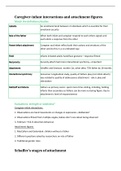
Caregiver-infant interactions and attachment figures
Match the definitions/studies
Isabella An emotional bond between 2 individuals which is essential for their
emotional security
Role of the father When both infant and caregiver respond to each others signals and
each elicits a response from the other
Parent-infant attachment Caregiver and infant reflect both their actions and emotions of the
other and do this in a co-ordinated way
Field Infants imitated adults hand/face gestures—response filmed
Reciprocity Securely-attach had more interactional synchrony—important
Attachment Schaffer and Emerson: mother 1st, other after, 75% father by 18 months
Interactional synchrony Grossman: longitudinal study, quality of fathers play (not infant attach)
was related to quality of adolescence attachment - role is play and
stimulation
Meltzoff and Moore Fathers as primary carers: spent more time smiling, imitating, holding
infants than secondary so fathers can be more nurturing figure. Key to
attachment is level of responsiveness
Evaluations: strength or weakness?
Caregiver-infant interactions
1. Observations are hand movements or changes in expression—deliberate?
2. Observations filmed from multiple angles, babies don’t care about being observed
3. Feldman—R & IS describes behaviour
Attachment figures
1. MacCallum and Golombok: children without a father
2. Different questions asked by researchers on role of father
3. Traditional gender roles
Schaffer’s stages of attachment
, Fill in the gaps
Schaffer and Emerson’s study was a __________ study of ___ Glasgow infants
from working class homes. They asked mothers questions about the protests
infants showed in 7 everyday separations, assessing separation and _______
anxiety.
25-32 weeks: ___% showed separation anxiety towards a specific adult
___ weeks: ___% had a specific attach, ___% displayed multiple attachment.
Clues:
80 longitudinal 50 stranger 60 30 40
Complete the table
Stage name Description When? Stranger/separation
anxiety?
1. Asocial First few N/A
weeks
2. Prefer people, recognise familiar 2-7
adults and accepts comfort from months
anyone
3. Specific Specific attachment to the primary Yes (starts to),
attachment figure—who is most mother 65%
interactive and responsive
4. Shortly N/A
after
specific
Animal studies of attachment
Fill in the gaps
, _______studied 16 baby _________, each with 2 ‘mothers’, one made of
_____that dispensed milk, the other of ______. He found the monkeys cuddled
the soft mother as they preferred _______ _______over food. There was a
______ period of ___ days, where if a mother was not introduced no
attachment would form and the damage would be irreversible. As adults the
monkeys were ___________, bred less often as they were unskilled at mating
and some mothers neglected or attacked their young.
His study showed that attachment developed as a result of contact comfort and
the _________ of the quality of early relationships for later development. It
can also be applied in real life such as with _____ _______where it’s helped
them understand risk factors in child neglect as well as with captive monkeys.
However there are ______ issues as the monkeys suffered greatly which could
be considered human-like because the findings have been _______ to humans.
________ randomly divided a clutch of goose eggs, half hatched with their
mother, the other in an incubator where the first _______ thing they saw was
Lorenz. The latter followed Lorenz due to _________: bird species attach to and
follow the first moving object they see. He identified a critical _______, where
if imprinting does not occur within that time the chicks did not attach to a
mother figure.
______ imprinting is where the animal would display __________behaviour
towards what it was imprinted on. For example, a _______ reared in the reptile
house sexually imprinted on giant tortoises, showing them direct courtship.
_______ questioned whether the effect of imprinting was _________. He
found chickens imprinted on yellow washing up gloves tried to mate with them
as adults but learned to ______ mating with other chickens.
Also, the mammalian attachment system is different from that in birds because
they show more ___________ attachment so it may be inappropriate to
generalise ideas.
Clues:
importance Harlow imprinting courtship monkeys permanent
aggressive wire emotional Lorenz period cloth
Match the definitions/studies
Isabella An emotional bond between 2 individuals which is essential for their
emotional security
Role of the father When both infant and caregiver respond to each others signals and
each elicits a response from the other
Parent-infant attachment Caregiver and infant reflect both their actions and emotions of the
other and do this in a co-ordinated way
Field Infants imitated adults hand/face gestures—response filmed
Reciprocity Securely-attach had more interactional synchrony—important
Attachment Schaffer and Emerson: mother 1st, other after, 75% father by 18 months
Interactional synchrony Grossman: longitudinal study, quality of fathers play (not infant attach)
was related to quality of adolescence attachment - role is play and
stimulation
Meltzoff and Moore Fathers as primary carers: spent more time smiling, imitating, holding
infants than secondary so fathers can be more nurturing figure. Key to
attachment is level of responsiveness
Evaluations: strength or weakness?
Caregiver-infant interactions
1. Observations are hand movements or changes in expression—deliberate?
2. Observations filmed from multiple angles, babies don’t care about being observed
3. Feldman—R & IS describes behaviour
Attachment figures
1. MacCallum and Golombok: children without a father
2. Different questions asked by researchers on role of father
3. Traditional gender roles
Schaffer’s stages of attachment
, Fill in the gaps
Schaffer and Emerson’s study was a __________ study of ___ Glasgow infants
from working class homes. They asked mothers questions about the protests
infants showed in 7 everyday separations, assessing separation and _______
anxiety.
25-32 weeks: ___% showed separation anxiety towards a specific adult
___ weeks: ___% had a specific attach, ___% displayed multiple attachment.
Clues:
80 longitudinal 50 stranger 60 30 40
Complete the table
Stage name Description When? Stranger/separation
anxiety?
1. Asocial First few N/A
weeks
2. Prefer people, recognise familiar 2-7
adults and accepts comfort from months
anyone
3. Specific Specific attachment to the primary Yes (starts to),
attachment figure—who is most mother 65%
interactive and responsive
4. Shortly N/A
after
specific
Animal studies of attachment
Fill in the gaps
, _______studied 16 baby _________, each with 2 ‘mothers’, one made of
_____that dispensed milk, the other of ______. He found the monkeys cuddled
the soft mother as they preferred _______ _______over food. There was a
______ period of ___ days, where if a mother was not introduced no
attachment would form and the damage would be irreversible. As adults the
monkeys were ___________, bred less often as they were unskilled at mating
and some mothers neglected or attacked their young.
His study showed that attachment developed as a result of contact comfort and
the _________ of the quality of early relationships for later development. It
can also be applied in real life such as with _____ _______where it’s helped
them understand risk factors in child neglect as well as with captive monkeys.
However there are ______ issues as the monkeys suffered greatly which could
be considered human-like because the findings have been _______ to humans.
________ randomly divided a clutch of goose eggs, half hatched with their
mother, the other in an incubator where the first _______ thing they saw was
Lorenz. The latter followed Lorenz due to _________: bird species attach to and
follow the first moving object they see. He identified a critical _______, where
if imprinting does not occur within that time the chicks did not attach to a
mother figure.
______ imprinting is where the animal would display __________behaviour
towards what it was imprinted on. For example, a _______ reared in the reptile
house sexually imprinted on giant tortoises, showing them direct courtship.
_______ questioned whether the effect of imprinting was _________. He
found chickens imprinted on yellow washing up gloves tried to mate with them
as adults but learned to ______ mating with other chickens.
Also, the mammalian attachment system is different from that in birds because
they show more ___________ attachment so it may be inappropriate to
generalise ideas.
Clues:
importance Harlow imprinting courtship monkeys permanent
aggressive wire emotional Lorenz period cloth