
Biology 1407 Practical 3 (Tarleton State) Questions and
Answers
Question 1.
deutersome development
Correct Answer: blastopore becomes anus
Question 2.
neural tissue
Correct Answer: -coordinates body functions -consist of neurons and supporting
cells called nuerogila
Question 3.
Levels of Structural Organization
Correct Answer: atoms molecules cells tissues organs organ systems organisms
Question 4.
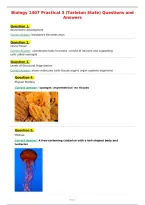
Phylum Porifera
Correct Answer: -sponges -asymmetrical -no tissues
Question 5.
Medusa
Correct Answer: A free-swimming cnidarian with a bell-shaped body and
tentacles
Page 1
, Question 6.
cardiac muscle tissue
Correct Answer: specialized muscle tissue found only in the heart
Question 7.
areolar connective tissue
Correct Answer: wraps and cushions organs
Question 8.
Echinodermata Larval vs. Adult Symmetry
Correct Answer: larval show bilateral symmetry while most adults show radial
symmetry
Question 9.
Polyp
Correct Answer: The sessile, tubular form of a cnidarian with a mouth and
tentacles at one end and a basal disk at the other
Page 2

