
[STUDY GUIDE] • HIGH-YIELD PRACTICE & REVIEW EDITION
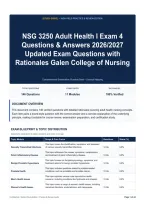
NSG 3250 Adult Health I Exam 4
Questions & Answers 2026/2027
Updated Exam Questions with
Rationales Galen College of Nursing
Comprehensive Examination Question Bank • Concept Mapping
TOTAL QUESTIONS EXAM TOPICS RATIONALES
146 Questions 11 Modules 100% Verified
DOCUMENT OVERVIEW
This document contains 146 verified questions with detailed rationales covering adult health nursing concepts.
Each item pairs a board-style question with the correct answer and a concise explanation of the underlying
principle, making it suitable for course review, examination preparation, and certification study.
EXAM BLUEPRINT & TOPIC DISTRIBUTION
Systematic breakdown of subject domains and exam coverage.
Topic Module Scope & Core Focus Questions Share (%)
This topic covers the identification, symptoms, and treatment
Sexually Transmitted Infections of various sexually transmitted infections. 14 Qs 9.6%
This topic addresses the causes, symptoms, complications,
Pelvic Inflammatory Disease and treatment of pelvic inflammatory disease. 14 Qs 9.6%
This topic focuses on the pathophysiology, symptoms, and
Benign Prostatic Hyperplasia treatment options for benign prostatic hyperplasia. 14 Qs 9.6%
This topic includes questions related to prostate-related
Prostate Health conditions, such as prostatitis and prostate cancer. 13 Qs 8.9%
This topic explores various male reproductive health
Men's Health Issues concerns, including conditions like hydrocele and priapism. 13 Qs 8.9%
This topic covers a range of women's health issues, including
Women's Health Issues menstrual disorders, endometriosis, and menopause. 13 Qs 8.9%
Confidential • Student Study Edition • Practice & Review Guide Page 1 of 44
,STUDENT STUDY & MASTERY EDITION PRACTICE & REVIEW GUIDE
This topic addresses age-related health concerns and
Geriatric Health syndromes prevalent in the elderly population. 13 Qs 8.9%
This topic examines hormonal changes and their implications
on women's health, including menopause and hormone
Hormonal Disorders therapy. 13 Qs 8.9%
This topic focuses on the recognition and treatment of various
Cancer Awareness cancers, including cervical and breast cancer. 13 Qs 8.9%
This topic discusses conditions affecting urinary function,
Urinary Health such as incontinence and urinary tract infections. 13 Qs 8.9%
Patient Education and Care This topic emphasizes the importance of patient education
Planning and care strategies in managing health conditions. 13 Qs 8.9%
Total Exam Coverage 11 Integrated Topic Modules 146 Qs 100.0%
Confidential • Student Study Edition • Practice & Review Guide Page 2 of 44
,STUDENT STUDY & MASTERY EDITION PRACTICE & REVIEW GUIDE
TOPIC 1: SEXUALLY TRANSMITTED INFECTIONS
14 Questions • 9.6% of Exam • This topic covers the identification, symptoms, and treatment of various sexually transmitted infections.
QUESTION 1
Spirochete: Treponema pallidum
Answer: Syphilis.
Rationale: Treponema pallidum is the causative spirochete responsible for the sexually transmitted infection
syphilis. This bacterium invades host cells and can manifest in primary, secondary, latent, and tertiary stages, affecting
multiple organ systems.
QUESTION 2
•. A painless lesion, a chancre, develops on the genitals
•. The chancre may be present for up to 3-12 weeks 2-3 weeks after exposure
Answer: Primary stage of syphilis.
Rationale: A painless chancre appearing 2-3 weeks after exposure, persisting for 3-12 weeks, is the hallmark clinical
manifestation of the primary stage of syphilis. This primary lesion represents the initial localized infection by *Treponema
pallidum*.
QUESTION 3
•. Most common in women 15-24 yrs old
•. Often asymptomatic• s/s include
•. Women: purulent discharge in the endocervical canal, UTI s/s, and vaginitis• --Men: s/s are more common, burning on
urination, penile discharge, painful/swollen testis
Answer: Chlamydia and gonorrhea.
Rationale: The clinical presentation described, including asymptomatic infection in young women, purulent discharge, and
urinary symptoms, aligns with the characteristic manifestations of both chlamydia and gonorrhea, which are the most
common causes of sexually transmitted infections in this
demographic. The key principle tested is the recognition of the epidemiology and varied symptomatology of common
bacterial STIs.
Confidential • Student Study Edition • Practice & Review Guide Page 3 of 44
, STUDENT STUDY & MASTERY EDITION PRACTICE & REVIEW GUIDE
QUESTION 4
Metronidazole or Tinidazole are
Answer: Treatments for trichomoniasis.
Rationale: Metronidazole and tinidazole are nitroimidazole antibiotics that disrupt anaerobic bacterial DNA synthesis,
making them first-line treatments for the protozoal infection trichomoniasis. The key principle tested is the pharmacologic
class and primary indication of these antimicrobial agents.
QUESTION 5
The rash that occurs in secondary syphilis occurs ________ after the chancer
Answer: 1-6 Months.
Rationale: The characteristic rash of secondary syphilis, a manifestation of disseminated *Treponema pallidum* infection,
typically appears 1 to 6 months following the initial chancre, which represents the primary stage of infection. This temporal
relationship is key to understanding the progression of this sexually transmitted infection.
QUESTION 6
Do you treat syphilis with antibiotics or antivirals?
Answer: Antibiotics.
Rationale: Syphilis is caused by the bacterium *Treponema pallidum*, which is susceptible to antibiotics like
penicillin. Antivirals are ineffective against bacterial infections.
QUESTION 7
Chlamydia infections are more common in _______ between the ages of __ and __
Answer: Females
15-24.
Rationale: Chlamydial infections disproportionately affect young women due to anatomical factors and higher incidence
rates in sexually active adolescents and young adults, particularly those aged 15-24. This age group exhibits a higher
prevalence of chlamydia due to biological susceptibility and behavioral risk factors.
Confidential • Student Study Edition • Practice & Review Guide Page 4 of 44
NSG 3250 Adult Health I Exam 4
Questions & Answers 2026/2027
Updated Exam Questions with
Rationales Galen College of Nursing
Comprehensive Examination Question Bank • Concept Mapping
TOTAL QUESTIONS EXAM TOPICS RATIONALES
146 Questions 11 Modules 100% Verified
DOCUMENT OVERVIEW
This document contains 146 verified questions with detailed rationales covering adult health nursing concepts.
Each item pairs a board-style question with the correct answer and a concise explanation of the underlying
principle, making it suitable for course review, examination preparation, and certification study.
EXAM BLUEPRINT & TOPIC DISTRIBUTION
Systematic breakdown of subject domains and exam coverage.
Topic Module Scope & Core Focus Questions Share (%)
This topic covers the identification, symptoms, and treatment
Sexually Transmitted Infections of various sexually transmitted infections. 14 Qs 9.6%
This topic addresses the causes, symptoms, complications,
Pelvic Inflammatory Disease and treatment of pelvic inflammatory disease. 14 Qs 9.6%
This topic focuses on the pathophysiology, symptoms, and
Benign Prostatic Hyperplasia treatment options for benign prostatic hyperplasia. 14 Qs 9.6%
This topic includes questions related to prostate-related
Prostate Health conditions, such as prostatitis and prostate cancer. 13 Qs 8.9%
This topic explores various male reproductive health
Men's Health Issues concerns, including conditions like hydrocele and priapism. 13 Qs 8.9%
This topic covers a range of women's health issues, including
Women's Health Issues menstrual disorders, endometriosis, and menopause. 13 Qs 8.9%
Confidential • Student Study Edition • Practice & Review Guide Page 1 of 44
,STUDENT STUDY & MASTERY EDITION PRACTICE & REVIEW GUIDE
This topic addresses age-related health concerns and
Geriatric Health syndromes prevalent in the elderly population. 13 Qs 8.9%
This topic examines hormonal changes and their implications
on women's health, including menopause and hormone
Hormonal Disorders therapy. 13 Qs 8.9%
This topic focuses on the recognition and treatment of various
Cancer Awareness cancers, including cervical and breast cancer. 13 Qs 8.9%
This topic discusses conditions affecting urinary function,
Urinary Health such as incontinence and urinary tract infections. 13 Qs 8.9%
Patient Education and Care This topic emphasizes the importance of patient education
Planning and care strategies in managing health conditions. 13 Qs 8.9%
Total Exam Coverage 11 Integrated Topic Modules 146 Qs 100.0%
Confidential • Student Study Edition • Practice & Review Guide Page 2 of 44
,STUDENT STUDY & MASTERY EDITION PRACTICE & REVIEW GUIDE
TOPIC 1: SEXUALLY TRANSMITTED INFECTIONS
14 Questions • 9.6% of Exam • This topic covers the identification, symptoms, and treatment of various sexually transmitted infections.
QUESTION 1
Spirochete: Treponema pallidum
Answer: Syphilis.
Rationale: Treponema pallidum is the causative spirochete responsible for the sexually transmitted infection
syphilis. This bacterium invades host cells and can manifest in primary, secondary, latent, and tertiary stages, affecting
multiple organ systems.
QUESTION 2
•. A painless lesion, a chancre, develops on the genitals
•. The chancre may be present for up to 3-12 weeks 2-3 weeks after exposure
Answer: Primary stage of syphilis.
Rationale: A painless chancre appearing 2-3 weeks after exposure, persisting for 3-12 weeks, is the hallmark clinical
manifestation of the primary stage of syphilis. This primary lesion represents the initial localized infection by *Treponema
pallidum*.
QUESTION 3
•. Most common in women 15-24 yrs old
•. Often asymptomatic• s/s include
•. Women: purulent discharge in the endocervical canal, UTI s/s, and vaginitis• --Men: s/s are more common, burning on
urination, penile discharge, painful/swollen testis
Answer: Chlamydia and gonorrhea.
Rationale: The clinical presentation described, including asymptomatic infection in young women, purulent discharge, and
urinary symptoms, aligns with the characteristic manifestations of both chlamydia and gonorrhea, which are the most
common causes of sexually transmitted infections in this
demographic. The key principle tested is the recognition of the epidemiology and varied symptomatology of common
bacterial STIs.
Confidential • Student Study Edition • Practice & Review Guide Page 3 of 44
, STUDENT STUDY & MASTERY EDITION PRACTICE & REVIEW GUIDE
QUESTION 4
Metronidazole or Tinidazole are
Answer: Treatments for trichomoniasis.
Rationale: Metronidazole and tinidazole are nitroimidazole antibiotics that disrupt anaerobic bacterial DNA synthesis,
making them first-line treatments for the protozoal infection trichomoniasis. The key principle tested is the pharmacologic
class and primary indication of these antimicrobial agents.
QUESTION 5
The rash that occurs in secondary syphilis occurs ________ after the chancer
Answer: 1-6 Months.
Rationale: The characteristic rash of secondary syphilis, a manifestation of disseminated *Treponema pallidum* infection,
typically appears 1 to 6 months following the initial chancre, which represents the primary stage of infection. This temporal
relationship is key to understanding the progression of this sexually transmitted infection.
QUESTION 6
Do you treat syphilis with antibiotics or antivirals?
Answer: Antibiotics.
Rationale: Syphilis is caused by the bacterium *Treponema pallidum*, which is susceptible to antibiotics like
penicillin. Antivirals are ineffective against bacterial infections.
QUESTION 7
Chlamydia infections are more common in _______ between the ages of __ and __
Answer: Females
15-24.
Rationale: Chlamydial infections disproportionately affect young women due to anatomical factors and higher incidence
rates in sexually active adolescents and young adults, particularly those aged 15-24. This age group exhibits a higher
prevalence of chlamydia due to biological susceptibility and behavioral risk factors.
Confidential • Student Study Edition • Practice & Review Guide Page 4 of 44

