
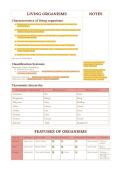
LIVING ORGANISMS NOTES
.-.-.-.-.-.-.-.-.-.-.-.-.-.-.-.-.-.-.-.-.-.-.-.-.-.-.-.-.-.-.-.-.-.-.-.-.-.-.-.-.-.-.-.-.-.-.-.-.-.-.-.-.-.-.-.-.-.- .-.-.-.-.-.-.-.-.-.-.-.-.-.-.-.-.-.-.-.-
Characteristics of living organisms
● Movement: an action done by an organism that causes it to stimuli it’s
position/place
● Respiration: a chemical reaction that breaks down nutrient molecules that
releases energy for metabolism
● Sensitivity: the ability to detect and respond to changes in internal and
external environments
● Growth: the permanent increase of dry mass
● Reproduction: the process of producing the same type of organism
● Excretion: the removal of metabolic waste + substances in excess of the
body’s requirements
● Nutrition: the uptake of materials for growth, development + energy
Mnemonic: MRSGREN
.-.-.-.-.-.-.-.-.-.-.-.-.-.-.-.-.-.-.-.-.-.-.-.-.-.-.-.-.-.-.-.-.-.-.-.-.-.-.-.-.-.-.-.-.-.-.-.-.-.-.-.-.-.-.-.-.-.- .-.-.-.-.-.-.-.-.-.-.-.-.-.-.-.-.-.-.-.-
Species: an organism the
Classification Systems reproduces to produce
fertile offspring
Organisms can be classified by:
● Features they share Binomial naming system:
● Evolutionary relationship → determined by similarity in the sequence of internationally agreed
the bases of their DNA system to name species
where scientific name of
Organisms that share a more recent ancestor → Greater similarity organism consists two parts
Organisms with a distant ancestor → Greater disparity showing genus + species
Taxonomic hierarchy
Taxonomic Hierarchy Mnemonic 1 Mnemonic 2
Domain Do Dear
Kingdom Kings King
Phlyum Play Phillip
Class Chess Came
Order On Over
Family Fine For
Genus Green Good
Species Silk Spaghetti
FEATURES OF ORGANISMS
.-.-.-.-.-.-.-.-.-.-.-.-.-.-.-.-.-.-.-.-.-.-.-.-.-.-.-.-.-.-.-.-.-.-.-.-.-.-.-.-.-.-.-.-.-.-.-.-.-.-.-.-.-.-.-.-.-.-.-.-.-.-.-.-.-.-.-.-.-.-.-.-.-.-.-.-.-.-.-.-.
Kingdom Cell type No. of cells Nucleus Cell wall Chloroplast Nutrition +Features
Animal Eukaryotic Multicellular ✅ ❌ ❌ Heterotroph Tissues +
organs
Plant Eukaryotic Multicellular ✅ ✅ ✅ Autotroph Roots,
stems, leave
Fungus Eukaryotic Uni/multicellular ✅ ✅ Chitin ❌ Heterotroph Hyphae →
reproduces
through
sporulation
,Protoctist Eukaryotic Uni/multicellular ✅ ✅/❌ ✅/❌ Auto/
heterotroph
Simple
Prokaryote Prokaryotic Unicellular ❌ ✅
Peptidoglycan
❌ Auto/
heterotroph
Free DNA +
plasmids, no
organelles
.-.-.-.-.-.-.-.-.-.-.-.-.-.-.-.-.-.-.-.-.-.-.-.-.-.-.-.-.-.-.-.-.-.-.-.-.-.-.-.-.-.-.-.-.-.-.-.-.-.-.-.-.-.-.-.-.-.-.-.-.-.-.-.-.-.-.-.-.-.-.-.-.-.-.-.-.-.-.-.-.
-.-
Animal kingdom
Arthropods
Myriapods: Arachnids:
● Many body segments ● 2 body segments (cephalothorax + abdomen)
● Many jointed legs ● 4 pairs of jointed legs
Insects: Crustaceans:
● 1 pair of antenna ● 2 pairs of antennae
● 2 pair of wings ● 4< pairs of jointed legs
● 3 pairs of jointed legs
● 3 body segment (head, thorax, abdomen)
Vertebrates
Warm Blooded
Mammals: Birds:
● Hair ● Beak
● sweat glands ● Wings
● Fetus develop in uterus ● Lay hard-shelled eggs
● Mammillary glands
● Ear flaps
● Specialised teeth
● diaphragm
Cold Blooded
Reptiles: Fish:
● Scaly skin ● Scales
● Lay hard-shelled eggs ● Long term gills
● Lay shell-less eggs
Amphibians:
● Moist, scale-less skin
● Tadpoles have gills → live in water
● Adults have lungs → live on land
● Lay shell-less eggs
.-.-.-.-.-.-.-.-.-.-.-.-.-.-.-.-.-.-.-.-.-.-.-.-.-.-.-.-.-.-.-.-.-.-.-.-.-.-.-.-.-.-.-.-.-.-.-.-.-.-.-.-.-.-.-.-.-.-.-.-.-.-.-.-.-.-.-.-.-.-.-.-.-.-.-.-.-.-.-.-.
-.-
Plant Kingdom
Ferns
● Do not produce flowers → reproduce through sporulation
● Divided into:
○ Stems
○ Leaves
○ Fronds
○ Roots
Flowering Plants
Monocotyledons: Dicotyledons:
● 1 cotyledon ● Two cotyledons
● Prod parts in 3/ 4’s ● Produce parts in 4’s or 5’s
● Vascular bundle arranged randomly ● Tap-root system
● Parallel veins ● Vascular bundles arranged in a ring
● Fibrous root system ● Leaves with network veins
.-.-.-.-.-.-.-.-.-.-.-.-.-.-.-.-.-.-.-.-.-.-.-.-.-.-.-.-.-.-.-.-.-.-.-.-.-.-.-.-.-.-.-.-.-.-.-.-.-.-.-.-.-.-.-.-.-.-.-.-.-.-.-.-.-.-.-.-.-.-.-.-.-.-.-.-.-.-.-.-.
-.-
,Viruses
● Have protein coat
● Dont show all 7 features of livin org.
● Have dna/rna
ORGANISATION OF ORGANISMS NOTES
.-.-.-.-.-.-.-.-.-.-.-.-.-.-.-.-.-.-.-.-.-.-.-.-.-.-.-.-.-.-.-.-.-.-.-.-.-.-.-.-.-.-.-.-.-.-.-.-.-.-.-.-.-.-.-.-.-.- .-.-.-.-.-.-.-.-.-.-.-.-.-.-.-.-.-.-.-
Levels of Organisation
1) Cell: smallest unit of life
Eg. blood cell, root hair cell, Palisade mesophyll cell
2) Tissue: group of cells working tgt to perform a certain function
Eg. Cardiac muscle tissue, Palisade mesophyll tissue
3) Organ: group of tissues working tgt to perform certain function
Eg. Heart, Leaf
4) Organ System: group of organs working tgt to do a major bodily function
Eg. Digestive System, Nervous System
5) Organism: individual made up of one or more organ systems
Eg. Humans, Flowering Plant
.-.-.-.-.-.-.-.-.-.-.-.-.-.-.-.-.-.-.-.-.-.-.-.-.-.-.-.-.-.-.-.-.-.-.-.-.-.-.-.-.-.-.-.-.-.-.-.-.-.-.-.-.-.-.-.-.-.- .-.-.-.-.-.-.-.-.-.-.-.-.-.-.-.-.-.-.-
Cell Structures
Animal Cell
● No cell wall
● No chloroplast
● Temporary vacuole
Bacterial cell
● peptidoglycan cell
wall
● Free circular dna in
the cytoplasm
● Plasmid
● No nucleus
● No Mitochondria
● No Chloroplast
● No vacuole
● Cell wall made of
cellulose
● Permanent vacuole
, Plant Cells
Cell Structure Functions
Structure Function
Cell wall Support, protection, prevent bursting
Cell membrane Controls movement of substance in/out
Cytoplasm Site of chemical reactions
Nucleus Controls cell activities, contains DNA
DNA Genetic info → code for proteins
Vacuole Storage, maintain turgor in plants
Ribosomes Protein synthesis
Mitochondria Aerobic respiration, releases energy
Chloroplast Photosynthesis
Plasmid Extra genes in bacteria
.-.-.-.-.-.-.-.-.-.-.-.-.-.-.-.-.-.-.-.-.-.-.-.-.-.-.-.-.-.-.-.-.-.-.-.-.-.-.-.-.-.-.-.-.-.-.-.-.-.-.-.-.-.-.-.-.-.- .-.-.-.-.-.-.-.-.-.-.-.-.-.-.-.-.-.-.-.-
Characteristics of living organisms
● Movement: an action done by an organism that causes it to stimuli it’s
position/place
● Respiration: a chemical reaction that breaks down nutrient molecules that
releases energy for metabolism
● Sensitivity: the ability to detect and respond to changes in internal and
external environments
● Growth: the permanent increase of dry mass
● Reproduction: the process of producing the same type of organism
● Excretion: the removal of metabolic waste + substances in excess of the
body’s requirements
● Nutrition: the uptake of materials for growth, development + energy
Mnemonic: MRSGREN
.-.-.-.-.-.-.-.-.-.-.-.-.-.-.-.-.-.-.-.-.-.-.-.-.-.-.-.-.-.-.-.-.-.-.-.-.-.-.-.-.-.-.-.-.-.-.-.-.-.-.-.-.-.-.-.-.-.- .-.-.-.-.-.-.-.-.-.-.-.-.-.-.-.-.-.-.-.-
Species: an organism the
Classification Systems reproduces to produce
fertile offspring
Organisms can be classified by:
● Features they share Binomial naming system:
● Evolutionary relationship → determined by similarity in the sequence of internationally agreed
the bases of their DNA system to name species
where scientific name of
Organisms that share a more recent ancestor → Greater similarity organism consists two parts
Organisms with a distant ancestor → Greater disparity showing genus + species
Taxonomic hierarchy
Taxonomic Hierarchy Mnemonic 1 Mnemonic 2
Domain Do Dear
Kingdom Kings King
Phlyum Play Phillip
Class Chess Came
Order On Over
Family Fine For
Genus Green Good
Species Silk Spaghetti
FEATURES OF ORGANISMS
.-.-.-.-.-.-.-.-.-.-.-.-.-.-.-.-.-.-.-.-.-.-.-.-.-.-.-.-.-.-.-.-.-.-.-.-.-.-.-.-.-.-.-.-.-.-.-.-.-.-.-.-.-.-.-.-.-.-.-.-.-.-.-.-.-.-.-.-.-.-.-.-.-.-.-.-.-.-.-.-.
Kingdom Cell type No. of cells Nucleus Cell wall Chloroplast Nutrition +Features
Animal Eukaryotic Multicellular ✅ ❌ ❌ Heterotroph Tissues +
organs
Plant Eukaryotic Multicellular ✅ ✅ ✅ Autotroph Roots,
stems, leave
Fungus Eukaryotic Uni/multicellular ✅ ✅ Chitin ❌ Heterotroph Hyphae →
reproduces
through
sporulation
,Protoctist Eukaryotic Uni/multicellular ✅ ✅/❌ ✅/❌ Auto/
heterotroph
Simple
Prokaryote Prokaryotic Unicellular ❌ ✅
Peptidoglycan
❌ Auto/
heterotroph
Free DNA +
plasmids, no
organelles
.-.-.-.-.-.-.-.-.-.-.-.-.-.-.-.-.-.-.-.-.-.-.-.-.-.-.-.-.-.-.-.-.-.-.-.-.-.-.-.-.-.-.-.-.-.-.-.-.-.-.-.-.-.-.-.-.-.-.-.-.-.-.-.-.-.-.-.-.-.-.-.-.-.-.-.-.-.-.-.-.
-.-
Animal kingdom
Arthropods
Myriapods: Arachnids:
● Many body segments ● 2 body segments (cephalothorax + abdomen)
● Many jointed legs ● 4 pairs of jointed legs
Insects: Crustaceans:
● 1 pair of antenna ● 2 pairs of antennae
● 2 pair of wings ● 4< pairs of jointed legs
● 3 pairs of jointed legs
● 3 body segment (head, thorax, abdomen)
Vertebrates
Warm Blooded
Mammals: Birds:
● Hair ● Beak
● sweat glands ● Wings
● Fetus develop in uterus ● Lay hard-shelled eggs
● Mammillary glands
● Ear flaps
● Specialised teeth
● diaphragm
Cold Blooded
Reptiles: Fish:
● Scaly skin ● Scales
● Lay hard-shelled eggs ● Long term gills
● Lay shell-less eggs
Amphibians:
● Moist, scale-less skin
● Tadpoles have gills → live in water
● Adults have lungs → live on land
● Lay shell-less eggs
.-.-.-.-.-.-.-.-.-.-.-.-.-.-.-.-.-.-.-.-.-.-.-.-.-.-.-.-.-.-.-.-.-.-.-.-.-.-.-.-.-.-.-.-.-.-.-.-.-.-.-.-.-.-.-.-.-.-.-.-.-.-.-.-.-.-.-.-.-.-.-.-.-.-.-.-.-.-.-.-.
-.-
Plant Kingdom
Ferns
● Do not produce flowers → reproduce through sporulation
● Divided into:
○ Stems
○ Leaves
○ Fronds
○ Roots
Flowering Plants
Monocotyledons: Dicotyledons:
● 1 cotyledon ● Two cotyledons
● Prod parts in 3/ 4’s ● Produce parts in 4’s or 5’s
● Vascular bundle arranged randomly ● Tap-root system
● Parallel veins ● Vascular bundles arranged in a ring
● Fibrous root system ● Leaves with network veins
.-.-.-.-.-.-.-.-.-.-.-.-.-.-.-.-.-.-.-.-.-.-.-.-.-.-.-.-.-.-.-.-.-.-.-.-.-.-.-.-.-.-.-.-.-.-.-.-.-.-.-.-.-.-.-.-.-.-.-.-.-.-.-.-.-.-.-.-.-.-.-.-.-.-.-.-.-.-.-.-.
-.-
,Viruses
● Have protein coat
● Dont show all 7 features of livin org.
● Have dna/rna
ORGANISATION OF ORGANISMS NOTES
.-.-.-.-.-.-.-.-.-.-.-.-.-.-.-.-.-.-.-.-.-.-.-.-.-.-.-.-.-.-.-.-.-.-.-.-.-.-.-.-.-.-.-.-.-.-.-.-.-.-.-.-.-.-.-.-.-.- .-.-.-.-.-.-.-.-.-.-.-.-.-.-.-.-.-.-.-
Levels of Organisation
1) Cell: smallest unit of life
Eg. blood cell, root hair cell, Palisade mesophyll cell
2) Tissue: group of cells working tgt to perform a certain function
Eg. Cardiac muscle tissue, Palisade mesophyll tissue
3) Organ: group of tissues working tgt to perform certain function
Eg. Heart, Leaf
4) Organ System: group of organs working tgt to do a major bodily function
Eg. Digestive System, Nervous System
5) Organism: individual made up of one or more organ systems
Eg. Humans, Flowering Plant
.-.-.-.-.-.-.-.-.-.-.-.-.-.-.-.-.-.-.-.-.-.-.-.-.-.-.-.-.-.-.-.-.-.-.-.-.-.-.-.-.-.-.-.-.-.-.-.-.-.-.-.-.-.-.-.-.-.- .-.-.-.-.-.-.-.-.-.-.-.-.-.-.-.-.-.-.-
Cell Structures
Animal Cell
● No cell wall
● No chloroplast
● Temporary vacuole
Bacterial cell
● peptidoglycan cell
wall
● Free circular dna in
the cytoplasm
● Plasmid
● No nucleus
● No Mitochondria
● No Chloroplast
● No vacuole
● Cell wall made of
cellulose
● Permanent vacuole
, Plant Cells
Cell Structure Functions
Structure Function
Cell wall Support, protection, prevent bursting
Cell membrane Controls movement of substance in/out
Cytoplasm Site of chemical reactions
Nucleus Controls cell activities, contains DNA
DNA Genetic info → code for proteins
Vacuole Storage, maintain turgor in plants
Ribosomes Protein synthesis
Mitochondria Aerobic respiration, releases energy
Chloroplast Photosynthesis
Plasmid Extra genes in bacteria

