
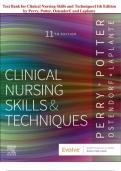
Test Bank for Clinical Nursing Skills and Techniques, 11th Edition
Authors: Anne Griffin Perry, Patricia A. Potter, Wendy Ostendorf, and others Edition: 11th Edition Subject: Nursing Skills, Clinical Nursing Practice, Patient Care, and Nursing Procedures Format: Digital Study Resource Use: Nursing Students, Clinical Practice Preparation, Skills Review, and Examination Preparation Prepare for nursing coursework, clinical skills assessments, quizzes, and examinations with this comprehensive Test Bank for Clinical Nursing Skills and Techniques, 11th Edition by Perry, Potter, Ostendorf, and LaPlante. This study resource is designed to help nursing students review important concepts related to clinical nursing skills, patient safety, nursing procedures, assessment, communication, infection prevention, documentation, and evidence-based patient care. Clinical nursing skills are an essential component of nursing education. Students are expected not only to understand theoretical concepts but also to demonstrate safe, organized, and professional approaches when providing patient care. A structured question-based resource can help students identify areas that require additional study and reinforce information learned in lectures, textbooks, laboratories, simulations, and clinical placements. This resource can be used alongside the Clinical Nursing Skills and Techniques, 11th Edition textbook to support systematic review and self-assessment. Students can use practice questions to test their understanding of nursing procedures, clinical judgment, patient safety principles, assessment techniques, and appropriate nursing interventions. What This Study Resource Covers The material is intended to support review across major areas of clinical nursing skills. Depending on the organization of the accompanying textbook and course, topics may include: Fundamentals of clinical nursing practice Patient safety Infection prevention and control Standard precautions Transmission-based precautions Hand hygiene Personal protective equipment Vital signs Physical assessment Health history and patient assessment Pain assessment and management Medication administration Oral, topical, subcutaneous, intramuscular, and other medication routes Dosage and medication safety concepts Documentation and reporting Therapeutic communication Patient identification Positioning and mobility Safe patient transfers Ambulation Use of assistive devices Bedmaking and patient comfort Hygiene and personal care Oral care Bathing procedures Elimination needs Urinary care Bowel management Nutrition and feeding Enteral nutrition concepts Skin integrity Pressure injury prevention Wound care Sterile and clean techniques Specimen collection Respiratory care Oxygen therapy Airway management concepts Cardiovascular monitoring Neurological assessment Preoperative and postoperative care Emergency nursing procedures Basic life-support-related concepts Patient education Discharge planning Clinical documentation Legal and ethical considerations Evidence-based nursing practice Designed for Nursing Students The test bank format makes it easier for students to transform passive reading into active learning. Rather than simply reviewing pages of information, learners can answer questions and determine whether they understand the underlying concepts. It can be particularly useful for students enrolled in: Associate Degree Nursing programs Bachelor of Science in Nursing programs Diploma nursing programs Practical nursing programs Registered nursing programs Clinical skills courses Fundamentals of nursing courses Medical-surgical nursing courses Nursing laboratory courses Nursing simulation courses Whether you are preparing for a classroom examination, skills check-off, simulation, or clinical placement, practice questions can provide an additional method of reviewing essential nursing concepts. Improve Understanding of Clinical Procedures Clinical nursing requires attention to detail. A small mistake in patient identification, infection control, positioning, medication administration, documentation, or communication can affect patient safety. For this reason, nursing students need repeated exposure to clinical situations and decision-making questions. This resource encourages learners to think about what should be done, why it should be done, when it should be done, and which action should be performed first. Question-based practice can help students review important concepts such as: Appropriate nursing interventions Prioritization of patient care Patient safety Assessment before intervention Expected versus unexpected findings Appropriate documentation Communication with patients and healthcare professionals Infection-control procedures Clinical decision-making Appropriate use of nursing equipment Patient education Prevention of complications Useful for Exam Preparation Students can use the test bank as part of a broader examination preparation strategy. Instead of waiting until the night before an examination, learners can use practice questions throughout the semester. A practical study approach is to read the relevant textbook material first, review classroom notes, answer practice questions, identify incorrect responses, and then return to the relevant topic for additional study. The resource can therefore be incorporated into a weekly study schedule or used for concentrated review before examinations. Active Learning and Self-Assessment One of the benefits of practice questions is that they provide students with immediate opportunities to evaluate their knowledge. If a learner consistently struggles with a particular subject, such as medication administration or wound care, additional time can be dedicated to that topic. Students can create personalized review sessions by grouping questions according to subject areas. For example, one study session can focus on infection control, another on medication administration, and another on patient mobility and safety. This approach can make studying more organized and help students concentrate on areas where they need additional practice. Suitable for Individual and Group Study The resource can be used independently or with classmates. Individual learners can answer questions and review concepts at their own pace. Nursing study groups can use selected questions to facilitate discussions about clinical situations and appropriate nursing interventions. Group study can also encourage learners to explain their reasoning to one another. Explaining why an answer is appropriate can strengthen understanding and reveal gaps in knowledge. Supports Clinical Skills Review Clinical nursing skills involve both knowledge and practical performance. A test bank should therefore be considered a supplementary learning resource, not a replacement for instructor demonstrations, laboratory practice, simulation, clinical experience, institutional policies, or the textbook. Students should always follow the procedures taught by their nursing program and the current policies of the healthcare facility in which they practice. Where clinical guidelines or institutional procedures differ, students should follow the instructions provided by their qualified instructors and clinical supervisors. Key Benefits Using this study resource can help students: Review important clinical nursing concepts Practice answering nursing questions Identify knowledge gaps Reinforce classroom learning Prepare for nursing examinations Review clinical procedures Improve familiarity with nursing terminology Strengthen understanding of patient safety Practice clinical reasoning Organize study sessions Reinforce infection-control principles Review nursing interventions Prepare for classroom quizzes Support laboratory and simulation preparation Develop consistent study habits A Convenient Nursing Study Companion Nursing programs involve a large amount of information, and students often need multiple methods of studying. A test bank provides a convenient question-based format that can be incorporated into a broader study plan. Students can use it after completing each chapter, before a classroom quiz, during study-group sessions, or as part of a comprehensive review before final examinations. For maximum benefit, combine practice-question review with textbook reading, lecture notes, instructor guidance, skills demonstrations, laboratory practice, simulation exercises, and supervised clinical experience. Important Note This product is intended as a study and review resource. It should be used together with the applicable textbook, course materials, instructor guidance, and current clinical policies. It is not a substitute for professional nursing instruction, supervised clinical practice, or institutional procedures. Students should verify clinical information against current evidence-based guidelines and their school's requirements because nursing procedures, recommendations, and institutional policies may change over time. Why Choose This Resource? The Test Bank for Clinical Nursing Skills and Techniques, 11th Edition offers students an organized way to practice their understanding of fundamental clinical nursing concepts. By working through questions and reviewing challenging topics, learners can make their study sessions more active and focused. Whether you are beginning your nursing education or reviewing clinical skills before an important examination, this resource can be incorporated into your existing study routine to reinforce knowledge and promote better preparation. Ideal For Nursing students | RN students | Practical nursing students | BSN students | ADN students | Diploma nursing students | Nursing instructors | Clinical skills learners | Nursing study groups | Fundamentals of nursing students | Clinical laboratory preparation | Nursing examination review Build a stronger study routine by combining structured question practice with textbook learning, classroom instruction, and hands-on clinical skills practice.
Información del documento
- Subido en
- 24 de septiembre de 2026
- Número de páginas
- 600
- Escrito en
- 2026/2027
- Tipo
- Examen
- Contiene
- Preguntas y respuestas

