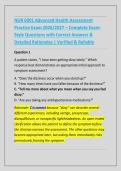
NUR 6001 Advanced Health Assessment
Practice Exam 2026/2027 – Complete Exam-
Style Questions with Correct Answers &
Detailed Rationales | Verified & Reliable
Question 1
A patient states, “I have been getting dizzy lately.” Which
response best demonstrates an appropriate initial approach to
symptom assessment?
A. “Does the dizziness occur when you stand up?”
B. “How many times have you fallen because of the dizziness?”
C. “Tell me more about what you mean when you say you feel
dizzy.”
D. “Are you taking any antihypertensive medications?”
Rationale: C is correct because “dizzy” can describe several
different experiences, including vertigo, presyncope,
disequilibrium, or nonspecific lightheadedness. An open-ended
clarification allows the patient to define the symptom before
the clinician narrows the assessment. The other questions may
become appropriate later, but asking them immediately risks
prematurely framing the symptom.
,Question 2
During an interview, a patient becomes visibly tearful while
discussing a recent diagnosis. Which response is most
therapeutic?
A. “Try not to worry; many patients recover from this.”
B. “We can discuss your diagnosis after the physical
examination.”
C. “You seem upset, so perhaps we should stop the interview.”
D. “I can see this is difficult for you. Would you like to tell me
what concerns you most?”
Rationale: D is correct because it acknowledges the patient's
emotional response without making assumptions or
prematurely ending the interaction. Therapeutic communication
validates emotion and invites the patient to identify specific
concerns. Reassurance without exploration can minimize the
patient's experience, while abruptly stopping the interview may
prevent important information from being disclosed.
Question 3
Which statement best distinguishes the chief complaint from
the history of present illness?
A. The chief complaint contains all relevant symptoms, whereas
the HPI contains only objective findings.
,B. The chief complaint identifies the primary reason for the
encounter, while the HPI elaborates on the characteristics and
progression of the problem.
C. The chief complaint is obtained from the physical
examination, whereas the HPI is obtained from laboratory
testing.
D. The chief complaint is documented only for acute conditions,
whereas the HPI is used only for chronic diseases.
Rationale: B is correct because the chief complaint concisely
identifies why the patient is seeking care, preferably using the
patient's own words. The HPI expands that concern by
describing onset, location, characteristics, timing, associated
symptoms, aggravating or relieving factors, and relevant
context. Both are primarily history components rather than
products of physical examination or laboratory testing.
Question 4
A patient reports abdominal pain that began yesterday. Which
question most directly assesses the “character” of the
symptom?
A. “Where does the pain occur?”
B. “When did the pain begin?”
, C. “How would you describe the pain?”
D. “What makes the pain better?”
Rationale: C is correct because character describes the quality
or nature of a symptom, such as sharp, burning, cramping,
pressure-like, or aching. Location addresses where the symptom
occurs, onset addresses timing, and relieving factors identify
what modifies the symptom.
Question 5
Which documentation entry is most appropriate for an
objective finding?
A. “Patient feels extremely anxious.”
B. “Patient reports severe fatigue for two weeks.”
C. “Patient believes the medication is causing nausea.”
D. “Respirations 24/min; patient speaking in short phrases.”
Rationale: D is correct because respiratory rate and the
patient's observed speech pattern are directly observable or
measurable findings. The other statements represent subjective
information reported by the patient and therefore belong in the
subjective portion of documentation.
Question 6
Practice Exam 2026/2027 – Complete Exam-
Style Questions with Correct Answers &
Detailed Rationales | Verified & Reliable
Question 1
A patient states, “I have been getting dizzy lately.” Which
response best demonstrates an appropriate initial approach to
symptom assessment?
A. “Does the dizziness occur when you stand up?”
B. “How many times have you fallen because of the dizziness?”
C. “Tell me more about what you mean when you say you feel
dizzy.”
D. “Are you taking any antihypertensive medications?”
Rationale: C is correct because “dizzy” can describe several
different experiences, including vertigo, presyncope,
disequilibrium, or nonspecific lightheadedness. An open-ended
clarification allows the patient to define the symptom before
the clinician narrows the assessment. The other questions may
become appropriate later, but asking them immediately risks
prematurely framing the symptom.
,Question 2
During an interview, a patient becomes visibly tearful while
discussing a recent diagnosis. Which response is most
therapeutic?
A. “Try not to worry; many patients recover from this.”
B. “We can discuss your diagnosis after the physical
examination.”
C. “You seem upset, so perhaps we should stop the interview.”
D. “I can see this is difficult for you. Would you like to tell me
what concerns you most?”
Rationale: D is correct because it acknowledges the patient's
emotional response without making assumptions or
prematurely ending the interaction. Therapeutic communication
validates emotion and invites the patient to identify specific
concerns. Reassurance without exploration can minimize the
patient's experience, while abruptly stopping the interview may
prevent important information from being disclosed.
Question 3
Which statement best distinguishes the chief complaint from
the history of present illness?
A. The chief complaint contains all relevant symptoms, whereas
the HPI contains only objective findings.
,B. The chief complaint identifies the primary reason for the
encounter, while the HPI elaborates on the characteristics and
progression of the problem.
C. The chief complaint is obtained from the physical
examination, whereas the HPI is obtained from laboratory
testing.
D. The chief complaint is documented only for acute conditions,
whereas the HPI is used only for chronic diseases.
Rationale: B is correct because the chief complaint concisely
identifies why the patient is seeking care, preferably using the
patient's own words. The HPI expands that concern by
describing onset, location, characteristics, timing, associated
symptoms, aggravating or relieving factors, and relevant
context. Both are primarily history components rather than
products of physical examination or laboratory testing.
Question 4
A patient reports abdominal pain that began yesterday. Which
question most directly assesses the “character” of the
symptom?
A. “Where does the pain occur?”
B. “When did the pain begin?”
, C. “How would you describe the pain?”
D. “What makes the pain better?”
Rationale: C is correct because character describes the quality
or nature of a symptom, such as sharp, burning, cramping,
pressure-like, or aching. Location addresses where the symptom
occurs, onset addresses timing, and relieving factors identify
what modifies the symptom.
Question 5
Which documentation entry is most appropriate for an
objective finding?
A. “Patient feels extremely anxious.”
B. “Patient reports severe fatigue for two weeks.”
C. “Patient believes the medication is causing nausea.”
D. “Respirations 24/min; patient speaking in short phrases.”
Rationale: D is correct because respiratory rate and the
patient's observed speech pattern are directly observable or
measurable findings. The other statements represent subjective
information reported by the patient and therefore belong in the
subjective portion of documentation.
Question 6