
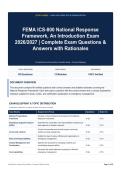
[STUDY GUIDE] • HIGH-YIELD PRACTICE & REVIEW EDITION
FEMA ICS-800 National Response
Framework, An Introduction Exam
2026/2027 | Complete Exam Questions &
Answers with Rationales
Comprehensive Examination Question Bank • Concept Mapping
TOTAL QUESTIONS EXAM TOPICS RATIONALES
69 Questions 12 Modules 100% Verified
DOCUMENT OVERVIEW
This document contains 69 verified questions with correct answers and detailed rationales covering the
National Response Framework. Each item pairs a question with the correct answer and a concise explanation,
making it suitable for study, review, and certification preparation in emergency management.
EXAM BLUEPRINT & TOPIC DISTRIBUTION
Systematic breakdown of subject domains and exam coverage.
Topic Module Scope & Core Focus Questions Share (%)
National Preparedness Focuses on the principles and structures of the National
Framework Response Framework. 6 Qs 8.7%
Emergency Support Functions Examines the coordination and responsibilities of federal and
(ESFs) state agencies in disaster response. 6 Qs 8.7%
Covers the essential services that support community
Community Lifelines resilience during emergencies. 6 Qs 8.7%
Details the roles of various officials and organizations in
Roles and Responsibilities emergency management. 6 Qs 8.7%
Incident Management and Explores the structures for managing incidents and
Coordination coordinating response efforts. 6 Qs 8.7%
Discusses the critical elements necessary for effective
Core Capabilities emergency management. 6 Qs 8.7%
Confidential • Student Study Edition • Practice & Review Guide Page 1 of 25
,STUDENT STUDY & MASTERY EDITION PRACTICE & REVIEW GUIDE
Focuses on the importance of planning and preparedness in
Preparedness and Planning reducing disaster impact. 6 Qs 8.7%
Covers the role of health services and public safety in
Public Health and Safety response efforts. 6 Qs 8.7%
Examines the management of resources and logistics during
Logistics and Supply Chain emergencies. 6 Qs 8.7%
Describes the systems in place for mutual aid and
Mutual Aid and Assistance collaboration among jurisdictions. 5 Qs 7.2%
Focuses on the role of cybersecurity in protecting critical
Cybersecurity and Infrastructure infrastructure. 5 Qs 7.2%
Child Locator and Missing Examines the systems for locating missing children and
Persons individuals during disasters. 5 Qs 7.2%
Total Exam Coverage 12 Integrated Topic Modules 69 Qs 100.0%
Confidential • Student Study Edition • Practice & Review Guide Page 2 of 25
, STUDENT STUDY & MASTERY EDITION PRACTICE & REVIEW GUIDE
TOPIC 1: NATIONAL PREPAREDNESS FRAMEWORK
6 Questions • 8.7% of Exam • Focuses on the principles and structures of the National Response Framework.
QUESTION 1
Scope
Answer: The National Response Framework describes structures for implementing nationwide response
policy and operational coordination for all types of domestic incidents.
Rationale: The National Response Framework establishes the guiding principles and structures for a unified, nationwide
approach to incident management, ensuring effective coordination across all levels of government and non-governmental
partners. This framework is designed to be flexible and adaptable to a wide range of emergencies, promoting a common
understanding of roles and responsibilities.
QUESTION 2
National Preparedness System (NPS)
Answer: The NPS was developed to provide the approach, resources, and tools to aid the whole community
in its preparedness activities to achieve the National Preparedness Goal. Part of this system involves
determining what capabilities are needed, how they should be developed and sustained, and how they should
be delivered.
Rationale: The National Preparedness System unifies the approach, resources, and tools for whole community
preparedness, focusing on identifying, developing, sustaining, and delivering necessary capabilities to meet the National
Preparedness Goal. This framework ensures a coordinated effort across all sectors to build and maintain readiness.
QUESTION 3
National Preparedness Goal
Answer: A secure and resilient Nation with the capabilities required across the whole community to prevent,
protect against, mitigate, respond to, and recover from the threats and hazards that pose the greatest risk.
Rationale: This goal defines the desired end state of national preparedness by emphasizing community-wide capabilities
across all phases of emergency management. It underscores the proactive and comprehensive approach needed to
address diverse threats and hazards effectively.
Confidential • Student Study Edition • Practice & Review Guide Page 3 of 25
FEMA ICS-800 National Response
Framework, An Introduction Exam
2026/2027 | Complete Exam Questions &
Answers with Rationales
Comprehensive Examination Question Bank • Concept Mapping
TOTAL QUESTIONS EXAM TOPICS RATIONALES
69 Questions 12 Modules 100% Verified
DOCUMENT OVERVIEW
This document contains 69 verified questions with correct answers and detailed rationales covering the
National Response Framework. Each item pairs a question with the correct answer and a concise explanation,
making it suitable for study, review, and certification preparation in emergency management.
EXAM BLUEPRINT & TOPIC DISTRIBUTION
Systematic breakdown of subject domains and exam coverage.
Topic Module Scope & Core Focus Questions Share (%)
National Preparedness Focuses on the principles and structures of the National
Framework Response Framework. 6 Qs 8.7%
Emergency Support Functions Examines the coordination and responsibilities of federal and
(ESFs) state agencies in disaster response. 6 Qs 8.7%
Covers the essential services that support community
Community Lifelines resilience during emergencies. 6 Qs 8.7%
Details the roles of various officials and organizations in
Roles and Responsibilities emergency management. 6 Qs 8.7%
Incident Management and Explores the structures for managing incidents and
Coordination coordinating response efforts. 6 Qs 8.7%
Discusses the critical elements necessary for effective
Core Capabilities emergency management. 6 Qs 8.7%
Confidential • Student Study Edition • Practice & Review Guide Page 1 of 25
,STUDENT STUDY & MASTERY EDITION PRACTICE & REVIEW GUIDE
Focuses on the importance of planning and preparedness in
Preparedness and Planning reducing disaster impact. 6 Qs 8.7%
Covers the role of health services and public safety in
Public Health and Safety response efforts. 6 Qs 8.7%
Examines the management of resources and logistics during
Logistics and Supply Chain emergencies. 6 Qs 8.7%
Describes the systems in place for mutual aid and
Mutual Aid and Assistance collaboration among jurisdictions. 5 Qs 7.2%
Focuses on the role of cybersecurity in protecting critical
Cybersecurity and Infrastructure infrastructure. 5 Qs 7.2%
Child Locator and Missing Examines the systems for locating missing children and
Persons individuals during disasters. 5 Qs 7.2%
Total Exam Coverage 12 Integrated Topic Modules 69 Qs 100.0%
Confidential • Student Study Edition • Practice & Review Guide Page 2 of 25
, STUDENT STUDY & MASTERY EDITION PRACTICE & REVIEW GUIDE
TOPIC 1: NATIONAL PREPAREDNESS FRAMEWORK
6 Questions • 8.7% of Exam • Focuses on the principles and structures of the National Response Framework.
QUESTION 1
Scope
Answer: The National Response Framework describes structures for implementing nationwide response
policy and operational coordination for all types of domestic incidents.
Rationale: The National Response Framework establishes the guiding principles and structures for a unified, nationwide
approach to incident management, ensuring effective coordination across all levels of government and non-governmental
partners. This framework is designed to be flexible and adaptable to a wide range of emergencies, promoting a common
understanding of roles and responsibilities.
QUESTION 2
National Preparedness System (NPS)
Answer: The NPS was developed to provide the approach, resources, and tools to aid the whole community
in its preparedness activities to achieve the National Preparedness Goal. Part of this system involves
determining what capabilities are needed, how they should be developed and sustained, and how they should
be delivered.
Rationale: The National Preparedness System unifies the approach, resources, and tools for whole community
preparedness, focusing on identifying, developing, sustaining, and delivering necessary capabilities to meet the National
Preparedness Goal. This framework ensures a coordinated effort across all sectors to build and maintain readiness.
QUESTION 3
National Preparedness Goal
Answer: A secure and resilient Nation with the capabilities required across the whole community to prevent,
protect against, mitigate, respond to, and recover from the threats and hazards that pose the greatest risk.
Rationale: This goal defines the desired end state of national preparedness by emphasizing community-wide capabilities
across all phases of emergency management. It underscores the proactive and comprehensive approach needed to
address diverse threats and hazards effectively.
Confidential • Student Study Edition • Practice & Review Guide Page 3 of 25

