@ProfdocDigitalLibraries <Best Online Study Materials>
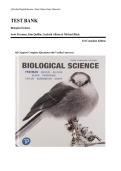
TEST BANK
Biological Science
Scott Freeman, Kim Quillin, Lizabeth Allison & Michael Black
3rd Canadian Edition
All Chapters Complete (Questions with Verified Answers)
,@ProfdocDigitalLibraries <Best Online Study Materials>
Table of Contents
Unit 1 — The Molecular Origin and Evolution of Life
1. Biology and the Tree of Life
2. Water and Carbon: The Chemical Basis of Life
3. Protein Structure and Function
4. Nucleic Acids and the RNA World
5. An Introduction to Carbohydrates
6. Lipids, Membranes, and the First Cells
Unit 2 — Cell Structure and Function
7. Inside the Cell
8. Energy and Enzymes: An Introduction to Metabolism
9. Cellular Respiration and Fermentation
10. Photosynthesis
11. Cell–Cell Interactions
12. The Cell Cycle
Unit 3 — Gene Structure and Expression
13. Meiosis
14. Mendel and the Gene
15. How DNA and the Gene: Synthesis and Repair
16. How Genes Work
17. Transcription, RNA Processing, and Translation
18. Control of Gene Expression in Bacteria
19. Control of Gene Expression in Eukaryotes
20. The Molecular Revolution: Biotechnology and Beyond
21. Genes, Development, and Evolution
Unit 4 — Evolutionary Patterns and Processes
22. Evolution by Natural Selection
23. Evolutionary Processes
24. Speciation
25. Phylogenies and the History of Life
Unit 5 — The Diversification of Life
26. Bacteria and Archaea
27. Protists
28. Green Algae and Land Plants
29. Fungi
30. An Introduction to Animals
31. Protostome Animals
32. Deuterostome Animals
33. Viruses
Unit 6 — How Plants Work
34. Plant Form and Function
35. Water and Sugar Transport in Plants
36. Plant Nutrition
37. Plant Sensory Systems, Signals, and Responses
38. Plant Reproduction and Development
Unit 7 — How Animals Work
39. Animal Form and Function
40. Water and Electrolyte Balance in Animals
41. Animal Nutrition
42. Gas Exchange and Circulation
,@ProfdocDigitalLibraries <Best Online Study Materials>
43. Animal Nervous Systems
44. Animal Sensory Systems
45. Animal Movement
46. Chemical Signals in Animals
47. Animal Reproduction and Development
48. The Immune System in Animals
Unit 8 — Ecology
49. An Introduction to Ecology
50. Behavioural Ecology
51. Population Ecology
52. Community Ecology
53. Ecosystems and Global Ecology
, @ProfdocDigitalLibraries <Best Online Study Materials>
Chapter 1 Biology and the Tree of Life
1) The pattern component of the cell theory claims that all organisms consist of cells.
A) true
B) false
Answer: A
Reference: Section 1.1
Bloom's Level: Remembering
LOs: Chp1-2. Describe the two components of the cell theory.
2) How does a scientific theory differ from a scientific hypothesis?
A) There is no difference—the terms are interchangeable.
B) A theory is an explanation for a very general phenomenon or observation; hypotheses treat
more specific observations.
C) A hypothesis is an explanation for a very general phenomenon; theories treat more specific
issues.
D) Theories define scientific laws; hypotheses are used to set up experiments.
Answer: B
Reference: Section 1.1
Bloom's Level: Comprehension
LOs: Chp1-2. Describe the two components of the cell theory.
3) Algae in the genus Caulerpa typically grow to a length of over half a meter and have
structures similar to stems, leaves, and roots. Reproduction occurs when adults produce sperm
and eggs that fuse to form offspring. Each adult Caulerpa, however, consists of just a single cell.
Which of the following statements is true?
A) Caulerpa violate the pattern component of the cell theory—that all organisms consist of cells.
B) Caulerpa violate the process component of the cell theory—that all cells come from
preexisting cells.
C) Caulerpa violate both the pattern and process components of the cell theory.
D) The existence of Caulerpa is consistent with the cell theory.
Answer: D
Reference: Section 1.1
Bloom's Level: Comprehension
LOs: Chp1-2. Describe the two components of the cell theory.
4) Which statement about spontaneous generation is FALSE?
A) Pasteur demonstrated that it does not occur under normal laboratory conditions.
B) It apparently occurred at least once–when life on Earth began.
C) It occurs every time a new species evolves from a preexisting species.
D) It addresses the formation of living cells from previously nonliving material.
Answer: C
Reference: Section 1.1
Bloom's Level: Remembering
LOs: Chp1-2. Describe the two components of the cell theory.
TEST BANK
Biological Science
Scott Freeman, Kim Quillin, Lizabeth Allison & Michael Black
3rd Canadian Edition
All Chapters Complete (Questions with Verified Answers)
,@ProfdocDigitalLibraries <Best Online Study Materials>
Table of Contents
Unit 1 — The Molecular Origin and Evolution of Life
1. Biology and the Tree of Life
2. Water and Carbon: The Chemical Basis of Life
3. Protein Structure and Function
4. Nucleic Acids and the RNA World
5. An Introduction to Carbohydrates
6. Lipids, Membranes, and the First Cells
Unit 2 — Cell Structure and Function
7. Inside the Cell
8. Energy and Enzymes: An Introduction to Metabolism
9. Cellular Respiration and Fermentation
10. Photosynthesis
11. Cell–Cell Interactions
12. The Cell Cycle
Unit 3 — Gene Structure and Expression
13. Meiosis
14. Mendel and the Gene
15. How DNA and the Gene: Synthesis and Repair
16. How Genes Work
17. Transcription, RNA Processing, and Translation
18. Control of Gene Expression in Bacteria
19. Control of Gene Expression in Eukaryotes
20. The Molecular Revolution: Biotechnology and Beyond
21. Genes, Development, and Evolution
Unit 4 — Evolutionary Patterns and Processes
22. Evolution by Natural Selection
23. Evolutionary Processes
24. Speciation
25. Phylogenies and the History of Life
Unit 5 — The Diversification of Life
26. Bacteria and Archaea
27. Protists
28. Green Algae and Land Plants
29. Fungi
30. An Introduction to Animals
31. Protostome Animals
32. Deuterostome Animals
33. Viruses
Unit 6 — How Plants Work
34. Plant Form and Function
35. Water and Sugar Transport in Plants
36. Plant Nutrition
37. Plant Sensory Systems, Signals, and Responses
38. Plant Reproduction and Development
Unit 7 — How Animals Work
39. Animal Form and Function
40. Water and Electrolyte Balance in Animals
41. Animal Nutrition
42. Gas Exchange and Circulation
,@ProfdocDigitalLibraries <Best Online Study Materials>
43. Animal Nervous Systems
44. Animal Sensory Systems
45. Animal Movement
46. Chemical Signals in Animals
47. Animal Reproduction and Development
48. The Immune System in Animals
Unit 8 — Ecology
49. An Introduction to Ecology
50. Behavioural Ecology
51. Population Ecology
52. Community Ecology
53. Ecosystems and Global Ecology
, @ProfdocDigitalLibraries <Best Online Study Materials>
Chapter 1 Biology and the Tree of Life
1) The pattern component of the cell theory claims that all organisms consist of cells.
A) true
B) false
Answer: A
Reference: Section 1.1
Bloom's Level: Remembering
LOs: Chp1-2. Describe the two components of the cell theory.
2) How does a scientific theory differ from a scientific hypothesis?
A) There is no difference—the terms are interchangeable.
B) A theory is an explanation for a very general phenomenon or observation; hypotheses treat
more specific observations.
C) A hypothesis is an explanation for a very general phenomenon; theories treat more specific
issues.
D) Theories define scientific laws; hypotheses are used to set up experiments.
Answer: B
Reference: Section 1.1
Bloom's Level: Comprehension
LOs: Chp1-2. Describe the two components of the cell theory.
3) Algae in the genus Caulerpa typically grow to a length of over half a meter and have
structures similar to stems, leaves, and roots. Reproduction occurs when adults produce sperm
and eggs that fuse to form offspring. Each adult Caulerpa, however, consists of just a single cell.
Which of the following statements is true?
A) Caulerpa violate the pattern component of the cell theory—that all organisms consist of cells.
B) Caulerpa violate the process component of the cell theory—that all cells come from
preexisting cells.
C) Caulerpa violate both the pattern and process components of the cell theory.
D) The existence of Caulerpa is consistent with the cell theory.
Answer: D
Reference: Section 1.1
Bloom's Level: Comprehension
LOs: Chp1-2. Describe the two components of the cell theory.
4) Which statement about spontaneous generation is FALSE?
A) Pasteur demonstrated that it does not occur under normal laboratory conditions.
B) It apparently occurred at least once–when life on Earth began.
C) It occurs every time a new species evolves from a preexisting species.
D) It addresses the formation of living cells from previously nonliving material.
Answer: C
Reference: Section 1.1
Bloom's Level: Remembering
LOs: Chp1-2. Describe the two components of the cell theory.