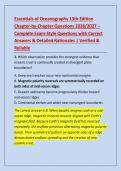
Essentials of Oceanography 13th Edition
Chapter-by-Chapter Questions 2026/2027 –
Complete Exam-Style Questions with Correct
Answers & Detailed Rationales | Verified &
Reliable
1. Which observation provides the strongest evidence that
oceanic crust is continually created at divergent plate
boundaries?
A. Deep-sea trenches occur near continental margins
B. Magnetic polarity reversals are symmetrically recorded on
both sides of mid-ocean ridges
C. Oceanic sediments become progressively thicker toward
mid-ocean ridges
D. Continental shelves are wider near convergent boundaries
The correct answer is B. When basaltic magma cools at a mid-
ocean ridge, magnetic minerals become aligned with Earth's
magnetic field. Because Earth's magnetic field has reversed
repeatedly, the seafloor preserves alternating magnetic-polarity
bands. Their symmetrical pattern on opposite sides of a ridge
demonstrates seafloor spreading and the creation of new
oceanic crust.
,2. A parcel of seawater moves from a region where evaporation
greatly exceeds precipitation to a region with lower salinity.
Assuming no mixing or phase change occurs during transport,
which property of the parcel remains essentially unchanged?
A. Density
B. Salinity
C. Temperature
D. Mass of dissolved salts relative to the water parcel
The correct answer is D. If no evaporation, precipitation,
freshwater input, or mixing occurs, the amount of dissolved salt
carried by the parcel does not change. Temperature, salinity,
and density may differ between regions, but the parcel's
dissolved-salt inventory remains constant under the stated
conditions.
3. Why does seawater generally become denser when it
becomes colder, assuming salinity remains approximately
constant?
A. Cold water contains less dissolved oxygen
B. Cooling causes salts to precipitate out of solution
C. Lower temperature causes seawater molecules to occupy a
smaller volume over the relevant oceanic temperature range
D. Cold water contains more dissolved gases, which always
increases its density more than temperature does
,The correct answer is C. For typical oceanic temperatures,
cooling seawater increases its density because thermal
contraction reduces its volume. This temperature effect,
together with salinity, is fundamental to determining seawater
density and therefore contributes to thermohaline circulation.
4. Which statement best describes the relationship between
ocean pressure and depth?
A. Pressure decreases exponentially with depth
B. Pressure remains nearly constant below the thermocline
C. Pressure increases approximately linearly with depth in the
ocean
D. Pressure depends only on temperature, not seawater density
The correct answer is C. Hydrostatic pressure results from the
weight of the water above a given depth. Because seawater
density varies only moderately with depth compared with the
large increase in depth itself, pressure increases approximately
linearly downward. The rate is roughly one atmosphere for
every 10 meters of seawater.
5. A seismic wave travels from a layer of oceanic crust into an
underlying layer with substantially different physical properties.
Which observation is most useful for identifying the boundary
between the layers?
, A. Changes in surface-wave height
B. A change in seismic-wave velocity or direction of
propagation
C. Changes in atmospheric pressure
D. Variations in tidal amplitude
The correct answer is B. Seismic waves respond to changes in
density and elastic properties of Earth's materials. At
boundaries between layers, their velocity and direction can
change through refraction and reflection. These changes allow
scientists to infer Earth's internal structure.
6. Which characteristic most directly distinguishes a passive
continental margin from an active continental margin?
A. Passive margins always have coral reefs
B. Active margins always have broad continental shelves
C. Active margins commonly occur near plate boundaries and
may include trenches and frequent earthquakes
D. Passive margins are composed entirely of oceanic crust
The correct answer is C. Active continental margins occur near
tectonic plate boundaries and commonly exhibit earthquakes,
volcanic activity, and steep offshore topography such as
trenches. Passive margins are generally farther from active
plate boundaries and often have broad shelves and thick
sediment accumulations.
Chapter-by-Chapter Questions 2026/2027 –
Complete Exam-Style Questions with Correct
Answers & Detailed Rationales | Verified &
Reliable
1. Which observation provides the strongest evidence that
oceanic crust is continually created at divergent plate
boundaries?
A. Deep-sea trenches occur near continental margins
B. Magnetic polarity reversals are symmetrically recorded on
both sides of mid-ocean ridges
C. Oceanic sediments become progressively thicker toward
mid-ocean ridges
D. Continental shelves are wider near convergent boundaries
The correct answer is B. When basaltic magma cools at a mid-
ocean ridge, magnetic minerals become aligned with Earth's
magnetic field. Because Earth's magnetic field has reversed
repeatedly, the seafloor preserves alternating magnetic-polarity
bands. Their symmetrical pattern on opposite sides of a ridge
demonstrates seafloor spreading and the creation of new
oceanic crust.
,2. A parcel of seawater moves from a region where evaporation
greatly exceeds precipitation to a region with lower salinity.
Assuming no mixing or phase change occurs during transport,
which property of the parcel remains essentially unchanged?
A. Density
B. Salinity
C. Temperature
D. Mass of dissolved salts relative to the water parcel
The correct answer is D. If no evaporation, precipitation,
freshwater input, or mixing occurs, the amount of dissolved salt
carried by the parcel does not change. Temperature, salinity,
and density may differ between regions, but the parcel's
dissolved-salt inventory remains constant under the stated
conditions.
3. Why does seawater generally become denser when it
becomes colder, assuming salinity remains approximately
constant?
A. Cold water contains less dissolved oxygen
B. Cooling causes salts to precipitate out of solution
C. Lower temperature causes seawater molecules to occupy a
smaller volume over the relevant oceanic temperature range
D. Cold water contains more dissolved gases, which always
increases its density more than temperature does
,The correct answer is C. For typical oceanic temperatures,
cooling seawater increases its density because thermal
contraction reduces its volume. This temperature effect,
together with salinity, is fundamental to determining seawater
density and therefore contributes to thermohaline circulation.
4. Which statement best describes the relationship between
ocean pressure and depth?
A. Pressure decreases exponentially with depth
B. Pressure remains nearly constant below the thermocline
C. Pressure increases approximately linearly with depth in the
ocean
D. Pressure depends only on temperature, not seawater density
The correct answer is C. Hydrostatic pressure results from the
weight of the water above a given depth. Because seawater
density varies only moderately with depth compared with the
large increase in depth itself, pressure increases approximately
linearly downward. The rate is roughly one atmosphere for
every 10 meters of seawater.
5. A seismic wave travels from a layer of oceanic crust into an
underlying layer with substantially different physical properties.
Which observation is most useful for identifying the boundary
between the layers?
, A. Changes in surface-wave height
B. A change in seismic-wave velocity or direction of
propagation
C. Changes in atmospheric pressure
D. Variations in tidal amplitude
The correct answer is B. Seismic waves respond to changes in
density and elastic properties of Earth's materials. At
boundaries between layers, their velocity and direction can
change through refraction and reflection. These changes allow
scientists to infer Earth's internal structure.
6. Which characteristic most directly distinguishes a passive
continental margin from an active continental margin?
A. Passive margins always have coral reefs
B. Active margins always have broad continental shelves
C. Active margins commonly occur near plate boundaries and
may include trenches and frequent earthquakes
D. Passive margins are composed entirely of oceanic crust
The correct answer is C. Active continental margins occur near
tectonic plate boundaries and commonly exhibit earthquakes,
volcanic activity, and steep offshore topography such as
trenches. Passive margins are generally farther from active
plate boundaries and often have broad shelves and thick
sediment accumulations.