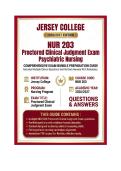
,NUR 203 Proctored Clinical Judgment Exam Psychiatric Nursing
Questions And Answers 2026/2027 Jersey College
Q1. During admission, a client repeatedly looks toward the door and
says, “I don't know whether I can trust anyone here.” Which
response best promotes therapeutic engagement?
A) “You need to trust us so treatment can work.”
B) “Tell me what has made it difficult to feel safe with people here.”
C) “There is no reason to be afraid in this unit.”
D) “Everyone here is trained to help you.”
Correct Answer: B) “Tell me what has made it difficult to feel safe with people
here.”
Rationale: Exploring the client's perception without arguing or offering false
reassurance encourages expression of concerns and supports development
of trust.
Q2. A client begins crying after describing the death of a sibling and
then becomes silent. What is the nurse's best action?
A) Remain present and allow the client time to continue when ready
B) Change the topic to reduce emotional distress
C) Tell the client that crying will delay recovery
D) Immediately leave to provide privacy
Correct Answer: A) Remain present and allow the client time to continue
when ready
Rationale: Therapeutic presence and silence allow the client to process
emotions without pressure while communicating acceptance and support.
Q3. A client says, “The staff are secretly recording every word I
say.” Which response is most therapeutic?
A) “That is impossible, so you need to stop thinking about it.”
B) “Why would the staff want to record you?”
C) “I do not see evidence that anyone is recording you, but I understand that
this feels frightening.”
D) “Yes, staff monitor everyone for safety.”
Correct Answer: C) “I do not see evidence that anyone is recording you, but I
understand that this feels frightening.”
,Rationale: The nurse presents reality without validating the delusion while
acknowledging the client's emotional experience.
Q4. Which documentation entry is most appropriate after a client
becomes verbally threatening in the dayroom?
A) “Client was crazy and aggressive.”
B) “Client behaved badly toward staff.”
C) “Client obviously intended to start a fight.”
D) “Client stood approximately 1 meter from another client, clenched fists,
and stated, ‘I will hit you if you come closer.’”
Correct Answer: D) “Client stood approximately 1 meter from another client,
clenched fists, and stated, ‘I will hit you if you come closer.’”
Rationale: Psychiatric documentation should describe observable behavior
and direct statements rather than labels, assumptions, or judgments.
Q5. A competent voluntary client refuses a prescribed antipsychotic
medication. Which nursing action is most appropriate initially?
A) Hide the medication in food
B) Explore the client's reason for refusing and provide relevant information
C) Tell the client medication refusal automatically results in discharge
D) Administer the medication intramuscularly without further assessment
Correct Answer: B) Explore the client's reason for refusing and provide
relevant information
Rationale: Competent clients generally retain the right to refuse treatment.
The nurse should assess concerns, provide education, and notify the
appropriate prescriber when needed.
Q6. A client tells the nurse, “Do not tell anyone, but I am going to
shoot my former partner tonight. The gun is already in my car.”
What is the nurse's priority response?
A) Promise confidentiality so the client continues talking
B) Ask the client to write the feelings in a journal
C) Initiate immediate safety procedures and communicate the credible threat
according to law and policy
D) Wait to see whether the client's mood improves
Correct Answer: C) Initiate immediate safety procedures and communicate
the credible threat according to law and policy
, Rationale: A specific threat toward an identifiable person with means and
stated intent requires immediate safety intervention and appropriate
disclosure rather than routine confidentiality.
Q7. Select all that apply. Which findings should the nurse include in
a focused mental status examination?
A) Appearance and behavior
B) Speech characteristics
C) Thought process and thought content
D) Mood and affect
E) Level of consciousness and cognition
Correct Answers: A) Appearance and behavior; B) Speech characteristics; C)
Thought process and thought content; D) Mood and affect; E) Level of
consciousness and cognition
Rationale: A mental status examination systematically assesses observable
behavior, speech, emotional state, thought, perception, cognition, insight,
judgment, and related functions.
Q8. A hospitalized client becomes increasingly agitated after
another client repeatedly enters the client's personal space. Which
intervention is most appropriate before behavior escalates further?
A) Move the client to a lower-stimulation area and help identify a safe coping
response
B) Confront the client in front of peers
C) Delay intervention until physical aggression occurs
D) Threaten seclusion if the client continues pacing
Correct Answer: A) Move the client to a lower-stimulation area and help
identify a safe coping response
Rationale: Early recognition and reduction of stimulation can interrupt
escalation before restrictive interventions become necessary.
Q9. A client offers the nurse an expensive watch and says, “You are
the only person who truly cares about me.” What is the best
response?
A) Accept the watch to avoid rejecting the client
B) Accept it but return it at discharge
C) Decline the gift and reinforce the professional nature of the relationship
D) Ask another nurse to accept it instead
Questions And Answers 2026/2027 Jersey College
Q1. During admission, a client repeatedly looks toward the door and
says, “I don't know whether I can trust anyone here.” Which
response best promotes therapeutic engagement?
A) “You need to trust us so treatment can work.”
B) “Tell me what has made it difficult to feel safe with people here.”
C) “There is no reason to be afraid in this unit.”
D) “Everyone here is trained to help you.”
Correct Answer: B) “Tell me what has made it difficult to feel safe with people
here.”
Rationale: Exploring the client's perception without arguing or offering false
reassurance encourages expression of concerns and supports development
of trust.
Q2. A client begins crying after describing the death of a sibling and
then becomes silent. What is the nurse's best action?
A) Remain present and allow the client time to continue when ready
B) Change the topic to reduce emotional distress
C) Tell the client that crying will delay recovery
D) Immediately leave to provide privacy
Correct Answer: A) Remain present and allow the client time to continue
when ready
Rationale: Therapeutic presence and silence allow the client to process
emotions without pressure while communicating acceptance and support.
Q3. A client says, “The staff are secretly recording every word I
say.” Which response is most therapeutic?
A) “That is impossible, so you need to stop thinking about it.”
B) “Why would the staff want to record you?”
C) “I do not see evidence that anyone is recording you, but I understand that
this feels frightening.”
D) “Yes, staff monitor everyone for safety.”
Correct Answer: C) “I do not see evidence that anyone is recording you, but I
understand that this feels frightening.”
,Rationale: The nurse presents reality without validating the delusion while
acknowledging the client's emotional experience.
Q4. Which documentation entry is most appropriate after a client
becomes verbally threatening in the dayroom?
A) “Client was crazy and aggressive.”
B) “Client behaved badly toward staff.”
C) “Client obviously intended to start a fight.”
D) “Client stood approximately 1 meter from another client, clenched fists,
and stated, ‘I will hit you if you come closer.’”
Correct Answer: D) “Client stood approximately 1 meter from another client,
clenched fists, and stated, ‘I will hit you if you come closer.’”
Rationale: Psychiatric documentation should describe observable behavior
and direct statements rather than labels, assumptions, or judgments.
Q5. A competent voluntary client refuses a prescribed antipsychotic
medication. Which nursing action is most appropriate initially?
A) Hide the medication in food
B) Explore the client's reason for refusing and provide relevant information
C) Tell the client medication refusal automatically results in discharge
D) Administer the medication intramuscularly without further assessment
Correct Answer: B) Explore the client's reason for refusing and provide
relevant information
Rationale: Competent clients generally retain the right to refuse treatment.
The nurse should assess concerns, provide education, and notify the
appropriate prescriber when needed.
Q6. A client tells the nurse, “Do not tell anyone, but I am going to
shoot my former partner tonight. The gun is already in my car.”
What is the nurse's priority response?
A) Promise confidentiality so the client continues talking
B) Ask the client to write the feelings in a journal
C) Initiate immediate safety procedures and communicate the credible threat
according to law and policy
D) Wait to see whether the client's mood improves
Correct Answer: C) Initiate immediate safety procedures and communicate
the credible threat according to law and policy
, Rationale: A specific threat toward an identifiable person with means and
stated intent requires immediate safety intervention and appropriate
disclosure rather than routine confidentiality.
Q7. Select all that apply. Which findings should the nurse include in
a focused mental status examination?
A) Appearance and behavior
B) Speech characteristics
C) Thought process and thought content
D) Mood and affect
E) Level of consciousness and cognition
Correct Answers: A) Appearance and behavior; B) Speech characteristics; C)
Thought process and thought content; D) Mood and affect; E) Level of
consciousness and cognition
Rationale: A mental status examination systematically assesses observable
behavior, speech, emotional state, thought, perception, cognition, insight,
judgment, and related functions.
Q8. A hospitalized client becomes increasingly agitated after
another client repeatedly enters the client's personal space. Which
intervention is most appropriate before behavior escalates further?
A) Move the client to a lower-stimulation area and help identify a safe coping
response
B) Confront the client in front of peers
C) Delay intervention until physical aggression occurs
D) Threaten seclusion if the client continues pacing
Correct Answer: A) Move the client to a lower-stimulation area and help
identify a safe coping response
Rationale: Early recognition and reduction of stimulation can interrupt
escalation before restrictive interventions become necessary.
Q9. A client offers the nurse an expensive watch and says, “You are
the only person who truly cares about me.” What is the best
response?
A) Accept the watch to avoid rejecting the client
B) Accept it but return it at discharge
C) Decline the gift and reinforce the professional nature of the relationship
D) Ask another nurse to accept it instead