
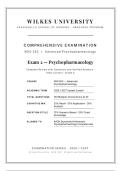
WILKES UNIVERSITY
PA S S I G U E L L O S C H O O L O F N U R S I N G · G R A D U AT E P R O G R A M
C O M P R E H E N S I V E E X A M I N AT I O N
NSG 552 • Advanced Psychopharmacol ogy
Exam 2 — Psychopharmacology
Complete Review with Questions and Verified Answers ·
100% Correct · Grade A
COURSE NSG 552 — Advanced
Psychopharmacology
ACAD EMIC TERM Update (Latest)
TOTAL QUESTIONS 100 Multiple-Choice Items (A–D)
COGNITIVE MIX 20% Recall · 50% Application · 30%
Analysis
QUESTION STYL E 75% Scenario-Based · 25% Direct
Knowledge
AL IGNED TO AACN Essentials & Advanced
Psychopharmacology Competencies
E X A M I N AT I O N S E R I E S · 2 0 2 0 2 7
W i l k e s U n i v e r s i t y · N S G 5 5 2 · G r a d e A Ve r i fi e d R e v i e w
, NSG 552 — Advanced Psychopharmacology
Exam 2 — Comprehensive Review
Complete Review with Questions and Verified Answers | 100% Correct | Grade A
Wilkes University — Passiguello School of Nursing · Update (Latest)
Examination Overview
This comprehensive examination is designed for graduate-level nursing students enrolled in NSG 552 Advanced
Psychopharmacology at Wilkes University. The examination is aligned with the AACN Essentials of Master's
Education in Nursing and the Advanced Practice Psychopharmacology Competencies (2026/2027 Edition). It
evaluates mastery across seven core psychopharmacology content domains, emphasizing safe prescribing,
monitoring, patient education, and clinical decision-making for psychiatric medications across the lifespan. Each
item has been verified against current FDA labeling, peer-reviewed literature, and established psychopharmacology
references, with rationales explaining both why the correct answer is correct and why the distractors are incorrect.
Examination Structure
Section Content Domain Questions Q Numbers
Section 1 Principles of Psychopharmacology 15 questions Q1–Q15
Section 2 Antidepressants 20 questions Q16–Q35
Section 3 Antipsychotics 20 questions Q36–Q55
Section 4 Mood Stabilizers 15 questions Q56–Q70
Section 5 Anxiolytics & Sedative-Hypnotics 15 questions Q71–Q85
Section 6 Psychostimulants & ADHD Medications 10 questions Q86–Q95
Section 7 Substance Use Disorder Pharmacotherapy 5 questions Q96–Q100
Total All Sections Combined 100 questions Q1–Q100
Cognitive Level Distribution & Question Style
This examination adheres to a structured cognitive level distribution calibrated to graduate-level nursing education.
Approximately 20% of items assess foundational recall of psychopharmacologic principles, including receptor
mechanisms, pharmacokinetic properties, and regulatory requirements. Approximately 50% of items require
application of knowledge to clinical scenarios, such as selecting appropriate medications based on patient
presentation, monitoring parameters, and managing common side effects. The remaining 30% of items require
analysis and clinical reasoning, including complex medication selection, drug interaction assessment, and adverse
event management. Approximately 75% of items are presented as scenario-based clinical reasoning questions,
while 25% are direct knowledge items.
NSG 552 Psychopharmacology · 100% Correct · Grade A Verified Review Page 1
,NSG 552 — Psychopharmacology · Exam 2 Wilkes University ·
• 20 scenario-based clinical reasoning items spanning medication selection, side effect management, and
patient education across the lifespan.
• 15 dedicated antidepressant and antipsychotic pharmacology items emphasizing mechanism of action,
receptor profiles, and clinically significant adverse effects.
• 10 dedicated mood stabilizer and anxiolytic items covering therapeutic monitoring, narrow therapeutic
index management, and discontinuation syndromes.
• All 100 items are multiple-choice with four options (A–D) and exactly one correct answer, with verified
rationales referencing NSG 552 curriculum content, AACN Essentials, and current psychopharmacology
evidence.
How to Use This Review
Each question is presented with its full stem, four lettered options, the correct answer clearly marked with
[CORRECT], and a 2-4 sentence rationale explaining the evidence-based reasoning behind the correct answer as
well as why distractors are incorrect. Students are encouraged to attempt each question independently before
reviewing the rationale, then use the rationale to consolidate understanding of underlying psychopharmacologic
principles. Faculty may use this examination for formative assessment, examination preparation, end-of-course
review, or as a basis for individualized remediation in identified areas of weakness.
NSG 552 Psychopharmacology · 100% Correct · Grade A Verified Review Page 2
, NSG 552 — Psychopharmacology · Exam 2 Wilkes University ·
Section 1: Principles of Psychopharmacology
Q1: A 38-year-old patient asks the PMHNP why a selective serotonin reuptake inhibitor (SSRI) prescribed for
major depressive disorder will not produce noticeable mood improvement for 2 to 4 weeks even though the
medication reaches peak plasma concentration within hours. Which explanation best reflects current
psychopharmacologic theory?
A. The drug must accumulate to a critical steady-state plasma concentration before any serotonin is available
in the synaptic cleft.
B. Therapeutic antidepressant effects depend on downstream receptor downregulation, neurotrophic
signaling, and signal transduction adaptations that take weeks to develop. [CORRECT]
C. The blood-brain barrier actively excludes the SSRI until repeated dosing induces permeability changes.
D. Hepatic CYP2D6 must be induced before the parent compound can be converted to its active
antidepressant metabolite.
Correct Answer: B
Rationale: Although SSRIs acutely raise synaptic serotonin within hours, clinical antidepressant response lags by 2-6 weeks
because therapeutic benefit depends on downstream adaptations such as 5-HT1A receptor desensitization, BDNF upregulation,
and intracellular signal transduction changes. Steady-state pharmacokinetics (option A) explains dosing but not therapeutic lag;
the BBB (option C) is not the rate-limiting step; and most SSRIs are active as parent compounds (option D), not prodrugs
requiring CYP2D6 bioactivation. This principle is foundational in the NSG 552 curriculum on pharmacodynamics.
Q2: A 47-year-old woman with breast cancer is prescribed tamoxifen and develops new-onset depression. The
PMHNP considers an SSRI. Which pharmacokinetic interaction is most clinically important to avoid?
A. CYP3A4 induction by the antidepressant, accelerating tamoxifen clearance.
B. CYP2D6 inhibition by paroxetine or fluoxetine, reducing conversion of tamoxifen to its active
metabolite endoxifen and increasing breast cancer recurrence risk. [CORRECT]
C. P-glycoprotein antagonism at the BBB, increasing CNS penetration of tamoxifen.
D. CYP2C19 inhibition, elevating tamoxifen to toxic plasma concentrations.
Correct Answer: B
Rationale: Tamoxifen is a prodrug requiring CYP2D6 bioactivation to endoxifen, its most potent anti-estrogenic metabolite.
Strong CYP2D6 inhibitors such as paroxetine, fluoxetine, and bupropion substantially reduce endoxifen formation and are
associated with increased breast cancer recurrence. The preferred alternatives are citalopram, escitalopram, sertraline, or
venlafaxine, which are weak CYP2D6 inhibitors. Options A, C, and D describe interactions that are not the primary concern
with tamoxifen.
Q3: A 55-year-old man of East Asian descent is started on clozapine for treatment-resistant schizophrenia. He
develops neutropenia on a modest dose and the team suspects a pharmacogenomic basis. Which cytochrome P450
variant is most relevant to clozapine metabolism and risk of adverse effects in this population?
A. CYP2D6 poor metabolizer phenotype.
B. CYP1A2 ultra-rapid metabolizer phenotype, which lowers clozapine levels.
C. HLA-DQB1 allele association with clozapine-induced agranulocytosis, alongside CYP1A2
dominance in clozapine clearance. [CORRECT]
D. CYP2C19 poor metabolizer phenotype, the principal determinant of clozapine toxicity.
Correct Answer: C
NSG 552 Psychopharmacology · 100% Correct · Grade A Verified Review Page 3
PA S S I G U E L L O S C H O O L O F N U R S I N G · G R A D U AT E P R O G R A M
C O M P R E H E N S I V E E X A M I N AT I O N
NSG 552 • Advanced Psychopharmacol ogy
Exam 2 — Psychopharmacology
Complete Review with Questions and Verified Answers ·
100% Correct · Grade A
COURSE NSG 552 — Advanced
Psychopharmacology
ACAD EMIC TERM Update (Latest)
TOTAL QUESTIONS 100 Multiple-Choice Items (A–D)
COGNITIVE MIX 20% Recall · 50% Application · 30%
Analysis
QUESTION STYL E 75% Scenario-Based · 25% Direct
Knowledge
AL IGNED TO AACN Essentials & Advanced
Psychopharmacology Competencies
E X A M I N AT I O N S E R I E S · 2 0 2 0 2 7
W i l k e s U n i v e r s i t y · N S G 5 5 2 · G r a d e A Ve r i fi e d R e v i e w
, NSG 552 — Advanced Psychopharmacology
Exam 2 — Comprehensive Review
Complete Review with Questions and Verified Answers | 100% Correct | Grade A
Wilkes University — Passiguello School of Nursing · Update (Latest)
Examination Overview
This comprehensive examination is designed for graduate-level nursing students enrolled in NSG 552 Advanced
Psychopharmacology at Wilkes University. The examination is aligned with the AACN Essentials of Master's
Education in Nursing and the Advanced Practice Psychopharmacology Competencies (2026/2027 Edition). It
evaluates mastery across seven core psychopharmacology content domains, emphasizing safe prescribing,
monitoring, patient education, and clinical decision-making for psychiatric medications across the lifespan. Each
item has been verified against current FDA labeling, peer-reviewed literature, and established psychopharmacology
references, with rationales explaining both why the correct answer is correct and why the distractors are incorrect.
Examination Structure
Section Content Domain Questions Q Numbers
Section 1 Principles of Psychopharmacology 15 questions Q1–Q15
Section 2 Antidepressants 20 questions Q16–Q35
Section 3 Antipsychotics 20 questions Q36–Q55
Section 4 Mood Stabilizers 15 questions Q56–Q70
Section 5 Anxiolytics & Sedative-Hypnotics 15 questions Q71–Q85
Section 6 Psychostimulants & ADHD Medications 10 questions Q86–Q95
Section 7 Substance Use Disorder Pharmacotherapy 5 questions Q96–Q100
Total All Sections Combined 100 questions Q1–Q100
Cognitive Level Distribution & Question Style
This examination adheres to a structured cognitive level distribution calibrated to graduate-level nursing education.
Approximately 20% of items assess foundational recall of psychopharmacologic principles, including receptor
mechanisms, pharmacokinetic properties, and regulatory requirements. Approximately 50% of items require
application of knowledge to clinical scenarios, such as selecting appropriate medications based on patient
presentation, monitoring parameters, and managing common side effects. The remaining 30% of items require
analysis and clinical reasoning, including complex medication selection, drug interaction assessment, and adverse
event management. Approximately 75% of items are presented as scenario-based clinical reasoning questions,
while 25% are direct knowledge items.
NSG 552 Psychopharmacology · 100% Correct · Grade A Verified Review Page 1
,NSG 552 — Psychopharmacology · Exam 2 Wilkes University ·
• 20 scenario-based clinical reasoning items spanning medication selection, side effect management, and
patient education across the lifespan.
• 15 dedicated antidepressant and antipsychotic pharmacology items emphasizing mechanism of action,
receptor profiles, and clinically significant adverse effects.
• 10 dedicated mood stabilizer and anxiolytic items covering therapeutic monitoring, narrow therapeutic
index management, and discontinuation syndromes.
• All 100 items are multiple-choice with four options (A–D) and exactly one correct answer, with verified
rationales referencing NSG 552 curriculum content, AACN Essentials, and current psychopharmacology
evidence.
How to Use This Review
Each question is presented with its full stem, four lettered options, the correct answer clearly marked with
[CORRECT], and a 2-4 sentence rationale explaining the evidence-based reasoning behind the correct answer as
well as why distractors are incorrect. Students are encouraged to attempt each question independently before
reviewing the rationale, then use the rationale to consolidate understanding of underlying psychopharmacologic
principles. Faculty may use this examination for formative assessment, examination preparation, end-of-course
review, or as a basis for individualized remediation in identified areas of weakness.
NSG 552 Psychopharmacology · 100% Correct · Grade A Verified Review Page 2
, NSG 552 — Psychopharmacology · Exam 2 Wilkes University ·
Section 1: Principles of Psychopharmacology
Q1: A 38-year-old patient asks the PMHNP why a selective serotonin reuptake inhibitor (SSRI) prescribed for
major depressive disorder will not produce noticeable mood improvement for 2 to 4 weeks even though the
medication reaches peak plasma concentration within hours. Which explanation best reflects current
psychopharmacologic theory?
A. The drug must accumulate to a critical steady-state plasma concentration before any serotonin is available
in the synaptic cleft.
B. Therapeutic antidepressant effects depend on downstream receptor downregulation, neurotrophic
signaling, and signal transduction adaptations that take weeks to develop. [CORRECT]
C. The blood-brain barrier actively excludes the SSRI until repeated dosing induces permeability changes.
D. Hepatic CYP2D6 must be induced before the parent compound can be converted to its active
antidepressant metabolite.
Correct Answer: B
Rationale: Although SSRIs acutely raise synaptic serotonin within hours, clinical antidepressant response lags by 2-6 weeks
because therapeutic benefit depends on downstream adaptations such as 5-HT1A receptor desensitization, BDNF upregulation,
and intracellular signal transduction changes. Steady-state pharmacokinetics (option A) explains dosing but not therapeutic lag;
the BBB (option C) is not the rate-limiting step; and most SSRIs are active as parent compounds (option D), not prodrugs
requiring CYP2D6 bioactivation. This principle is foundational in the NSG 552 curriculum on pharmacodynamics.
Q2: A 47-year-old woman with breast cancer is prescribed tamoxifen and develops new-onset depression. The
PMHNP considers an SSRI. Which pharmacokinetic interaction is most clinically important to avoid?
A. CYP3A4 induction by the antidepressant, accelerating tamoxifen clearance.
B. CYP2D6 inhibition by paroxetine or fluoxetine, reducing conversion of tamoxifen to its active
metabolite endoxifen and increasing breast cancer recurrence risk. [CORRECT]
C. P-glycoprotein antagonism at the BBB, increasing CNS penetration of tamoxifen.
D. CYP2C19 inhibition, elevating tamoxifen to toxic plasma concentrations.
Correct Answer: B
Rationale: Tamoxifen is a prodrug requiring CYP2D6 bioactivation to endoxifen, its most potent anti-estrogenic metabolite.
Strong CYP2D6 inhibitors such as paroxetine, fluoxetine, and bupropion substantially reduce endoxifen formation and are
associated with increased breast cancer recurrence. The preferred alternatives are citalopram, escitalopram, sertraline, or
venlafaxine, which are weak CYP2D6 inhibitors. Options A, C, and D describe interactions that are not the primary concern
with tamoxifen.
Q3: A 55-year-old man of East Asian descent is started on clozapine for treatment-resistant schizophrenia. He
develops neutropenia on a modest dose and the team suspects a pharmacogenomic basis. Which cytochrome P450
variant is most relevant to clozapine metabolism and risk of adverse effects in this population?
A. CYP2D6 poor metabolizer phenotype.
B. CYP1A2 ultra-rapid metabolizer phenotype, which lowers clozapine levels.
C. HLA-DQB1 allele association with clozapine-induced agranulocytosis, alongside CYP1A2
dominance in clozapine clearance. [CORRECT]
D. CYP2C19 poor metabolizer phenotype, the principal determinant of clozapine toxicity.
Correct Answer: C
NSG 552 Psychopharmacology · 100% Correct · Grade A Verified Review Page 3

