
ECONOMICS / ELASTICITY / INDEPENDENT SUPPLEMENT
METHOD SUMMARY + ORIGINAL PRACTICE
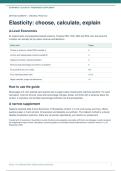
Elasticity: choose, calculate, explain
A-Level Economics
24 original tasks and separated worked solutions. Practise PED, YED, XED and PES, then test what the
numbers can actually tell you about revenue and decisions.
Study route Pages
Choose a measure; worked PED example A 2
Income and related goods; worked example B 3
Supply and context; worked example C 4
Revenue and percentage conventions; example D 5
Four practice sets of six tasks 6-9
Four matching solution sets 10-13
Repair checklist, scope and references 14
How to use the guide
Read pages 2-5, then attempt each practice set on paper before checking the matching solutions. For each
calculation, write the formula, show both percentage changes, divide, and finish with a sentence about the
context. A calculator and confident percentage arithmetic are the prerequisites.
A narrow supplement
Supports selected AQA A-level Economics 7136 elasticity content. It is not a full-course summary, official
question paper or mark scheme. All scenarios and datasets are synthetic. The midpoint method is a clearly
labelled comparison extension; follow any convention specified by your teacher or assessment.
Created with AI assistance. Quantitative results checked using separate executable arithmetic and all pages visually reviewed.
No independent expert review, attendance, achieved grade or examination-board endorsement is claimed. Version 1.0, 22
September 2026.
Version 1.0 | September 2026 | Original methods and practice 1
, ECONOMICS / ELASTICITY / INDEPENDENT SUPPLEMENT
01 / CHOOSE THE RATIO
The response goes on top
Elasticity compares percentage changes. First name what responds, then name what changes to cause that
response. Keep other relevant influences fixed in the model.
Measure Numerator: response Denominator: cause
PED % change in quantity demanded % change in own price
YED % change in quantity demanded % change in income
XED of A to B % change in quantity demanded of A % change in price of B
PES % change in quantity supplied % change in own price
Calculation convention
Unless a task says midpoint, use initial values: percentage change = (new - old) / old x 100. Keep signs until
the interpretation. Elasticity is a ratio, with no currency unit and no final percent sign. Do not divide a raw
quantity change by a price percentage.
Worked example A: a printing service
Price rises from GBP 12 to GBP 15; monthly orders fall from 180 to 126. Price change = 3/12 x 100 = +25%.
Quantity change = -54/180 x 100 = -30%. PED = -30/25 = -1.2. Demand is elastic on this initial-base
measure: quantity is more responsive proportionately than price.
Read the sign and the size separately
For ordinary downward-sloping demand, signed PED is negative. Compare its magnitude with 1: below 1 is
inelastic, equal to 1 is unit elastic, above 1 is elastic. A PED of zero describes no quantity response to the
measured nonzero price change. Perfectly elastic demand is a limiting horizontal-curve case, not a result you
obtain by dividing by zero in an observed dataset.
Check the claim
If an item sells more units after a price cut, that fact alone does not mean demand is elastic. You need both
percentage changes. If income, tastes or events changed too, the observed pair of values may not isolate the
own-price response.
Version 1.0 | September 2026 | Original methods and practice 2

