
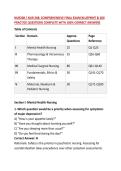
NUR208 / NUR 208: COMPREHENSIVE FINAL EXAM BLUEPRINT & 200
PRACTICE QUESTIONS COMPLETE WITH 100% CORRECT ANSWERS
Table of Contents
Section Domain Approx. Page
Questions Reference
I Mental Health Nursing 25 Q1-Q25
II Pharmacology & Intravenous 35 Q26-Q60
Therapy
III Medical-Surgical Nursing 80 Q61-Q140
IV Fundamentals, Ethics & 30 Q141-Q170
Safety
V Maternal, Newborn & 30 Q171-Q200
Pediatric Nursing
Section I: Mental Health Nursing
1. Which question would be a priority when assessing for symptoms
of major depression?
A) "How is your appetite lately?"
B) "Have you thought about harming yourself?"
C) "Are you sleeping more than usual?"
D) "Do you feel tired during the day?"
Correct Answer: B
Rationale: Safety is the priority in psychiatric nursing. Assessing for
suicidal ideation takes precedence over other symptom assessments.
,2. A nurse is assessing a patient with bipolar disorder experiencing
acute mania. Which finding should the nurse expect?
A) Decreased need for sleep
B) Psychomotor retardation
C) Anhedonia
D) Hypotension
Correct Answer: A
Rationale: Acute mania is characterized by decreased need for sleep,
increased energy, grandiosity, and rapid speech.
3. A patient with schizophrenia is experiencing auditory
hallucinations. Which intervention should the nurse implement first?
A) Tell the patient the voices are not real
B) Ask the patient what the voices are saying
C) Distract the patient with a board game
D) Administer PRN antipsychotic medication
Correct Answer: B
Rationale: Assessing the content of the hallucinations helps determine
if they are command hallucinations, which could indicate a risk for harm
to self or others.
4. A nurse is caring for a patient experiencing severe anxiety. Which
physical symptom should the nurse expect?
A) Bradycardia
B) Hypotension
C) Tachycardia
D) Hypothermia
Correct Answer: C
Rationale: Severe anxiety triggers the sympathetic nervous system,
leading to tachycardia, hypertension, and tachypnea.
,5. Which finding indicates a patient taking lithium for bipolar disorder
is experiencing toxicity?
A) Serum lithium level of 0.8 mEq/L
B) Fine hand tremors
C) Coarse hand tremors and vomiting
D) Increased appetite
Correct Answer: C
Rationale: Coarse hand tremors, vomiting, and ataxia are signs of
lithium toxicity. Therapeutic range is 0.6 to 1.2 mEq/L.
6. A patient starting an SSRI for depression asks how long it will take
to feel better. What is the nurse's best response?
A) "You will feel the full effects within 24 hours."
B) "It usually takes 2 to 4 weeks to see therapeutic effects."
C) "You should feel better after your first dose."
D) "Medications only work if you attend therapy."
Correct Answer: B
Rationale: SSRIs typically take 2 to 4 weeks to reach full therapeutic
effect. Patients should be monitored for increased suicidal ideation
during this initial period.
7. A nurse is teaching a patient about MAOIs. Which statement
indicates a need for further teaching?
A) "I should avoid aged cheese and red wine."
B) "I can take over-the-counter cold medications."
C) "I need to avoid tyramine-containing foods."
D) "I should report severe headaches immediately."
Correct Answer: B
Rationale: Over-the-counter cold medications often contain
, sympathomimetics, which can precipitate a hypertensive crisis when
combined with MAOIs.
8. Which symptom is a priority for a nurse to assess in a patient
experiencing alcohol withdrawal?
A) Nausea
B) Tremors
C) Seizures
D) Diaphoresis
Correct Answer: C
Rationale: Alcohol withdrawal can progress to seizures, delirium
tremens, and cardiovascular collapse, making seizure prevention and
monitoring the priority.
9. A patient with anorexia nervosa is admitted to the unit. Which
intervention is most appropriate initially?
A) Weigh the patient daily after breakfast
B) Monitor vital signs and electrolyte levels
C) Allow the patient to choose their own meals
D) Encourage vigorous exercise
Correct Answer: B
Rationale: Physiological stabilization, including monitoring for refeeding
syndrome and electrolyte imbalances (e.g., hypokalemia), is the priority.
10. A nurse is assessing a patient with PTSD. Which symptom is
commonly associated with this disorder?
A) Hypervigilance
B) Grandiosity
C) Apathy
D) Compulsions
PRACTICE QUESTIONS COMPLETE WITH 100% CORRECT ANSWERS
Table of Contents
Section Domain Approx. Page
Questions Reference
I Mental Health Nursing 25 Q1-Q25
II Pharmacology & Intravenous 35 Q26-Q60
Therapy
III Medical-Surgical Nursing 80 Q61-Q140
IV Fundamentals, Ethics & 30 Q141-Q170
Safety
V Maternal, Newborn & 30 Q171-Q200
Pediatric Nursing
Section I: Mental Health Nursing
1. Which question would be a priority when assessing for symptoms
of major depression?
A) "How is your appetite lately?"
B) "Have you thought about harming yourself?"
C) "Are you sleeping more than usual?"
D) "Do you feel tired during the day?"
Correct Answer: B
Rationale: Safety is the priority in psychiatric nursing. Assessing for
suicidal ideation takes precedence over other symptom assessments.
,2. A nurse is assessing a patient with bipolar disorder experiencing
acute mania. Which finding should the nurse expect?
A) Decreased need for sleep
B) Psychomotor retardation
C) Anhedonia
D) Hypotension
Correct Answer: A
Rationale: Acute mania is characterized by decreased need for sleep,
increased energy, grandiosity, and rapid speech.
3. A patient with schizophrenia is experiencing auditory
hallucinations. Which intervention should the nurse implement first?
A) Tell the patient the voices are not real
B) Ask the patient what the voices are saying
C) Distract the patient with a board game
D) Administer PRN antipsychotic medication
Correct Answer: B
Rationale: Assessing the content of the hallucinations helps determine
if they are command hallucinations, which could indicate a risk for harm
to self or others.
4. A nurse is caring for a patient experiencing severe anxiety. Which
physical symptom should the nurse expect?
A) Bradycardia
B) Hypotension
C) Tachycardia
D) Hypothermia
Correct Answer: C
Rationale: Severe anxiety triggers the sympathetic nervous system,
leading to tachycardia, hypertension, and tachypnea.
,5. Which finding indicates a patient taking lithium for bipolar disorder
is experiencing toxicity?
A) Serum lithium level of 0.8 mEq/L
B) Fine hand tremors
C) Coarse hand tremors and vomiting
D) Increased appetite
Correct Answer: C
Rationale: Coarse hand tremors, vomiting, and ataxia are signs of
lithium toxicity. Therapeutic range is 0.6 to 1.2 mEq/L.
6. A patient starting an SSRI for depression asks how long it will take
to feel better. What is the nurse's best response?
A) "You will feel the full effects within 24 hours."
B) "It usually takes 2 to 4 weeks to see therapeutic effects."
C) "You should feel better after your first dose."
D) "Medications only work if you attend therapy."
Correct Answer: B
Rationale: SSRIs typically take 2 to 4 weeks to reach full therapeutic
effect. Patients should be monitored for increased suicidal ideation
during this initial period.
7. A nurse is teaching a patient about MAOIs. Which statement
indicates a need for further teaching?
A) "I should avoid aged cheese and red wine."
B) "I can take over-the-counter cold medications."
C) "I need to avoid tyramine-containing foods."
D) "I should report severe headaches immediately."
Correct Answer: B
Rationale: Over-the-counter cold medications often contain
, sympathomimetics, which can precipitate a hypertensive crisis when
combined with MAOIs.
8. Which symptom is a priority for a nurse to assess in a patient
experiencing alcohol withdrawal?
A) Nausea
B) Tremors
C) Seizures
D) Diaphoresis
Correct Answer: C
Rationale: Alcohol withdrawal can progress to seizures, delirium
tremens, and cardiovascular collapse, making seizure prevention and
monitoring the priority.
9. A patient with anorexia nervosa is admitted to the unit. Which
intervention is most appropriate initially?
A) Weigh the patient daily after breakfast
B) Monitor vital signs and electrolyte levels
C) Allow the patient to choose their own meals
D) Encourage vigorous exercise
Correct Answer: B
Rationale: Physiological stabilization, including monitoring for refeeding
syndrome and electrolyte imbalances (e.g., hypokalemia), is the priority.
10. A nurse is assessing a patient with PTSD. Which symptom is
commonly associated with this disorder?
A) Hypervigilance
B) Grandiosity
C) Apathy
D) Compulsions

