
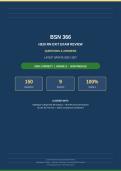
BSN 366
HESI RN EXIT EXAM REVIEW
QUESTIONS & ANSWERS
LATEST UPDATE
100% CORRECT | GRADE A - NIGHTINGALE
150 9 100%
Questions Sections Grade A
ALIGNED WITH:
Nightingale College BSN 366 Syllabus | HESI RN Exit Exam Blueprint
NCLEX-RN Test Plan | QSEN Competencies (2026/2027)
Comprehensive Exit Examination Review
Nightingale College | Bachelor of Science in Nursing (BSN) Program
For Educational Use - BSN 366 Course
,BSN 366 - HESI RN Exit Exam Review (2026/2027) Nightingale College | Grade A
BSN 366 HESI RN EXIT EXAM REVIEW
Questions & Answers - Latest Update
150 Questions | 9 Sections | 100% Correct | Grade A - Nightingale
Aligned With: Nightingale College BSN 366 Course Syllabus, HESI RN Exit Exam Blueprint, NCLEX-RN Test Plan, and QSEN
Competencies (2026/2027 Edition). Cognitive Distribution: 20% Recall, 50% Application, 30% Analysis. Format: 75%
scenario-based, 25% direct knowledge. Includes 20 priority-setting, 15 pharmacology, 10 delegation questions, and 5 integrated case
studies.
SECTION 1: Management of Care Q1-Q20
*Q1:* A 78-year-old client with terminal cancer is alert and oriented. The client's adult daughter demands that
the nurse not tell her father his diagnosis, stating, "It will kill him." Which action by the nurse best demonstrates
advocacy and the ethical principle of autonomy?
A. Honor the daughter's request to protect the client from emotional harm.
B. Inform the daughter that the client has the right to know his diagnosis if he asks. *[CORRECT]*
C. Document the daughter's request and avoid discussing the diagnosis with the client.
D. Tell the client his diagnosis immediately to ensure full disclosure.
Correct Answer: B
Rationale:
Autonomy requires that competent clients receive truthful information about their condition. The nurse advocates by
acknowledging the family's concern while clarifying that the client has the right to know. Option A violates autonomy and
veracity; C avoids the issue; D disregards cultural/family dynamics and could be emotionally harmful. The BSN 366 curriculum
and ANA Code of Ethics emphasize client self-determination.
*Q2:* A client scheduled for an elective cholecystectomy refuses to sign the surgical consent after the surgeon has
explained the procedure. What is the nurse's most appropriate initial action?
A. Notify the operating room to cancel the surgery.
B. Ask the client to explain concerns and notify the surgeon of the refusal. *[CORRECT]*
C. Encourage the client to sign so the scheduled surgery can proceed.
D. Document the refusal and witness the client's signature on the refusal form.
Correct Answer: B
Rationale:
Informed consent requires understanding and voluntary agreement. The nurse's role is to assess the client's understanding, explore
concerns, and notify the surgeon so additional explanation can occur. The nurse does NOT coerce (C) or merely document (D)
without further assessment. Canceling (A) is premature without surgeon reassessment. This reflects HESI Exit standards for
advocacy and informed consent.
*Q3:* A client with a living will specifying no artificial nutrition or hydration is admitted unconscious after a
stroke. The family insists on placing a feeding tube. Which action should the nurse take first?
A. Insert the feeding tube as requested by the family.
100% Correct | Grade A - Nightingale Page 2
,BSN 366 - HESI RN Exit Exam Review (2026/2027) Nightingale College | Grade A
B. Contact the health care provider (HCP) to clarify the client's advance directive.
C. Explain to the family that the living will must be followed. *[CORRECT]*
D. Ask the ethics committee to convene an emergency meeting.
Correct Answer: C
Rationale:
Advance directives are legal documents that must be honored when the client lacks decision-making capacity. The nurse's first
action is to explain the legal obligation to follow the directive. Contacting the HCP (B) is appropriate but follows the immediate
family explanation. Inserting the tube (A) violates the directive; ethics committee (D) is premature unless conflict persists. BSN
366 emphasizes Patient Self-Determination Act compliance.
*Q4:* A nurse discovers that a colleague has been documenting medications as given when they were actually
wasted. After reporting the issue to the nurse manager, the manager takes no action. What should the nurse do
next according to the Nurse Practice Act and mandatory reporting requirements?
A. Report the colleague directly to the state Board of Nursing. *[CORRECT]*
B. Continue monitoring the colleague and document additional observations.
C. Confront the colleague directly about the documentation discrepancy.
D. Transfer to a different unit to avoid further involvement.
Correct Answer: A
Rationale:
Falsification of medical records is a violation of the Nurse Practice Act and constitutes professional misconduct. When internal
reporting fails, the nurse has a legal and ethical obligation to report to the state Board of Nursing. Option B delays appropriate
action; C may compromise an investigation; D avoids professional responsibility. This is consistent with NCLEX-RN legal/ethical
standards and QSEN safety competencies.
*Q5:* A client is admitted with severe abdominal pain and requests that no information be shared with family
members. Later, the client's spouse calls the unit asking for an update. Which response by the nurse is most
appropriate?
A. Provide general information only, such as the client's room number.
B. Inform the spouse that the client has requested no information be shared. *[CORRECT]*
C. Transfer the call to the client so they can decide what to share.
D. Ask the spouse to come in person to receive information.
Correct Answer: B
Rationale:
HIPAA protects client privacy, and the nurse must honor the client's explicit request not to share information. Option B respects
the client's autonomy while remaining courteous. Option A violates HIPAA; C places the burden of communication on the client
during illness; D does not address the privacy request. This aligns with BSN 366 confidentiality requirements.
*Q6:* An RN on a medical-surgical unit is assigned the following clients. Which client should the RN assess
FIRST after receiving shift report?
A. A client 2 days postoperative with a temperature of 100.4°F (38°C).
B. A client with chronic kidney disease whose potassium is 5.8 mEq/L. *[CORRECT]*
C. A client with atrial fibrillation requesting medication for heartburn.
D. A client 4 hours post-colonoscopy reporting mild cramping.
Correct Answer: B
Rationale:
100% Correct | Grade A - Nightingale Page 3
, BSN 366 - HESI RN Exit Exam Review (2026/2027) Nightingale College | Grade A
Using the ABC (Airway, Breathing, Circulation) and acute-vs-chronic prioritization framework, the client with hyperkalemia (5.8
mEq/L) is at risk for life-threatening cardiac dysrhythmias and requires immediate assessment. A low-grade postoperative fever
(A) is expected; heartburn (C) is non-urgent; mild cramping post-colonoscopy (D) is typical. This reflects NCLEX-RN
prioritization principles taught in BSN 366.
*Q7:* Which of the following tasks is MOST appropriate for the RN to delegate to a licensed practical nurse
(LPN)?
A. Initial postoperative assessment of a client who had a total hip replacement 2 hours ago.
B. Administering oral medications to a stable client with type 2 diabetes. *[CORRECT]*
C. Developing a plan of care for a newly admitted client with heart failure.
D. Providing discharge teaching to a client starting warfarin therapy.
Correct Answer: B
Rationale:
The LPN scope of practice includes administering oral medications to stable clients. Initial postoperative assessment (A), care
plan development (C), and discharge teaching (D) require RN-level judgment and cannot be delegated. The RN retains
accountability for assessment, planning, and evaluation per the Five Rights of Delegation taught in BSN 366.
*Q8:* An RN is supervising a UAP (unlicensed assistive personnel). Which task is appropriate to delegate to the
UAP?
A. Measuring and recording vital signs on a stable postoperative client. *[CORRECT]*
B. Assessing a client's incision site for signs of infection.
C. Reinforcing teaching about a low-sodium diet.
D. Evaluating a client's response to a new pain medication.
Correct Answer: A
Rationale:
UAPs can perform routine, non-invasive tasks such as measuring vital signs on stable clients. Assessment (B), teaching
reinforcement (C), and evaluation (D) require nursing judgment and are RN responsibilities. The Five Rights of Delegation (right
task, right circumstance, right person, right communication, right supervision) guide this decision per BSN 366 delegation
principles.
*Q9:* A nurse-manager is making client assignments for the shift. Which assignment is MOST appropriate for an
LPN/LVN?
A. A newly admitted client with acute gastrointestinal bleeding.
B. A client requiring an initial assessment for chest pain.
C. A stable client receiving continuous tube feedings. *[CORRECT]*
D. A client who needs pre-operative teaching for a coronary bypass.
Correct Answer: C
Rationale:
LPN/LVN scope includes caring for stable clients with predictable outcomes, such as those receiving continuous tube feedings.
Clients with acute GI bleeding (A), chest pain (B), or requiring complex teaching (D) need RN-level assessment and judgment.
This follows the NCSBN delegation guidelines emphasized in the HESI Exit Exam blueprint.
*Q10:* A UAP reports that a client who is 2 days postoperative is refusing to ambulate. What is the RN's BEST
response?
A. Tell the UAP to document the refusal in the chart.
100% Correct | Grade A - Nightingale Page 4
HESI RN EXIT EXAM REVIEW
QUESTIONS & ANSWERS
LATEST UPDATE
100% CORRECT | GRADE A - NIGHTINGALE
150 9 100%
Questions Sections Grade A
ALIGNED WITH:
Nightingale College BSN 366 Syllabus | HESI RN Exit Exam Blueprint
NCLEX-RN Test Plan | QSEN Competencies (2026/2027)
Comprehensive Exit Examination Review
Nightingale College | Bachelor of Science in Nursing (BSN) Program
For Educational Use - BSN 366 Course
,BSN 366 - HESI RN Exit Exam Review (2026/2027) Nightingale College | Grade A
BSN 366 HESI RN EXIT EXAM REVIEW
Questions & Answers - Latest Update
150 Questions | 9 Sections | 100% Correct | Grade A - Nightingale
Aligned With: Nightingale College BSN 366 Course Syllabus, HESI RN Exit Exam Blueprint, NCLEX-RN Test Plan, and QSEN
Competencies (2026/2027 Edition). Cognitive Distribution: 20% Recall, 50% Application, 30% Analysis. Format: 75%
scenario-based, 25% direct knowledge. Includes 20 priority-setting, 15 pharmacology, 10 delegation questions, and 5 integrated case
studies.
SECTION 1: Management of Care Q1-Q20
*Q1:* A 78-year-old client with terminal cancer is alert and oriented. The client's adult daughter demands that
the nurse not tell her father his diagnosis, stating, "It will kill him." Which action by the nurse best demonstrates
advocacy and the ethical principle of autonomy?
A. Honor the daughter's request to protect the client from emotional harm.
B. Inform the daughter that the client has the right to know his diagnosis if he asks. *[CORRECT]*
C. Document the daughter's request and avoid discussing the diagnosis with the client.
D. Tell the client his diagnosis immediately to ensure full disclosure.
Correct Answer: B
Rationale:
Autonomy requires that competent clients receive truthful information about their condition. The nurse advocates by
acknowledging the family's concern while clarifying that the client has the right to know. Option A violates autonomy and
veracity; C avoids the issue; D disregards cultural/family dynamics and could be emotionally harmful. The BSN 366 curriculum
and ANA Code of Ethics emphasize client self-determination.
*Q2:* A client scheduled for an elective cholecystectomy refuses to sign the surgical consent after the surgeon has
explained the procedure. What is the nurse's most appropriate initial action?
A. Notify the operating room to cancel the surgery.
B. Ask the client to explain concerns and notify the surgeon of the refusal. *[CORRECT]*
C. Encourage the client to sign so the scheduled surgery can proceed.
D. Document the refusal and witness the client's signature on the refusal form.
Correct Answer: B
Rationale:
Informed consent requires understanding and voluntary agreement. The nurse's role is to assess the client's understanding, explore
concerns, and notify the surgeon so additional explanation can occur. The nurse does NOT coerce (C) or merely document (D)
without further assessment. Canceling (A) is premature without surgeon reassessment. This reflects HESI Exit standards for
advocacy and informed consent.
*Q3:* A client with a living will specifying no artificial nutrition or hydration is admitted unconscious after a
stroke. The family insists on placing a feeding tube. Which action should the nurse take first?
A. Insert the feeding tube as requested by the family.
100% Correct | Grade A - Nightingale Page 2
,BSN 366 - HESI RN Exit Exam Review (2026/2027) Nightingale College | Grade A
B. Contact the health care provider (HCP) to clarify the client's advance directive.
C. Explain to the family that the living will must be followed. *[CORRECT]*
D. Ask the ethics committee to convene an emergency meeting.
Correct Answer: C
Rationale:
Advance directives are legal documents that must be honored when the client lacks decision-making capacity. The nurse's first
action is to explain the legal obligation to follow the directive. Contacting the HCP (B) is appropriate but follows the immediate
family explanation. Inserting the tube (A) violates the directive; ethics committee (D) is premature unless conflict persists. BSN
366 emphasizes Patient Self-Determination Act compliance.
*Q4:* A nurse discovers that a colleague has been documenting medications as given when they were actually
wasted. After reporting the issue to the nurse manager, the manager takes no action. What should the nurse do
next according to the Nurse Practice Act and mandatory reporting requirements?
A. Report the colleague directly to the state Board of Nursing. *[CORRECT]*
B. Continue monitoring the colleague and document additional observations.
C. Confront the colleague directly about the documentation discrepancy.
D. Transfer to a different unit to avoid further involvement.
Correct Answer: A
Rationale:
Falsification of medical records is a violation of the Nurse Practice Act and constitutes professional misconduct. When internal
reporting fails, the nurse has a legal and ethical obligation to report to the state Board of Nursing. Option B delays appropriate
action; C may compromise an investigation; D avoids professional responsibility. This is consistent with NCLEX-RN legal/ethical
standards and QSEN safety competencies.
*Q5:* A client is admitted with severe abdominal pain and requests that no information be shared with family
members. Later, the client's spouse calls the unit asking for an update. Which response by the nurse is most
appropriate?
A. Provide general information only, such as the client's room number.
B. Inform the spouse that the client has requested no information be shared. *[CORRECT]*
C. Transfer the call to the client so they can decide what to share.
D. Ask the spouse to come in person to receive information.
Correct Answer: B
Rationale:
HIPAA protects client privacy, and the nurse must honor the client's explicit request not to share information. Option B respects
the client's autonomy while remaining courteous. Option A violates HIPAA; C places the burden of communication on the client
during illness; D does not address the privacy request. This aligns with BSN 366 confidentiality requirements.
*Q6:* An RN on a medical-surgical unit is assigned the following clients. Which client should the RN assess
FIRST after receiving shift report?
A. A client 2 days postoperative with a temperature of 100.4°F (38°C).
B. A client with chronic kidney disease whose potassium is 5.8 mEq/L. *[CORRECT]*
C. A client with atrial fibrillation requesting medication for heartburn.
D. A client 4 hours post-colonoscopy reporting mild cramping.
Correct Answer: B
Rationale:
100% Correct | Grade A - Nightingale Page 3
, BSN 366 - HESI RN Exit Exam Review (2026/2027) Nightingale College | Grade A
Using the ABC (Airway, Breathing, Circulation) and acute-vs-chronic prioritization framework, the client with hyperkalemia (5.8
mEq/L) is at risk for life-threatening cardiac dysrhythmias and requires immediate assessment. A low-grade postoperative fever
(A) is expected; heartburn (C) is non-urgent; mild cramping post-colonoscopy (D) is typical. This reflects NCLEX-RN
prioritization principles taught in BSN 366.
*Q7:* Which of the following tasks is MOST appropriate for the RN to delegate to a licensed practical nurse
(LPN)?
A. Initial postoperative assessment of a client who had a total hip replacement 2 hours ago.
B. Administering oral medications to a stable client with type 2 diabetes. *[CORRECT]*
C. Developing a plan of care for a newly admitted client with heart failure.
D. Providing discharge teaching to a client starting warfarin therapy.
Correct Answer: B
Rationale:
The LPN scope of practice includes administering oral medications to stable clients. Initial postoperative assessment (A), care
plan development (C), and discharge teaching (D) require RN-level judgment and cannot be delegated. The RN retains
accountability for assessment, planning, and evaluation per the Five Rights of Delegation taught in BSN 366.
*Q8:* An RN is supervising a UAP (unlicensed assistive personnel). Which task is appropriate to delegate to the
UAP?
A. Measuring and recording vital signs on a stable postoperative client. *[CORRECT]*
B. Assessing a client's incision site for signs of infection.
C. Reinforcing teaching about a low-sodium diet.
D. Evaluating a client's response to a new pain medication.
Correct Answer: A
Rationale:
UAPs can perform routine, non-invasive tasks such as measuring vital signs on stable clients. Assessment (B), teaching
reinforcement (C), and evaluation (D) require nursing judgment and are RN responsibilities. The Five Rights of Delegation (right
task, right circumstance, right person, right communication, right supervision) guide this decision per BSN 366 delegation
principles.
*Q9:* A nurse-manager is making client assignments for the shift. Which assignment is MOST appropriate for an
LPN/LVN?
A. A newly admitted client with acute gastrointestinal bleeding.
B. A client requiring an initial assessment for chest pain.
C. A stable client receiving continuous tube feedings. *[CORRECT]*
D. A client who needs pre-operative teaching for a coronary bypass.
Correct Answer: C
Rationale:
LPN/LVN scope includes caring for stable clients with predictable outcomes, such as those receiving continuous tube feedings.
Clients with acute GI bleeding (A), chest pain (B), or requiring complex teaching (D) need RN-level assessment and judgment.
This follows the NCSBN delegation guidelines emphasized in the HESI Exit Exam blueprint.
*Q10:* A UAP reports that a client who is 2 days postoperative is refusing to ambulate. What is the RN's BEST
response?
A. Tell the UAP to document the refusal in the chart.
100% Correct | Grade A - Nightingale Page 4

