
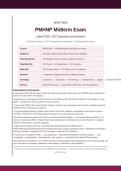
NRNP 6665
PMHNP Midterm Exam
Latest Questions and Answers
(Verified Answers) • 150 Comprehensive Questions • 9 Competency Sections
Course NRNP 6665 — PMHNP Midterm (Walden University)
Audience Psychiatric-Mental Health Nurse Practitioner candidates
Total Questions 150 Multiple-Choice (4 options, single best answer)
Cognitive Mix 25% Recall | 55% Application | 20% Analysis
Style Mix 75% Scenario-based | 25% Direct recall / mechanism
Sections 9 competency-aligned sections per midterm blueprint
Coverage Foundations → Assessment → Neurobiology → Antidepressants → Bipolar → Anxiety/OCD/PTS
Version 2026/2027 Revised — current DSM-5-TR, FDA, and APA guidelines
Examination Instructions
• Each question has ONE best answer. Select the single option that best reflects entry-level PMHNP clinical judgment per
current APA and DSM-5-TR standards.
• Rationales are verified against DSM-5-TR criteria, FDA labeling, and APA Practice Guidelines. They double as a study
guide — read them all, even for questions answered correctly.
• Always apply DSM-5-TR criteria explicitly: duration, symptom count, impairment, and exclusion of substances/medical
conditions before committing to a diagnosis.
• For pharmacology questions, consider patient-specific factors first: diagnosis, comorbidities, organ function, genetics
(CYP2D6, CYP2C19, HLA-B*1502), pregnancy/lactation status, and concurrent medications.
• Master the commonly confused pairs: NMS vs. Serotonin Syndrome (rigidity vs. clonus/hyperreflexia), Bipolar I vs. II
(mania vs. hypomania), MDD vs. Bipolar depression (antidepressant monotherapy risks switch), Akathisia vs. Agitation
(subjective restlessness vs. psychotic agitation).
• High-yield interactions: tamoxifen + paroxetine/fluoxetine/bupropion (CYP2D6); MAOI +
SSRIs/SNRIs/tramadol/meperidine/dextromethorphan/linezolid (serotonin syndrome); lithium + NSAIDs/ACE-I/thiazides
(toxicity); clozapine + smoking (CYP1A2); lamotrigine + valproate (UGT inhibition).
• For psychiatric emergencies: NMS → stop antipsychotic + dantrolene/bromocriptine; Serotonin syndrome → stop
serotonergics + cyproheptadine + benzodiazepine; acute agitation → de-escalation first, then PO/IM medication.
• Risk assessment is mandatory: use C-SSRS for suicide, document specific behaviors/plan/intent, ensure safety planning, and
know state-specific involuntary commitment criteria (danger to self/others or grave disability).
Verified for A+ midterm preparation. Master PMHNP clinical reasoning — your patients deserve evidence-based, compassionate
psychiatric care.
,NRNP 6665 — PMHNP Midterm Exam Latest 2026/2027 | 150 Questions | Verified Answers
Section 1: Foundations of PMHNP Practice
Scope of practice, licensure, ethical principles, informed consent, confidentiality, Tarasoff duty to warn, therapeutic
relationships, boundaries, and transference/countertransference.
Q1: A PMHNP in independent practice receives a subpoena for a patient’s psychotherapy notes. The
patient has not authorized release. What is the most appropriate response?
A. Release the notes because a subpoena overrides confidentiality
B. Assert psychotherapy notes privilege under HIPAA; require patient authorization or a court order
before releasing [CORRECT]
C. Release only the medication list and diagnosis
D. Ignore the subpoena
Correct Answer: B
Rationale: Under HIPAA, psychotherapy notes (process notes kept separate from the medical record) receive heightened
protection — they require patient authorization for release, even with a subpoena. A court order would be required to
compel disclosure. Progress notes, diagnosis, medications, and treatment plans are part of the designated record set and
have standard protections. Consult risk management/legal counsel and document the response.
Q2: A patient in outpatient therapy tells the PMHNP, "I’m going to kill my ex-wife when she gets off work
Friday." The PMHNP’s legal obligation under Tarasoff is to:
A. Maintain strict confidentiality; do nothing
B. Warn the identifiable victim and notify law enforcement; document the assessment and actions taken
[CORRECT]
C. Only document the threat in the chart
D. Have the patient sign a no-harm contract
Correct Answer: B
Rationale: Tarasoff duty (California case law, adopted in most states) establishes a duty to protect identifiable third parties
when a patient makes a credible threat. The PMHNP must take reasonable steps: warn the intended victim, notify law
enforcement, and consider hospitalization. No-harm contracts have NO legal standing and do not fulfill the duty. Document
threat assessment, victim identifiability, and all protective actions. State law specifics vary.
Q3: A 19-year-old college student with new-onset depression refuses medication, stating, "I want to handle
this myself." The PMHNP’s ethical obligation is to:
A. Prescribe antidepressants anyway because the patient is depressed
B. Respect the patient’s autonomy; provide psychoeducation, discuss evidence-based options including
therapy, assess decisional capacity, and document the informed refusal [CORRECT]
C. Notify the parents so they can insist on treatment
D. Discharge the patient from the practice
Correct Answer: B
Rationale: Autonomy is a foundational ethical principle. A competent adult patient has the right to refuse treatment. The
PMHNP ensures decisional capacity, provides informed refusal education (risks of untreated illness, alternatives like
therapy, warning signs), documents the discussion and reasoning, and arranges follow-up. violates autonomy.
Confidentiality precludes notifying parents of an adult. Continuity of care precludes discharge without transition.
Walden PMHNP — Midterm Exam Questions and Answers (Verified) Page 2
,NRNP 6665 — PMHNP Midterm Exam Latest 2026/2027 | 150 Questions | Verified Answers
Q4: During a therapy session, a patient repeatedly asks the PMHNP personal questions and tries to extend
sessions beyond the scheduled time. The PMHNP’s most appropriate response is to:
A. Answer personal questions to build rapport
B. Explore the behavior as possible transference, gently re-establish boundaries, and discuss the
therapeutic frame [CORRECT]
C. Terminate therapy immediately
D. Extend sessions to meet the patient’s needs
Correct Answer: B
Rationale: Boundary crossings should be explored therapeutically rather than ignored or acted on. The behavior may
reflect transference (unconscious redirection of feelings from past relationships onto the therapist). Re-establish the frame
(session length, professional role), explore the meaning, and use the discussion to advance therapy. Persistent boundary
violations require termination with proper transition, but exploration is the first step.
Q5: A PMHNP prescribes controlled substances to a patient. Per DEA regulations, which statement is
correct?
A. Schedule II prescriptions may be refilled
B. Schedule II prescriptions cannot be refilled; must be a new prescription each time; partial fills allowed
under specific conditions [CORRECT]
C. Schedule IV drugs have the highest abuse potential
D. DEA registration is optional for PMHNPs
Correct Answer: B
Rationale: Schedule II (stimulants, opioids) cannot be refilled — a new prescription is required each time. Partial fills of
Schedule II are permitted under the Comprehensive Addiction and Recovery Act (CARA) with a 30-day supply default.
Schedule II = highest abuse potential with accepted medical use; Schedule V = lowest. DEA registration is required for any
PMHNP prescribing controlled substances. Check state scope and prescribing authority; some states require collaborative
agreements.
Q6: A patient with schizophrenia is brought to the ER by family. The patient is agitated, has not eaten in 5
days, and believes the FBI is poisoning the water. The patient refuses voluntary admission. Which criterion
supports involuntary hospitalization?
A. Presence of psychosis alone
B. Grave disability (inability to provide food, clothing, shelter due to mental illness) and/or danger to
self/others [CORRECT]
C. Lack of insight
D. Family request
Correct Answer: B
Rationale: Involuntary hospitalization criteria (vary by state, generally): danger to self (suicidal), danger to others
(homicidal), or grave disability (inability to provide food, clothing, shelter as a result of mental illness). Psychosis alone or
lack of insight is insufficient. Family request does not override patient autonomy. The patient retains due process rights
(hearing, attorney, periodic review). Document the specific behaviors supporting the commitment.
Walden PMHNP — Midterm Exam Questions and Answers (Verified) Page 3
, NRNP 6665 — PMHNP Midterm Exam Latest 2026/2027 | 150 Questions | Verified Answers
Q7: A patient expresses strong positive feelings toward the PMHNP, idealizing them as the "perfect
healer." This phenomenon is best described as:
A. Countertransference
B. Positive transference (unconscious redirection of feelings from past relationships onto the therapist)
[CORRECT]
C. Therapeutic alliance
D. Boundary violation
Correct Answer: B
Rationale: Transference is the patient’s unconscious redirection of feelings from significant past relationships onto the
therapist. Positive transference (idealization, love, admiration) can be used therapeutically to explore relationship patterns.
Countertransference is the therapist’s emotional reaction to the patient. Therapeutic alliance is the conscious collaborative
relationship. Boundary violation is an ethical breach, not an unconscious process.
Q8: A PMHNP feels unusually angry and resentful toward a patient with borderline personality disorder
who frequently calls between sessions. This emotional reaction is best described as:
A. Transference
B. Countertransference (therapist’s emotional reaction to the patient, often reflecting patient’s
interpersonal patterns) [CORRECT]
C. Compassion fatigue
D. Boundary crossing
Correct Answer: B
Rationale: Countertransference is the therapist’s emotional reaction to the patient, often evoked by the patient’s
interpersonal style (e.g., anger in response to a borderline patient’s clinginess). It is a useful clinical signal — the patient
likely evokes similar reactions in others, contributing to their relational difficulties. PMHNPs should use
supervision/consultation to manage countertransference therapeutically rather than acting on it.
Q9: A PMHNP is asked to evaluate a 16-year-old for antidepressant medication. Who must provide
informed consent?
A. Only the 16-year-old
B. Parent or legal guardian; assent from the minor when developmentally appropriate [CORRECT]
C. The school counselor
D. No consent required for minors
Correct Answer: B
Rationale: For minors, parent/guardian consent is generally required for psychiatric treatment. Assent (age-appropriate
agreement) from the minor should also be sought. State laws vary on minor consent for mental health (some states allow
minors 12+ to consent to outpatient therapy). Verify your state’s minor consent laws. Document consent/assent discussion,
risks/benefits/alternatives, and FDA black box warning (suicidality in <24).
Walden PMHNP — Midterm Exam Questions and Answers (Verified) Page 4
PMHNP Midterm Exam
Latest Questions and Answers
(Verified Answers) • 150 Comprehensive Questions • 9 Competency Sections
Course NRNP 6665 — PMHNP Midterm (Walden University)
Audience Psychiatric-Mental Health Nurse Practitioner candidates
Total Questions 150 Multiple-Choice (4 options, single best answer)
Cognitive Mix 25% Recall | 55% Application | 20% Analysis
Style Mix 75% Scenario-based | 25% Direct recall / mechanism
Sections 9 competency-aligned sections per midterm blueprint
Coverage Foundations → Assessment → Neurobiology → Antidepressants → Bipolar → Anxiety/OCD/PTS
Version 2026/2027 Revised — current DSM-5-TR, FDA, and APA guidelines
Examination Instructions
• Each question has ONE best answer. Select the single option that best reflects entry-level PMHNP clinical judgment per
current APA and DSM-5-TR standards.
• Rationales are verified against DSM-5-TR criteria, FDA labeling, and APA Practice Guidelines. They double as a study
guide — read them all, even for questions answered correctly.
• Always apply DSM-5-TR criteria explicitly: duration, symptom count, impairment, and exclusion of substances/medical
conditions before committing to a diagnosis.
• For pharmacology questions, consider patient-specific factors first: diagnosis, comorbidities, organ function, genetics
(CYP2D6, CYP2C19, HLA-B*1502), pregnancy/lactation status, and concurrent medications.
• Master the commonly confused pairs: NMS vs. Serotonin Syndrome (rigidity vs. clonus/hyperreflexia), Bipolar I vs. II
(mania vs. hypomania), MDD vs. Bipolar depression (antidepressant monotherapy risks switch), Akathisia vs. Agitation
(subjective restlessness vs. psychotic agitation).
• High-yield interactions: tamoxifen + paroxetine/fluoxetine/bupropion (CYP2D6); MAOI +
SSRIs/SNRIs/tramadol/meperidine/dextromethorphan/linezolid (serotonin syndrome); lithium + NSAIDs/ACE-I/thiazides
(toxicity); clozapine + smoking (CYP1A2); lamotrigine + valproate (UGT inhibition).
• For psychiatric emergencies: NMS → stop antipsychotic + dantrolene/bromocriptine; Serotonin syndrome → stop
serotonergics + cyproheptadine + benzodiazepine; acute agitation → de-escalation first, then PO/IM medication.
• Risk assessment is mandatory: use C-SSRS for suicide, document specific behaviors/plan/intent, ensure safety planning, and
know state-specific involuntary commitment criteria (danger to self/others or grave disability).
Verified for A+ midterm preparation. Master PMHNP clinical reasoning — your patients deserve evidence-based, compassionate
psychiatric care.
,NRNP 6665 — PMHNP Midterm Exam Latest 2026/2027 | 150 Questions | Verified Answers
Section 1: Foundations of PMHNP Practice
Scope of practice, licensure, ethical principles, informed consent, confidentiality, Tarasoff duty to warn, therapeutic
relationships, boundaries, and transference/countertransference.
Q1: A PMHNP in independent practice receives a subpoena for a patient’s psychotherapy notes. The
patient has not authorized release. What is the most appropriate response?
A. Release the notes because a subpoena overrides confidentiality
B. Assert psychotherapy notes privilege under HIPAA; require patient authorization or a court order
before releasing [CORRECT]
C. Release only the medication list and diagnosis
D. Ignore the subpoena
Correct Answer: B
Rationale: Under HIPAA, psychotherapy notes (process notes kept separate from the medical record) receive heightened
protection — they require patient authorization for release, even with a subpoena. A court order would be required to
compel disclosure. Progress notes, diagnosis, medications, and treatment plans are part of the designated record set and
have standard protections. Consult risk management/legal counsel and document the response.
Q2: A patient in outpatient therapy tells the PMHNP, "I’m going to kill my ex-wife when she gets off work
Friday." The PMHNP’s legal obligation under Tarasoff is to:
A. Maintain strict confidentiality; do nothing
B. Warn the identifiable victim and notify law enforcement; document the assessment and actions taken
[CORRECT]
C. Only document the threat in the chart
D. Have the patient sign a no-harm contract
Correct Answer: B
Rationale: Tarasoff duty (California case law, adopted in most states) establishes a duty to protect identifiable third parties
when a patient makes a credible threat. The PMHNP must take reasonable steps: warn the intended victim, notify law
enforcement, and consider hospitalization. No-harm contracts have NO legal standing and do not fulfill the duty. Document
threat assessment, victim identifiability, and all protective actions. State law specifics vary.
Q3: A 19-year-old college student with new-onset depression refuses medication, stating, "I want to handle
this myself." The PMHNP’s ethical obligation is to:
A. Prescribe antidepressants anyway because the patient is depressed
B. Respect the patient’s autonomy; provide psychoeducation, discuss evidence-based options including
therapy, assess decisional capacity, and document the informed refusal [CORRECT]
C. Notify the parents so they can insist on treatment
D. Discharge the patient from the practice
Correct Answer: B
Rationale: Autonomy is a foundational ethical principle. A competent adult patient has the right to refuse treatment. The
PMHNP ensures decisional capacity, provides informed refusal education (risks of untreated illness, alternatives like
therapy, warning signs), documents the discussion and reasoning, and arranges follow-up. violates autonomy.
Confidentiality precludes notifying parents of an adult. Continuity of care precludes discharge without transition.
Walden PMHNP — Midterm Exam Questions and Answers (Verified) Page 2
,NRNP 6665 — PMHNP Midterm Exam Latest 2026/2027 | 150 Questions | Verified Answers
Q4: During a therapy session, a patient repeatedly asks the PMHNP personal questions and tries to extend
sessions beyond the scheduled time. The PMHNP’s most appropriate response is to:
A. Answer personal questions to build rapport
B. Explore the behavior as possible transference, gently re-establish boundaries, and discuss the
therapeutic frame [CORRECT]
C. Terminate therapy immediately
D. Extend sessions to meet the patient’s needs
Correct Answer: B
Rationale: Boundary crossings should be explored therapeutically rather than ignored or acted on. The behavior may
reflect transference (unconscious redirection of feelings from past relationships onto the therapist). Re-establish the frame
(session length, professional role), explore the meaning, and use the discussion to advance therapy. Persistent boundary
violations require termination with proper transition, but exploration is the first step.
Q5: A PMHNP prescribes controlled substances to a patient. Per DEA regulations, which statement is
correct?
A. Schedule II prescriptions may be refilled
B. Schedule II prescriptions cannot be refilled; must be a new prescription each time; partial fills allowed
under specific conditions [CORRECT]
C. Schedule IV drugs have the highest abuse potential
D. DEA registration is optional for PMHNPs
Correct Answer: B
Rationale: Schedule II (stimulants, opioids) cannot be refilled — a new prescription is required each time. Partial fills of
Schedule II are permitted under the Comprehensive Addiction and Recovery Act (CARA) with a 30-day supply default.
Schedule II = highest abuse potential with accepted medical use; Schedule V = lowest. DEA registration is required for any
PMHNP prescribing controlled substances. Check state scope and prescribing authority; some states require collaborative
agreements.
Q6: A patient with schizophrenia is brought to the ER by family. The patient is agitated, has not eaten in 5
days, and believes the FBI is poisoning the water. The patient refuses voluntary admission. Which criterion
supports involuntary hospitalization?
A. Presence of psychosis alone
B. Grave disability (inability to provide food, clothing, shelter due to mental illness) and/or danger to
self/others [CORRECT]
C. Lack of insight
D. Family request
Correct Answer: B
Rationale: Involuntary hospitalization criteria (vary by state, generally): danger to self (suicidal), danger to others
(homicidal), or grave disability (inability to provide food, clothing, shelter as a result of mental illness). Psychosis alone or
lack of insight is insufficient. Family request does not override patient autonomy. The patient retains due process rights
(hearing, attorney, periodic review). Document the specific behaviors supporting the commitment.
Walden PMHNP — Midterm Exam Questions and Answers (Verified) Page 3
, NRNP 6665 — PMHNP Midterm Exam Latest 2026/2027 | 150 Questions | Verified Answers
Q7: A patient expresses strong positive feelings toward the PMHNP, idealizing them as the "perfect
healer." This phenomenon is best described as:
A. Countertransference
B. Positive transference (unconscious redirection of feelings from past relationships onto the therapist)
[CORRECT]
C. Therapeutic alliance
D. Boundary violation
Correct Answer: B
Rationale: Transference is the patient’s unconscious redirection of feelings from significant past relationships onto the
therapist. Positive transference (idealization, love, admiration) can be used therapeutically to explore relationship patterns.
Countertransference is the therapist’s emotional reaction to the patient. Therapeutic alliance is the conscious collaborative
relationship. Boundary violation is an ethical breach, not an unconscious process.
Q8: A PMHNP feels unusually angry and resentful toward a patient with borderline personality disorder
who frequently calls between sessions. This emotional reaction is best described as:
A. Transference
B. Countertransference (therapist’s emotional reaction to the patient, often reflecting patient’s
interpersonal patterns) [CORRECT]
C. Compassion fatigue
D. Boundary crossing
Correct Answer: B
Rationale: Countertransference is the therapist’s emotional reaction to the patient, often evoked by the patient’s
interpersonal style (e.g., anger in response to a borderline patient’s clinginess). It is a useful clinical signal — the patient
likely evokes similar reactions in others, contributing to their relational difficulties. PMHNPs should use
supervision/consultation to manage countertransference therapeutically rather than acting on it.
Q9: A PMHNP is asked to evaluate a 16-year-old for antidepressant medication. Who must provide
informed consent?
A. Only the 16-year-old
B. Parent or legal guardian; assent from the minor when developmentally appropriate [CORRECT]
C. The school counselor
D. No consent required for minors
Correct Answer: B
Rationale: For minors, parent/guardian consent is generally required for psychiatric treatment. Assent (age-appropriate
agreement) from the minor should also be sought. State laws vary on minor consent for mental health (some states allow
minors 12+ to consent to outpatient therapy). Verify your state’s minor consent laws. Document consent/assent discussion,
risks/benefits/alternatives, and FDA black box warning (suicidality in <24).
Walden PMHNP — Midterm Exam Questions and Answers (Verified) Page 4

