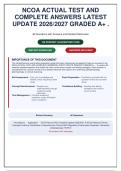
NCOA ACTUAL TEST AND
COMPLETE ANSWERS LATEST
UPDATE 2026/2027 GRADED A+ .
80 Questions with Answers and Detailed Rationales
100 PERCENT GUARANTEED PASS
INSTANT DOWNLOAD ANSWERS INCLUDED
IMPORTANCE OF THIS DOCUMENT
This comprehensive examination preparation guide has been meticulously developed to help you succeed in the
NCOA ACTUAL TEST AND COMPLETE ANSWERS LATEST UPDATE 2026/2027 GRADED A+ .. It contains 80
carefully selected questions that reflect the most current exam content and testing strategies. Each question is
accompanied by a correct answer and a detailed rationale that explains the underlying pathophysiology,
pharmacology, or clinical reasoning.
Self-Assessment – Test your knowledge and Exam Preparation – Familiarize yourself with the
identify areas requiring further question format and content
study areas
Concept Reinforcement – Deepen your Confidence Building – Develop test-taking
understanding through strategies and reduce
evidence-based exam anxiety
rationales
Time Management – Practice answering
questions under simulated
exam conditions
Review Summary 80 Questions
Foundations - Application - NCOA Actual AND Complete Update 2026/2027 A NCOA National Clinical
Oversight Authority Certification Comprehensive Clinical AND Regulatory Examination Graduate / Advanced
Undergraduate YEAR 4
All answers with rationales
,Table of Contents
Content Area Questions Key Topics
Leadership AND 1-14 Appropriate, History, Diabetes, Prescribed, According
Management
Followership AND TEAM 15-28 Violation, Likely, Disease, Appropriate, History
Building
Communication AND Conflict 29-42 Likely, Trial, Stroke, Major, Appropriate
Resolution
Military Professionalism AND 43-56 Facility, Presents, According, Appropriate, Therapy
Ethics
Enlisted Force Development 57-70 According, Medication, Prescribed, Guidelines, Current
Supervision AND Mentoring 71-80 Target, Officer, Operation, Principle, Military
TOTAL 80 All questions include answers and detailed rationales
,Section A - Leadership AND Management
Q1.
A patient with chronic kidney disease (eGFR 25 mL/min) and type 2 diabetes is prescribed
metformin. The prescriber orders a contrast-enhanced CT. What is the most appropriate
action according to current FDA guidance and KDIGO guidelines?
A. Continue metformin without adjustment, B. Hold metformin at the time of contrast
as renal function is stable. administration and resume 48 hours later if
renal function remains stable.
C. Discontinue metformin permanently due D. Reduce metformin dose by 50% and
to contraindication in CKD. proceed with contrast.
Correct: B - Hold metformin at the time of contrast administration and resume 48 hours
later if renal function remains stable.
Rationale:Current guidelines recommend holding metformin in patients with eGFR <30
mL/min or at risk of contrast-induced nephropathy (eGFR 30-59 with additional risk factors) at
the time of contrast administration, and resuming after 48 hours if renal function has not
worsened. This prevents lactic acidosis while allowing continuation of therapy.
Why the other answers are wrong:
A. Continuing metformin without holding increases risk of lactic acidosis if contrast-induced
nephropathy occurs.
C. Permanent discontinuation is not required; temporary hold with reassessment is the
standard of care.
D. Dose reduction does not mitigate the acute risk during contrast exposure; holding is
indicated.
Reference: KDIGO 2024 Clinical Practice Guideline for the Management of CKD; FDA Drug Safety
Communication (2020).
Q2.
A 30-year-old patient with a history of recurrent unprovoked venous thromboembolism
(VTE) is newly diagnosed with antiphospholipid syndrome (APS) and is currently on
warfarin with subtherapeutic INRs. Which anticoagulation strategy is most appropriate
according to current guidelines?
A. Switch to rivaroxaban, as DOACs are B. Continue warfarin with target INR 2-3, but
preferred for all APS patients. add aspirin.
C. Switch to a direct oral anticoagulant D. Increase warfarin target to INR 3-4 or add
(DOAC) such as apixaban. low-dose aspirin.
Correct: D - Increase warfarin target to INR 3-4 or add low-dose aspirin.
Page 3
, Section A - Leadership AND Management
Rationale: For patients with APS and prior VTE, current guidelines (e.g., ACR 2020)
recommend either warfarin with INR 2-3 or, in high-risk cases (e.g., recurrent thrombosis
despite adequate therapy), increasing INR target to 3-4 or adding low-dose aspirin. DOACs
are not recommended for triple-positive APS (lupus anticoagulant, anticardiolipin,
anti-beta-2-glycoprotein) due to increased thrombotic risk.
Why the other answers are wrong:
A. Rivaroxaban and other DOACs are contraindicated in triple-positive APS due to higher
recurrence rates.
B. Adding aspirin without intensifying INR target is insufficient for recurrent VTE in high-risk
APS.
C. DOACs are not first-line for APS, especially in triple-positive patients.
Reference: American College of Rheumatology (ACR) 2020 APS Guidelines; ISTH guidance (2021).
Q3.
A 45-year-old patient with a history of major depressive disorder is being started on an
SSRI. Which pharmacogenomic testing result would most likely predict poor response to
SSRIs and suggest an alternative class?
A. CYP2D6 ultrarapid metabolizer B. CYP2C19 poor metabolizer phenotype
phenotype
C. SLC6A4 (5-HTTLPR) short/short D. HTR2A T102C polymorphism (CC
genotype genotype)
Correct: C - SLC6A4 (5-HTTLPR) short/short genotype
Rationale:The 5-HTTLPR short/short (S/S) genotype is associated with reduced serotonin
transporter expression, leading to poorer response to SSRIs and increased risk of adverse
effects. This is the most established pharmacogenetic predictor of SSRI response. CYP2C19
poor metabolizer status affects drug metabolism but does not directly predict efficacy;
CYP2D6 ultrarapid metabolism may reduce levels of some SSRIs but is less directly linked to
response.
Why the other answers are wrong:
A. CYP2D6 ultrarapid metabolism affects levels of some antidepressants but is not the primary
predictor of SSRI response.
B. CYP2C19 poor metabolizer status affects drug clearance but is not directly linked to efficacy.
D. HTR2A variants are associated with side effects (e.g., weight gain) rather than lack of
efficacy.
Reference: CPIC Guideline for SSRI and SNRI based on CYP2D6/CYP2C19; Pharmacogenomics
Journal (2022).
Page 4
COMPLETE ANSWERS LATEST
UPDATE 2026/2027 GRADED A+ .
80 Questions with Answers and Detailed Rationales
100 PERCENT GUARANTEED PASS
INSTANT DOWNLOAD ANSWERS INCLUDED
IMPORTANCE OF THIS DOCUMENT
This comprehensive examination preparation guide has been meticulously developed to help you succeed in the
NCOA ACTUAL TEST AND COMPLETE ANSWERS LATEST UPDATE 2026/2027 GRADED A+ .. It contains 80
carefully selected questions that reflect the most current exam content and testing strategies. Each question is
accompanied by a correct answer and a detailed rationale that explains the underlying pathophysiology,
pharmacology, or clinical reasoning.
Self-Assessment – Test your knowledge and Exam Preparation – Familiarize yourself with the
identify areas requiring further question format and content
study areas
Concept Reinforcement – Deepen your Confidence Building – Develop test-taking
understanding through strategies and reduce
evidence-based exam anxiety
rationales
Time Management – Practice answering
questions under simulated
exam conditions
Review Summary 80 Questions
Foundations - Application - NCOA Actual AND Complete Update 2026/2027 A NCOA National Clinical
Oversight Authority Certification Comprehensive Clinical AND Regulatory Examination Graduate / Advanced
Undergraduate YEAR 4
All answers with rationales
,Table of Contents
Content Area Questions Key Topics
Leadership AND 1-14 Appropriate, History, Diabetes, Prescribed, According
Management
Followership AND TEAM 15-28 Violation, Likely, Disease, Appropriate, History
Building
Communication AND Conflict 29-42 Likely, Trial, Stroke, Major, Appropriate
Resolution
Military Professionalism AND 43-56 Facility, Presents, According, Appropriate, Therapy
Ethics
Enlisted Force Development 57-70 According, Medication, Prescribed, Guidelines, Current
Supervision AND Mentoring 71-80 Target, Officer, Operation, Principle, Military
TOTAL 80 All questions include answers and detailed rationales
,Section A - Leadership AND Management
Q1.
A patient with chronic kidney disease (eGFR 25 mL/min) and type 2 diabetes is prescribed
metformin. The prescriber orders a contrast-enhanced CT. What is the most appropriate
action according to current FDA guidance and KDIGO guidelines?
A. Continue metformin without adjustment, B. Hold metformin at the time of contrast
as renal function is stable. administration and resume 48 hours later if
renal function remains stable.
C. Discontinue metformin permanently due D. Reduce metformin dose by 50% and
to contraindication in CKD. proceed with contrast.
Correct: B - Hold metformin at the time of contrast administration and resume 48 hours
later if renal function remains stable.
Rationale:Current guidelines recommend holding metformin in patients with eGFR <30
mL/min or at risk of contrast-induced nephropathy (eGFR 30-59 with additional risk factors) at
the time of contrast administration, and resuming after 48 hours if renal function has not
worsened. This prevents lactic acidosis while allowing continuation of therapy.
Why the other answers are wrong:
A. Continuing metformin without holding increases risk of lactic acidosis if contrast-induced
nephropathy occurs.
C. Permanent discontinuation is not required; temporary hold with reassessment is the
standard of care.
D. Dose reduction does not mitigate the acute risk during contrast exposure; holding is
indicated.
Reference: KDIGO 2024 Clinical Practice Guideline for the Management of CKD; FDA Drug Safety
Communication (2020).
Q2.
A 30-year-old patient with a history of recurrent unprovoked venous thromboembolism
(VTE) is newly diagnosed with antiphospholipid syndrome (APS) and is currently on
warfarin with subtherapeutic INRs. Which anticoagulation strategy is most appropriate
according to current guidelines?
A. Switch to rivaroxaban, as DOACs are B. Continue warfarin with target INR 2-3, but
preferred for all APS patients. add aspirin.
C. Switch to a direct oral anticoagulant D. Increase warfarin target to INR 3-4 or add
(DOAC) such as apixaban. low-dose aspirin.
Correct: D - Increase warfarin target to INR 3-4 or add low-dose aspirin.
Page 3
, Section A - Leadership AND Management
Rationale: For patients with APS and prior VTE, current guidelines (e.g., ACR 2020)
recommend either warfarin with INR 2-3 or, in high-risk cases (e.g., recurrent thrombosis
despite adequate therapy), increasing INR target to 3-4 or adding low-dose aspirin. DOACs
are not recommended for triple-positive APS (lupus anticoagulant, anticardiolipin,
anti-beta-2-glycoprotein) due to increased thrombotic risk.
Why the other answers are wrong:
A. Rivaroxaban and other DOACs are contraindicated in triple-positive APS due to higher
recurrence rates.
B. Adding aspirin without intensifying INR target is insufficient for recurrent VTE in high-risk
APS.
C. DOACs are not first-line for APS, especially in triple-positive patients.
Reference: American College of Rheumatology (ACR) 2020 APS Guidelines; ISTH guidance (2021).
Q3.
A 45-year-old patient with a history of major depressive disorder is being started on an
SSRI. Which pharmacogenomic testing result would most likely predict poor response to
SSRIs and suggest an alternative class?
A. CYP2D6 ultrarapid metabolizer B. CYP2C19 poor metabolizer phenotype
phenotype
C. SLC6A4 (5-HTTLPR) short/short D. HTR2A T102C polymorphism (CC
genotype genotype)
Correct: C - SLC6A4 (5-HTTLPR) short/short genotype
Rationale:The 5-HTTLPR short/short (S/S) genotype is associated with reduced serotonin
transporter expression, leading to poorer response to SSRIs and increased risk of adverse
effects. This is the most established pharmacogenetic predictor of SSRI response. CYP2C19
poor metabolizer status affects drug metabolism but does not directly predict efficacy;
CYP2D6 ultrarapid metabolism may reduce levels of some SSRIs but is less directly linked to
response.
Why the other answers are wrong:
A. CYP2D6 ultrarapid metabolism affects levels of some antidepressants but is not the primary
predictor of SSRI response.
B. CYP2C19 poor metabolizer status affects drug clearance but is not directly linked to efficacy.
D. HTR2A variants are associated with side effects (e.g., weight gain) rather than lack of
efficacy.
Reference: CPIC Guideline for SSRI and SNRI based on CYP2D6/CYP2C19; Pharmacogenomics
Journal (2022).
Page 4