
NUR 155 Skin Integrity and Wound Care 2026/2027 (Answered)
NUR 155: Skin Integrity and Wound Care
Study online at https://quizlet.com/_8kirc6
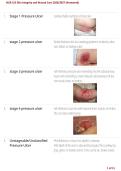
1. Stage 1 Pressure Ulcer nonblanchable erythema of intact skin
2. stage 2 pressure ulcer Partial-thickness skin loss involving epidermis or dermis, abra-
sion, blister, or shallow crater.
3. stage 3 pressure ulcer Full-thickness pressure ulcer extending into the subcutaneous
tissue and resembling a crater. May see subcutaneous fat but
not muscle, bone, or tendon.
4. stage 4 pressure ulcer Full-thickness tissue loss with exposed bone, muscle, or tendon.
This can have undermining
5. Unstageable/Unclassified •Full thickness or tissue loss-depth is unknown
Pressure Ulcer •The depth of the ulcer is obscured by slough ( this is yellow, tan,
gray, green, or brown) and/or ( this can be tan, brown, black)
1 of 11
, NUR 155 Skin Integrity and Wound Care 2026/2027 (Answered)
NUR 155: Skin Integrity and Wound Care
Study online at https://quizlet.com/_8kirc6
6. Suspected Deep Tissue In- Purple or maroon localized area of discolored intact skin or
jury—Depth Unknown. blood-filled blister caused by damage of underlying soft tissue
from pressure and/or shear
7. Braden Scale Pressure ulcers
lower the number, higher the risk
4-23
less than 17 = risk for pressure ulcers
8. Inflammatory phase of Lasts 4-6 days,
wound healing Homeostasis and phagocytosis happen at this stage
9. Inflammatory phase: Home- the drawing back of injured blood vessels and the deposition of
ostasis fibrin *connective tissue
10. Inflammatory phase: Phago- Clean up debris of damage from injury and make way for re-
cytosis building to begin
11. Proliferative phase of wound Day 3 to 21 post-injury
healing Fibroblasts migrate and begin to synthesize collagen
12. maturation phase of wound Begins about day 21 & can extend 1 or 2 yrs after injury. Wounds
healing are remodeled and contracted. Keloids can form
2 of 11
NUR 155: Skin Integrity and Wound Care
Study online at https://quizlet.com/_8kirc6
1. Stage 1 Pressure Ulcer nonblanchable erythema of intact skin
2. stage 2 pressure ulcer Partial-thickness skin loss involving epidermis or dermis, abra-
sion, blister, or shallow crater.
3. stage 3 pressure ulcer Full-thickness pressure ulcer extending into the subcutaneous
tissue and resembling a crater. May see subcutaneous fat but
not muscle, bone, or tendon.
4. stage 4 pressure ulcer Full-thickness tissue loss with exposed bone, muscle, or tendon.
This can have undermining
5. Unstageable/Unclassified •Full thickness or tissue loss-depth is unknown
Pressure Ulcer •The depth of the ulcer is obscured by slough ( this is yellow, tan,
gray, green, or brown) and/or ( this can be tan, brown, black)
1 of 11
, NUR 155 Skin Integrity and Wound Care 2026/2027 (Answered)
NUR 155: Skin Integrity and Wound Care
Study online at https://quizlet.com/_8kirc6
6. Suspected Deep Tissue In- Purple or maroon localized area of discolored intact skin or
jury—Depth Unknown. blood-filled blister caused by damage of underlying soft tissue
from pressure and/or shear
7. Braden Scale Pressure ulcers
lower the number, higher the risk
4-23
less than 17 = risk for pressure ulcers
8. Inflammatory phase of Lasts 4-6 days,
wound healing Homeostasis and phagocytosis happen at this stage
9. Inflammatory phase: Home- the drawing back of injured blood vessels and the deposition of
ostasis fibrin *connective tissue
10. Inflammatory phase: Phago- Clean up debris of damage from injury and make way for re-
cytosis building to begin
11. Proliferative phase of wound Day 3 to 21 post-injury
healing Fibroblasts migrate and begin to synthesize collagen
12. maturation phase of wound Begins about day 21 & can extend 1 or 2 yrs after injury. Wounds
healing are remodeled and contracted. Keloids can form
2 of 11

