
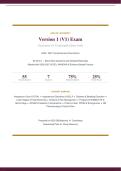
HESI OB / MATERNITY
Version 1 (V1) Exam
Guaranteed A+ Verified Q&A Study Guide
Comprehensive Examination
All 55 Q's — Brand New Questions with Detailed Rationales
Aligned with 2026-2027 ACOG, AWHONN & Evidence-Based Practice
55 7 75% 25%
Total Questions Sections Scenario-Based Direct Recall
CONTENT DOMAINS
Antepartum Care & GTPAL • Hypertensive Disorders & HELLP • Diabetes & Bleeding Disorders •
Labor Stages & Fetal Monitoring • Epidural & Pain Management • Postpartum BUBBLE-HE &
Hemorrhage • APGAR & Newborn Complications • Preterm Labor, PROM & Emergencies • OB
Pharmacology & Cultural Care
Prepared for HESI OB/Maternity V1 Candidates
Guaranteed Pass A+ Study Resource
, Examination Overview & Section Map
This 55-question HESI OB/Maternity Version 1 (V1) exam preparation guide provides comprehensive coverage
of antepartum, intrapartum, postpartum, and newborn nursing care aligned with 2026/2027 ACOG and
AWHONN standards. Each question includes a detailed rationale explaining the correct answer, why each
distractor is wrong, and the maternal-fetal physiology and nursing priorities behind the answer—designed to
deliver guaranteed A+ exam readiness.
Section 1: Antepartum Care and Assessment (Q1-8)
Prenatal care, maternal adaptations, GTPAL, and nutritional needs.
Section 2: Complications of Pregnancy (Q9-17)
Hypertensive disorders, diabetes, bleeding disorders, and infections.
Section 3: Intrapartum Care and Labor Management (Q18-27)
Stages of labor, fetal monitoring, and pain management.
Section 4: Postpartum Care and Complications (Q28-36)
Maternal assessment, involution, hemorrhage, and infections.
Section 5: Newborn Assessment and Care (Q37-44)
Transition, APGAR, feeding, jaundice, and complications.
Section 6: High-Risk Pregnancy and Perinatal Emergencies (Q45-50)
Preterm labor, PROM, and perinatal emergencies.
Section 7: Women's Health, Pharmacology, and Professional Practice (Q51-55)
Contraception, OB medications, and cultural considerations.
Cognitive Level Distribution
Recall (30%) — Direct identification of definitions, calculations, and key concepts (GTPAL, Naegele's rule,
APGAR).
Application (50%) — Clinical scenarios requiring nursing intervention and prioritization.
Analysis (20%) — Fetal monitoring strip interpretation, complication differentiation, and clinical judgment.
How to Read Each Question
Each question presents a stem, four options (A-D), and a rationale. The correct option is marked [CORRECT] in
green, and the explicit Correct Answer line follows. Rationales explain the OB/maternity nursing reasoning,
maternal-fetal physiology, pharmacological principles, and clinical priorities—with study tips to reinforce the most
commonly tested concepts on the HESI OB/Maternity V1 exam.
, HESI OB/Maternity V1 Exam 2026/2027 — Guaranteed A+ Verified Q&A Study Guide All 55 Q's — Practice Exam
SECTION 1: Antepartum Care and Assessment (Q1-8)
Prenatal care, maternal adaptations, GTPAL, and nutritional needs.
Q1.
A 28-year-old client at her first prenatal visit reports her last menstrual period (LMP) began on January 1. Using
Naegele's rule, what is the estimated date of delivery (EDD)?
A. October 8. [CORRECT]
B. October 1.
C. September 8.
D. November 8.
Correct Answer: A — October 8.
Rationale: Naegele's rule: add 7 days to the first day of the LMP, subtract 3 months, and add 1 year. January 1
+ 7 days = January 8; subtract 3 months = October 8. The other options either fail to add the 7 days, subtract the
wrong number of months, or add the wrong number of days. Study tip: 'plus 7, minus 3' is the Naegele
mnemonic.
Q2.
A client states she is pregnant for the fourth time. She has one child born at 39 weeks (alive), one born at 34
weeks (alive), and one spontaneous abortion at 10 weeks. Using GTPAL, what is her correct designation?
A. G4 T1 P1 A1 L2. [CORRECT]
B. G4 T2 P0 A1 L2.
C. G3 T1 P1 A1 L2.
D. G4 T1 P1 A0 L2.
Correct Answer: A — G4 T1 P1 A1 L2.
Rationale: GTPAL: G (total pregnancies) = 4; T (term births, ≥37 weeks) = 1; P (preterm births, 20–36 weeks)
= 1; A (abortions, <20 weeks or <500 g) = 1; L (living children) = 2. The miscarriage counts as an A, the
39-week baby is term, and the 34-week baby is preterm. Both living children are alive. Option B miscounts term
vs preterm; option C miscounts gravidity; option D omits the abortion.
Q3.
At 28 weeks' gestation, a nurse measures the client's fundal height at 32 cm. Which interpretation is most
accurate, and what is the priority nursing action?
A. Fundal height is greater than expected; notify the provider to evaluate for multifetal gestation,
polyhydramnios, or incorrect dates. [CORRECT]
B. Fundal height is normal for 28 weeks; document and continue routine care.
C. Fundal height indicates intrauterine growth restriction; order an immediate ultrasound.
D. Fundal height suggests fetal demise; prepare for delivery.
Correct Answer: A — Fundal height is greater than expected; notify the provider to evaluate for
multifetal ...
Rationale: From 20 to 36 weeks, fundal height in centimeters should approximate gestational age ±2 cm. At 28
weeks, 32 cm is >2 cm greater than expected and warrants provider evaluation for multifetal gestation,
polyhydramnios, incorrect dates, or macrosomia. Option B normalizes an abnormal finding; options C and D
jump to severe diagnoses without provider evaluation.
HESI OB/Maternity V1 • Study Guide Page 3
Version 1 (V1) Exam
Guaranteed A+ Verified Q&A Study Guide
Comprehensive Examination
All 55 Q's — Brand New Questions with Detailed Rationales
Aligned with 2026-2027 ACOG, AWHONN & Evidence-Based Practice
55 7 75% 25%
Total Questions Sections Scenario-Based Direct Recall
CONTENT DOMAINS
Antepartum Care & GTPAL • Hypertensive Disorders & HELLP • Diabetes & Bleeding Disorders •
Labor Stages & Fetal Monitoring • Epidural & Pain Management • Postpartum BUBBLE-HE &
Hemorrhage • APGAR & Newborn Complications • Preterm Labor, PROM & Emergencies • OB
Pharmacology & Cultural Care
Prepared for HESI OB/Maternity V1 Candidates
Guaranteed Pass A+ Study Resource
, Examination Overview & Section Map
This 55-question HESI OB/Maternity Version 1 (V1) exam preparation guide provides comprehensive coverage
of antepartum, intrapartum, postpartum, and newborn nursing care aligned with 2026/2027 ACOG and
AWHONN standards. Each question includes a detailed rationale explaining the correct answer, why each
distractor is wrong, and the maternal-fetal physiology and nursing priorities behind the answer—designed to
deliver guaranteed A+ exam readiness.
Section 1: Antepartum Care and Assessment (Q1-8)
Prenatal care, maternal adaptations, GTPAL, and nutritional needs.
Section 2: Complications of Pregnancy (Q9-17)
Hypertensive disorders, diabetes, bleeding disorders, and infections.
Section 3: Intrapartum Care and Labor Management (Q18-27)
Stages of labor, fetal monitoring, and pain management.
Section 4: Postpartum Care and Complications (Q28-36)
Maternal assessment, involution, hemorrhage, and infections.
Section 5: Newborn Assessment and Care (Q37-44)
Transition, APGAR, feeding, jaundice, and complications.
Section 6: High-Risk Pregnancy and Perinatal Emergencies (Q45-50)
Preterm labor, PROM, and perinatal emergencies.
Section 7: Women's Health, Pharmacology, and Professional Practice (Q51-55)
Contraception, OB medications, and cultural considerations.
Cognitive Level Distribution
Recall (30%) — Direct identification of definitions, calculations, and key concepts (GTPAL, Naegele's rule,
APGAR).
Application (50%) — Clinical scenarios requiring nursing intervention and prioritization.
Analysis (20%) — Fetal monitoring strip interpretation, complication differentiation, and clinical judgment.
How to Read Each Question
Each question presents a stem, four options (A-D), and a rationale. The correct option is marked [CORRECT] in
green, and the explicit Correct Answer line follows. Rationales explain the OB/maternity nursing reasoning,
maternal-fetal physiology, pharmacological principles, and clinical priorities—with study tips to reinforce the most
commonly tested concepts on the HESI OB/Maternity V1 exam.
, HESI OB/Maternity V1 Exam 2026/2027 — Guaranteed A+ Verified Q&A Study Guide All 55 Q's — Practice Exam
SECTION 1: Antepartum Care and Assessment (Q1-8)
Prenatal care, maternal adaptations, GTPAL, and nutritional needs.
Q1.
A 28-year-old client at her first prenatal visit reports her last menstrual period (LMP) began on January 1. Using
Naegele's rule, what is the estimated date of delivery (EDD)?
A. October 8. [CORRECT]
B. October 1.
C. September 8.
D. November 8.
Correct Answer: A — October 8.
Rationale: Naegele's rule: add 7 days to the first day of the LMP, subtract 3 months, and add 1 year. January 1
+ 7 days = January 8; subtract 3 months = October 8. The other options either fail to add the 7 days, subtract the
wrong number of months, or add the wrong number of days. Study tip: 'plus 7, minus 3' is the Naegele
mnemonic.
Q2.
A client states she is pregnant for the fourth time. She has one child born at 39 weeks (alive), one born at 34
weeks (alive), and one spontaneous abortion at 10 weeks. Using GTPAL, what is her correct designation?
A. G4 T1 P1 A1 L2. [CORRECT]
B. G4 T2 P0 A1 L2.
C. G3 T1 P1 A1 L2.
D. G4 T1 P1 A0 L2.
Correct Answer: A — G4 T1 P1 A1 L2.
Rationale: GTPAL: G (total pregnancies) = 4; T (term births, ≥37 weeks) = 1; P (preterm births, 20–36 weeks)
= 1; A (abortions, <20 weeks or <500 g) = 1; L (living children) = 2. The miscarriage counts as an A, the
39-week baby is term, and the 34-week baby is preterm. Both living children are alive. Option B miscounts term
vs preterm; option C miscounts gravidity; option D omits the abortion.
Q3.
At 28 weeks' gestation, a nurse measures the client's fundal height at 32 cm. Which interpretation is most
accurate, and what is the priority nursing action?
A. Fundal height is greater than expected; notify the provider to evaluate for multifetal gestation,
polyhydramnios, or incorrect dates. [CORRECT]
B. Fundal height is normal for 28 weeks; document and continue routine care.
C. Fundal height indicates intrauterine growth restriction; order an immediate ultrasound.
D. Fundal height suggests fetal demise; prepare for delivery.
Correct Answer: A — Fundal height is greater than expected; notify the provider to evaluate for
multifetal ...
Rationale: From 20 to 36 weeks, fundal height in centimeters should approximate gestational age ±2 cm. At 28
weeks, 32 cm is >2 cm greater than expected and warrants provider evaluation for multifetal gestation,
polyhydramnios, incorrect dates, or macrosomia. Option B normalizes an abnormal finding; options C and D
jump to severe diagnoses without provider evaluation.
HESI OB/Maternity V1 • Study Guide Page 3

