
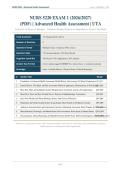
NURS 5220 – Advanced Health Assessment Exam 1 (2026/2027) | UTA
NURS 5220 EXAM 1 (2026/2027)
(PDF) | Advanced Health Assessment | UTA
University of Texas at Arlington – Graduate Nursing Program • Comprehensive Exam 1 Test Bank
Total Questions 110 (Sequential Q1–Q110)
Number of Sections 9
Question Format Multiple Choice (4 options, ONE correct)
Question Style 75% Scenario-Based • 25% Direct Recall
Cognitive Level Mix 30% Recall • 50% Application • 20% Analysis
Answer Key Format Correct option tagged [CORRECT] • Answer line • 2–4 sentence rationale
Coverage Exam 1 • Health History • Physical Exam • Clinical Reasoning
# Section Title Range
1 Foundations of Advanced Health Assessment (Health History, Interviewing, & Cultural Competence) Q1-Q14
2 General Survey, Vital Signs, and Pain Assessment (Physical Appearance, Measurements, & Pain Scales)
Q15-Q26
3 Skin, Hair, Nails, and Lymphatic System (Integumentary Assessment, Lesions, & Lymph Nodes) Q27-Q38
4 Head, Face, Neck, and Eyes (Cranial Nerves, Thyroid, & Ophthalmologic Assessment) Q39-Q52
5 Ears, Nose, Mouth, and Throat (Hearing, Sinuses, Oral Cavity, & Pharynx) Q53-Q64
6 Respiratory and Cardiovascular Systems (Lung Sounds, Heart Sounds, & Peripheral Vascular) Q65-Q80
7 Abdomen, Gastrointestinal, and Genitourinary Systems (Abdominal Assessment, Bowel Sounds, & GU
Q81-Q92
Assessment)
8 Musculoskeletal, Neurologic, and Mental Status (Joint Assessment, Neuro Exam, & Mental Status) Q93-Q104
9 Documentation, Clinical Reasoning, and Health Promotion (SOAP Notes, Differential Diagnosis, & Q105-Q110
Patient Education)
All answers verified for accuracy. Each rationale includes correct-answer verification with comprehensive advanced
health assessment reasoning and clinical application.
Page 1
,NURS 5220 – Advanced Health Assessment Exam 1 (2026/2027) | UTA
SECTION 1
Section 1: Foundations of Advanced Health Assessment (Health History,
Interviewing, & Cultural Competence)
Questions Q1-Q14
Q1: A 52-year-old patient presents to the clinic for the first time. The advanced practice nurse begins
the comprehensive health history. Which of the following BEST describes the appropriate sequence
for the history-taking component of the encounter?
A. Biographic data, source of history and reliability, chief complaint, history of present illness, past health
history, family history, personal and psychosocial history, and review of systems. [CORRECT]
B. Chief complaint, review of systems, history of present illness, family history, past health history, and
biographic data.
C. Review of systems, chief complaint, past health history, family history, biographic data, and history of
present illness.
D. Past health history, family history, chief complaint, history of present illness, biographic data, and review
of systems.
Correct Answer: A
Rationale: The complete health history follows a structured sequence: biographic data, source/reliability, chief
complaint, HPI, past health history, family history, personal/psychosocial history, and ROS. This order builds
rapport before exploring sensitive areas and ensures no critical content is omitted. Verified correct: this is the
standard sequence taught in advanced health assessment curricula (Bates; Jarvis).
Q2: An APN is interviewing a patient who reports "chest pain." Which of the following is the MOST
appropriate initial open-ended question to elicit the history of present illness (HPI)?
A. "Can you tell me more about the chest pain you've been experiencing?" [CORRECT]
B. "Does the pain feel sharp or dull?"
C. "Is the pain rated 7 out of 10?"
D. "Did you take nitroglycerin for the pain?"
Correct Answer: A
Rationale: Open-ended questions such as "Can you tell me more about the chest pain you've been experiencing?"
allow the patient to describe the symptom in their own words before the clinician narrows with focused questions.
Options B, C, and D are closed-ended and limit patient response. Verified correct: the HPI begins with a broad,
open-ended exploration of the chief complaint.
Page 2
,NURS 5220 – Advanced Health Assessment Exam 1 (2026/2027) | UTA
Q3: An APN uses the mnemonic OLDCARTS to explore the chief complaint. Which set of elements
does OLDCARTS represent?
A. Onset, Location, Duration, Character, Aggravating/Alleviating factors, Radiation, Timing, Severity.
[CORRECT]
B. Onset, Laterality, Disease, Course, Activity, Region, Treatment, Symptom.
C. Origin, Location, Description, Chronology, Associated symptoms, Radiation, Triggers, Severity.
D. Onset, Location, Depth, Color, Area, Radiation, Type, Site.
Correct Answer: A
Rationale: OLDCARTS is a standard mnemonic for symptom analysis: Onset, Location, Duration, Character,
Aggravating/Alleviating factors, Radiation, Timing, and Severity. The other options misrepresent or omit key
symptom attributes. Verified correct: OLDCARTS captures the seven cardinal features of a symptom used in HPI
documentation.
Q4: During a comprehensive history, the patient reports "I have high blood pressure, diabetes, and a
heart murmur." The APN asks, "Have you ever been hospitalized for any of these conditions?" This
type of questioning is BEST described as:
A. A direct closed-ended question used to clarify specific facts in the past medical history. [CORRECT]
B. An open-ended question designed to elicit narrative detail.
C. A leading question that biases the patient's response.
D. A funnel question that begins broad and narrows.
Correct Answer: A
Rationale: Closed-ended (direct) questions are appropriate for clarifying specific facts such as hospitalizations,
medications, and dates within the past medical history. Open-ended questions are better for the narrative HPI.
Leading questions bias responses and should be avoided. Verified correct: direct closed-ended questions are
appropriate for clarification of factual past medical history data.
Q5: An APN is caring for a 68-year-old Vietnamese patient who avoids eye contact during the
interview. The APN interprets this behavior according to cultural norms. Which response is MOST
culturally competent?
A. Recognize that avoidance of direct eye contact may be a sign of respect in some Asian cultures and
continue the interview without forcing eye contact. [CORRECT]
B. Document the patient as depressed based on lack of eye contact.
C. Insist the patient make eye contact to facilitate communication.
D. Terminate the interview because the patient is uncooperative.
Correct Answer: A
Rationale: In many Asian cultures, avoiding direct eye contact is a sign of respect, particularly when interacting
with authority figures such as healthcare providers. Misinterpreting this as depression, nonadherence, or
uncooperativeness is a culturally based error. Verified correct: cultural competence requires interpreting nonverbal
behaviors within the patient's cultural framework.
Page 3
, NURS 5220 – Advanced Health Assessment Exam 1 (2026/2027) | UTA
Q6: An APN uses the LEARN model (Listen, Explain, Acknowledge, Recommend, Negotiate) for
culturally sensitive care. Which activity BEST represents the "Acknowledge" step?
A. Discussing the similarities and differences between the patient's perspective and the biomedical
perspective. [CORRECT]
B. Providing recommendations based solely on clinical evidence without discussion.
C. Listening to the patient's perception of the problem only.
D. Negotiating a plan of care based only on the biomedical perspective.
Correct Answer: A
Rationale: In the LEARN model, Acknowledge involves discussing the similarities and differences between the
patient's perspective and the biomedical perspective, demonstrating respect for both. Verified correct: the
Acknowledge step bridges the patient's health beliefs with the clinician's biomedical understanding.
Q7: An APN is taking a family history. Which of the following information is MOST important to
elicit regarding the patient's first-degree relatives?
A. Age, living or deceased status, cause of death, and presence of conditions such as hypertension, diabetes,
coronary artery disease, cancer, and mental illness. [CORRECT]
B. Only the cause of death of the patient's parents.
C. The patient's siblings' dietary preferences only.
D. The patient's grandparents' hobbies and lifestyle.
Correct Answer: A
Rationale: A thorough family history of first-degree relatives includes age, living/deceased status, cause of death,
and presence of common heritable conditions (HTN, DM, CAD, cancer, mental illness). Verified correct:
comprehensive family history targets genetically linked diseases in first-degree relatives.
Q8: An APN is performing a review of systems (ROS) on a 65-year-old patient. Which approach is
MOST appropriate?
A. Proceed system by system, asking about presence or absence of relevant symptoms and documenting
positive and pertinent negative findings. [CORRECT]
B. Limit the ROS to the chief complaint system only.
C. Skip the ROS if the patient appears healthy.
D. Document only the positive findings without recording pertinent negatives.
Correct Answer: A
Rationale: The ROS is conducted system by system, recording both positive findings and pertinent negatives
relevant to the differential diagnosis. Limiting to the chief complaint system omits relevant data, and skipping or
recording only positives compromises completeness. Verified correct: ROS must be systematic and include
pertinent negatives.
Page 4
NURS 5220 EXAM 1 (2026/2027)
(PDF) | Advanced Health Assessment | UTA
University of Texas at Arlington – Graduate Nursing Program • Comprehensive Exam 1 Test Bank
Total Questions 110 (Sequential Q1–Q110)
Number of Sections 9
Question Format Multiple Choice (4 options, ONE correct)
Question Style 75% Scenario-Based • 25% Direct Recall
Cognitive Level Mix 30% Recall • 50% Application • 20% Analysis
Answer Key Format Correct option tagged [CORRECT] • Answer line • 2–4 sentence rationale
Coverage Exam 1 • Health History • Physical Exam • Clinical Reasoning
# Section Title Range
1 Foundations of Advanced Health Assessment (Health History, Interviewing, & Cultural Competence) Q1-Q14
2 General Survey, Vital Signs, and Pain Assessment (Physical Appearance, Measurements, & Pain Scales)
Q15-Q26
3 Skin, Hair, Nails, and Lymphatic System (Integumentary Assessment, Lesions, & Lymph Nodes) Q27-Q38
4 Head, Face, Neck, and Eyes (Cranial Nerves, Thyroid, & Ophthalmologic Assessment) Q39-Q52
5 Ears, Nose, Mouth, and Throat (Hearing, Sinuses, Oral Cavity, & Pharynx) Q53-Q64
6 Respiratory and Cardiovascular Systems (Lung Sounds, Heart Sounds, & Peripheral Vascular) Q65-Q80
7 Abdomen, Gastrointestinal, and Genitourinary Systems (Abdominal Assessment, Bowel Sounds, & GU
Q81-Q92
Assessment)
8 Musculoskeletal, Neurologic, and Mental Status (Joint Assessment, Neuro Exam, & Mental Status) Q93-Q104
9 Documentation, Clinical Reasoning, and Health Promotion (SOAP Notes, Differential Diagnosis, & Q105-Q110
Patient Education)
All answers verified for accuracy. Each rationale includes correct-answer verification with comprehensive advanced
health assessment reasoning and clinical application.
Page 1
,NURS 5220 – Advanced Health Assessment Exam 1 (2026/2027) | UTA
SECTION 1
Section 1: Foundations of Advanced Health Assessment (Health History,
Interviewing, & Cultural Competence)
Questions Q1-Q14
Q1: A 52-year-old patient presents to the clinic for the first time. The advanced practice nurse begins
the comprehensive health history. Which of the following BEST describes the appropriate sequence
for the history-taking component of the encounter?
A. Biographic data, source of history and reliability, chief complaint, history of present illness, past health
history, family history, personal and psychosocial history, and review of systems. [CORRECT]
B. Chief complaint, review of systems, history of present illness, family history, past health history, and
biographic data.
C. Review of systems, chief complaint, past health history, family history, biographic data, and history of
present illness.
D. Past health history, family history, chief complaint, history of present illness, biographic data, and review
of systems.
Correct Answer: A
Rationale: The complete health history follows a structured sequence: biographic data, source/reliability, chief
complaint, HPI, past health history, family history, personal/psychosocial history, and ROS. This order builds
rapport before exploring sensitive areas and ensures no critical content is omitted. Verified correct: this is the
standard sequence taught in advanced health assessment curricula (Bates; Jarvis).
Q2: An APN is interviewing a patient who reports "chest pain." Which of the following is the MOST
appropriate initial open-ended question to elicit the history of present illness (HPI)?
A. "Can you tell me more about the chest pain you've been experiencing?" [CORRECT]
B. "Does the pain feel sharp or dull?"
C. "Is the pain rated 7 out of 10?"
D. "Did you take nitroglycerin for the pain?"
Correct Answer: A
Rationale: Open-ended questions such as "Can you tell me more about the chest pain you've been experiencing?"
allow the patient to describe the symptom in their own words before the clinician narrows with focused questions.
Options B, C, and D are closed-ended and limit patient response. Verified correct: the HPI begins with a broad,
open-ended exploration of the chief complaint.
Page 2
,NURS 5220 – Advanced Health Assessment Exam 1 (2026/2027) | UTA
Q3: An APN uses the mnemonic OLDCARTS to explore the chief complaint. Which set of elements
does OLDCARTS represent?
A. Onset, Location, Duration, Character, Aggravating/Alleviating factors, Radiation, Timing, Severity.
[CORRECT]
B. Onset, Laterality, Disease, Course, Activity, Region, Treatment, Symptom.
C. Origin, Location, Description, Chronology, Associated symptoms, Radiation, Triggers, Severity.
D. Onset, Location, Depth, Color, Area, Radiation, Type, Site.
Correct Answer: A
Rationale: OLDCARTS is a standard mnemonic for symptom analysis: Onset, Location, Duration, Character,
Aggravating/Alleviating factors, Radiation, Timing, and Severity. The other options misrepresent or omit key
symptom attributes. Verified correct: OLDCARTS captures the seven cardinal features of a symptom used in HPI
documentation.
Q4: During a comprehensive history, the patient reports "I have high blood pressure, diabetes, and a
heart murmur." The APN asks, "Have you ever been hospitalized for any of these conditions?" This
type of questioning is BEST described as:
A. A direct closed-ended question used to clarify specific facts in the past medical history. [CORRECT]
B. An open-ended question designed to elicit narrative detail.
C. A leading question that biases the patient's response.
D. A funnel question that begins broad and narrows.
Correct Answer: A
Rationale: Closed-ended (direct) questions are appropriate for clarifying specific facts such as hospitalizations,
medications, and dates within the past medical history. Open-ended questions are better for the narrative HPI.
Leading questions bias responses and should be avoided. Verified correct: direct closed-ended questions are
appropriate for clarification of factual past medical history data.
Q5: An APN is caring for a 68-year-old Vietnamese patient who avoids eye contact during the
interview. The APN interprets this behavior according to cultural norms. Which response is MOST
culturally competent?
A. Recognize that avoidance of direct eye contact may be a sign of respect in some Asian cultures and
continue the interview without forcing eye contact. [CORRECT]
B. Document the patient as depressed based on lack of eye contact.
C. Insist the patient make eye contact to facilitate communication.
D. Terminate the interview because the patient is uncooperative.
Correct Answer: A
Rationale: In many Asian cultures, avoiding direct eye contact is a sign of respect, particularly when interacting
with authority figures such as healthcare providers. Misinterpreting this as depression, nonadherence, or
uncooperativeness is a culturally based error. Verified correct: cultural competence requires interpreting nonverbal
behaviors within the patient's cultural framework.
Page 3
, NURS 5220 – Advanced Health Assessment Exam 1 (2026/2027) | UTA
Q6: An APN uses the LEARN model (Listen, Explain, Acknowledge, Recommend, Negotiate) for
culturally sensitive care. Which activity BEST represents the "Acknowledge" step?
A. Discussing the similarities and differences between the patient's perspective and the biomedical
perspective. [CORRECT]
B. Providing recommendations based solely on clinical evidence without discussion.
C. Listening to the patient's perception of the problem only.
D. Negotiating a plan of care based only on the biomedical perspective.
Correct Answer: A
Rationale: In the LEARN model, Acknowledge involves discussing the similarities and differences between the
patient's perspective and the biomedical perspective, demonstrating respect for both. Verified correct: the
Acknowledge step bridges the patient's health beliefs with the clinician's biomedical understanding.
Q7: An APN is taking a family history. Which of the following information is MOST important to
elicit regarding the patient's first-degree relatives?
A. Age, living or deceased status, cause of death, and presence of conditions such as hypertension, diabetes,
coronary artery disease, cancer, and mental illness. [CORRECT]
B. Only the cause of death of the patient's parents.
C. The patient's siblings' dietary preferences only.
D. The patient's grandparents' hobbies and lifestyle.
Correct Answer: A
Rationale: A thorough family history of first-degree relatives includes age, living/deceased status, cause of death,
and presence of common heritable conditions (HTN, DM, CAD, cancer, mental illness). Verified correct:
comprehensive family history targets genetically linked diseases in first-degree relatives.
Q8: An APN is performing a review of systems (ROS) on a 65-year-old patient. Which approach is
MOST appropriate?
A. Proceed system by system, asking about presence or absence of relevant symptoms and documenting
positive and pertinent negative findings. [CORRECT]
B. Limit the ROS to the chief complaint system only.
C. Skip the ROS if the patient appears healthy.
D. Document only the positive findings without recording pertinent negatives.
Correct Answer: A
Rationale: The ROS is conducted system by system, recording both positive findings and pertinent negatives
relevant to the differential diagnosis. Limiting to the chief complaint system omits relevant data, and skipping or
recording only positives compromises completeness. Verified correct: ROS must be systematic and include
pertinent negatives.
Page 4

