

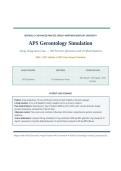
SENTINEL U • ADVANCED PRACTICE SERIES • NORTHERN KENTUCKY UNIVERSITY
APS Gerontology Simulation
Jeong Jeong-hoon Case — 100 Practice Questions with Verified Solutions
Update • 100% Score Report Standard
EXAM VOLUME SECTIONS COGNITIVE MIX
30% Recall / 50% Apply / 20%
100 Questions 8 Competency Areas
Analyze
PATIENT CASE SCENARIO
Patient: Jeong Jeong-hoon, 78-year-old Korean American male; English as Second Language.
Living situation: Lives with daughter's family; daughter serves as primary caregiver.
Past medical history: Hypertension, Type 2 Diabetes Mellitus (A1c 8.4%), early vascular dementia, benign
prostatic hyperplasia, osteoarthritis of the left knee.
Admission context: New-onset acute confusion following a fall at home; comprehensive geriatric assessment
underway.
Active medications: Lisinopril 20 mg, amlodipine 10 mg, metformin 1000 mg BID, glipizide 5 mg, donepezil 10
mg HS, tamsulosin 0.4 mg HS, diphenhydramine 25 mg HS (Beers), ibuprofen 400 mg PRN (Beers).
Aligned with AACN Essentials • Age-Friendly 4Ms Framework • NGNA Gerontologic Nursing Competencies
,Sentinel U APS Gerontology Simulation • Jeong Jeong-hoon Case Northern Kentucky University | 2026/2027
Exam Blueprint & Competency Map
# Section Question Range Items
Section 1: Gerontologic Assessment and Age-Related
1 Q1 – Q14 14
Changes
Section 2: Geriatric Syndromes and Common
2 Q15 – Q30 16
Conditions
Section 3: Polypharmacy and Medication Management
3 Q31 – Q44 14
in Older Adults
Section 4: Chronic Disease Management in Older
4 Q45 – Q58 14
Adults
5 Section 5: Cognitive and Mental Health in Aging Q59 – Q70 12
6 Section 6: Functional Decline, Mobility, and Safety Q71 – Q80 10
Section 7: Family-Centered Care, Ethics, and
7 Q81 – Q90 10
End-of-Life
Section 8: Sentinel U Simulation Competencies and
8 Q91 – Q100 10
Debriefing
— TOTAL Q1 – Q100 100
Cognitive Level Distribution
Recall (Concepts / Guidelines) ~30% Gerontologic concepts, age-related changes,
assessment tools, criteria
Application (Scenario-based) ~50% Clinical decisions in the Jeong Jeong-hoon case
(assessment, medications, falls,
communication)
Analysis (Differentiation) ~20% Differentiating delirium vs. dementia vs.
depression, capacity vs. competency, ADLs vs.
IADLs
100% Score Report • Advanced Practice Series Gerontology Page 2
,Sentinel U APS Gerontology Simulation • Jeong Jeong-hoon Case Northern Kentucky University | 2026/2027
How to Read Each Test Card
Each card follows a uniform structure to support rapid review and spaced repetition:
• Stem: A concise question, often scenario-based on the Jeong Jeong-hoon case.
• Options A–D: Four choices; one is verified correct and three are plausible distractors drawn from common
gerontologic nursing misconceptions.
• Correct Answer: The verified letter (e.g., “C”) and the option text, marked [CORRECT].
• Rationale: 2–4 sentences explaining why the correct answer is right and why distractors are wrong, including
the underlying age-related change, geriatric syndrome recognition, clinical decision-making, and Sentinel U
competency alignment.
100% Score Report • Advanced Practice Series Gerontology Page 3
, Sentinel U APS Gerontology Simulation • Jeong Jeong-hoon Case Northern Kentucky University | 2026/2027
Section 1: Gerontologic Assessment and Age-Related Changes
Physiologic Changes, Functional Assessment, & Comprehensive Geriatric Assessment (Q1–14) • Questions
1–14
Q1. In the Sentinel U APS Gerontology Simulation, Jeong Jeong-hoon is a 78-year-old Korean
American male presenting for comprehensive geriatric assessment. Which of the following is a
NORMAL age-related physiologic change that should NOT be attributed to disease?
Competency: Sentinel U APS Gerontology | Cognitive Level: Application
A. A resting heart rate of 110 beats per minute at rest.
B. A decreased baroreceptor sensitivity leading to orthostatic blood pressure changes. [CORRECT]
C. A forced expiratory volume in 1 second (FEV1) that has increased compared to age 30.
D. A glomerular filtration rate (GFR) of 30 mL/min/1.73 m² in the absence of kidney disease.
Correct Answer: B. A decreased baroreceptor sensitivity leading to orthostatic blood pressure changes.
[CORRECT]
Rationale:
Aging reduces baroreceptor sensitivity, blunting the vasoconstrictive response to position changes and producing
mild orthostatic BP shifts. Tachycardia at rest (A) is pathologic, FEV1 declines (not increases) with age (C), and a
GFR of 30 mL/min/1.73 m² represents CKD stage 4–5, not normal aging (D). The simulation competency here is
differentiating normal aging from disease.
Q2. Jeong Jeong-hoon, 78, is being assessed using the Comprehensive Geriatric Assessment (CGA).
Which domain is NOT one of the four core CGA domains?
Competency: Sentinel U APS Gerontology | Cognitive Level: Application
A. Functional capacity.
B. Cognitive status.
C. Financial status. [CORRECT]
D. Psychosocial functioning.
Correct Answer: C. Financial status. [CORRECT]
Rationale:
The four core CGA domains are functional capacity, cognitive status, psychosocial functioning, and physical
health (including nutrition, medications, and environment). Financial status (B-inverted, option C) is a
contextual/social determinant factor but not one of the four core domains. Sentinel U expects students to
demonstrate domain-specific assessment competencies.
100% Score Report • Advanced Practice Series Gerontology Page 4
APS Gerontology Simulation
Jeong Jeong-hoon Case — 100 Practice Questions with Verified Solutions
Update • 100% Score Report Standard
EXAM VOLUME SECTIONS COGNITIVE MIX
30% Recall / 50% Apply / 20%
100 Questions 8 Competency Areas
Analyze
PATIENT CASE SCENARIO
Patient: Jeong Jeong-hoon, 78-year-old Korean American male; English as Second Language.
Living situation: Lives with daughter's family; daughter serves as primary caregiver.
Past medical history: Hypertension, Type 2 Diabetes Mellitus (A1c 8.4%), early vascular dementia, benign
prostatic hyperplasia, osteoarthritis of the left knee.
Admission context: New-onset acute confusion following a fall at home; comprehensive geriatric assessment
underway.
Active medications: Lisinopril 20 mg, amlodipine 10 mg, metformin 1000 mg BID, glipizide 5 mg, donepezil 10
mg HS, tamsulosin 0.4 mg HS, diphenhydramine 25 mg HS (Beers), ibuprofen 400 mg PRN (Beers).
Aligned with AACN Essentials • Age-Friendly 4Ms Framework • NGNA Gerontologic Nursing Competencies
,Sentinel U APS Gerontology Simulation • Jeong Jeong-hoon Case Northern Kentucky University | 2026/2027
Exam Blueprint & Competency Map
# Section Question Range Items
Section 1: Gerontologic Assessment and Age-Related
1 Q1 – Q14 14
Changes
Section 2: Geriatric Syndromes and Common
2 Q15 – Q30 16
Conditions
Section 3: Polypharmacy and Medication Management
3 Q31 – Q44 14
in Older Adults
Section 4: Chronic Disease Management in Older
4 Q45 – Q58 14
Adults
5 Section 5: Cognitive and Mental Health in Aging Q59 – Q70 12
6 Section 6: Functional Decline, Mobility, and Safety Q71 – Q80 10
Section 7: Family-Centered Care, Ethics, and
7 Q81 – Q90 10
End-of-Life
Section 8: Sentinel U Simulation Competencies and
8 Q91 – Q100 10
Debriefing
— TOTAL Q1 – Q100 100
Cognitive Level Distribution
Recall (Concepts / Guidelines) ~30% Gerontologic concepts, age-related changes,
assessment tools, criteria
Application (Scenario-based) ~50% Clinical decisions in the Jeong Jeong-hoon case
(assessment, medications, falls,
communication)
Analysis (Differentiation) ~20% Differentiating delirium vs. dementia vs.
depression, capacity vs. competency, ADLs vs.
IADLs
100% Score Report • Advanced Practice Series Gerontology Page 2
,Sentinel U APS Gerontology Simulation • Jeong Jeong-hoon Case Northern Kentucky University | 2026/2027
How to Read Each Test Card
Each card follows a uniform structure to support rapid review and spaced repetition:
• Stem: A concise question, often scenario-based on the Jeong Jeong-hoon case.
• Options A–D: Four choices; one is verified correct and three are plausible distractors drawn from common
gerontologic nursing misconceptions.
• Correct Answer: The verified letter (e.g., “C”) and the option text, marked [CORRECT].
• Rationale: 2–4 sentences explaining why the correct answer is right and why distractors are wrong, including
the underlying age-related change, geriatric syndrome recognition, clinical decision-making, and Sentinel U
competency alignment.
100% Score Report • Advanced Practice Series Gerontology Page 3
, Sentinel U APS Gerontology Simulation • Jeong Jeong-hoon Case Northern Kentucky University | 2026/2027
Section 1: Gerontologic Assessment and Age-Related Changes
Physiologic Changes, Functional Assessment, & Comprehensive Geriatric Assessment (Q1–14) • Questions
1–14
Q1. In the Sentinel U APS Gerontology Simulation, Jeong Jeong-hoon is a 78-year-old Korean
American male presenting for comprehensive geriatric assessment. Which of the following is a
NORMAL age-related physiologic change that should NOT be attributed to disease?
Competency: Sentinel U APS Gerontology | Cognitive Level: Application
A. A resting heart rate of 110 beats per minute at rest.
B. A decreased baroreceptor sensitivity leading to orthostatic blood pressure changes. [CORRECT]
C. A forced expiratory volume in 1 second (FEV1) that has increased compared to age 30.
D. A glomerular filtration rate (GFR) of 30 mL/min/1.73 m² in the absence of kidney disease.
Correct Answer: B. A decreased baroreceptor sensitivity leading to orthostatic blood pressure changes.
[CORRECT]
Rationale:
Aging reduces baroreceptor sensitivity, blunting the vasoconstrictive response to position changes and producing
mild orthostatic BP shifts. Tachycardia at rest (A) is pathologic, FEV1 declines (not increases) with age (C), and a
GFR of 30 mL/min/1.73 m² represents CKD stage 4–5, not normal aging (D). The simulation competency here is
differentiating normal aging from disease.
Q2. Jeong Jeong-hoon, 78, is being assessed using the Comprehensive Geriatric Assessment (CGA).
Which domain is NOT one of the four core CGA domains?
Competency: Sentinel U APS Gerontology | Cognitive Level: Application
A. Functional capacity.
B. Cognitive status.
C. Financial status. [CORRECT]
D. Psychosocial functioning.
Correct Answer: C. Financial status. [CORRECT]
Rationale:
The four core CGA domains are functional capacity, cognitive status, psychosocial functioning, and physical
health (including nutrition, medications, and environment). Financial status (B-inverted, option C) is a
contextual/social determinant factor but not one of the four core domains. Sentinel U expects students to
demonstrate domain-specific assessment competencies.
100% Score Report • Advanced Practice Series Gerontology Page 4

