[STUDY GUIDE] • HIGH-YIELD PRACTICE & REVIEW EDITION
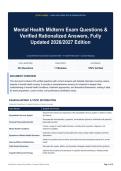
Mental Health Midterm Exam Questions &
Verified Rationalized Answers, Fully
Updated 2026/2027 Edition
Comprehensive Examination Question Bank • In-Depth Rationales • Concept Mapping
TOTAL QUESTIONS EXAM TOPICS RATIONALES
233 Questions 11 Modules 100% Verified
DOCUMENT OVERVIEW
This document contains 233 verified questions with correct answers and detailed rationales covering various
aspects of mental health nursing. It provides a comprehensive resource for students to deepen their
understanding of mental health conditions, treatment approaches, and theoretical frameworks, making it ideal
for exam preparation, course review, and professional certification study.
EXAM BLUEPRINT & TOPIC DISTRIBUTION
Systematic breakdown of subject domains and exam coverage.
Topic Module Scope & Core Focus
Explores the functions and responses of the sympathetic nervous system in relation to stress
Sympathetic Nervous System and trauma.
Discusses the characteristics, symptoms, and treatment options for individuals with paranoid
Paranoid Personality Disorder personality disorder.
Covers a range of mental health disorders, including their symptoms, diagnosis, and
Mental Health Conditions treatment modalities.
Examines common symptoms associated with various mental health conditions and their
Symptoms of Mental Health Disorders implications.
Details the potential adverse effects associated with pharmacological treatments in mental
Adverse Effects of Medications health.
Fetal Alcohol Syndrome Discusses the causes, effects, and prevention strategies related to fetal alcohol syndrome.
Explores the principles and techniques of cognitive behavioral therapy in treating mental
Cognitive Behavioral Therapy health disorders.
Confidential • Student Study Edition • Practice & Review Guide Page 1 of 79
,STUDENT STUDY & MASTERY EDITION PRACTICE & REVIEW GUIDE
Analyzes the role of neurotransmitters in mental health and their impact on behavior and
Neurotransmission in Mental Health emotions.
Trauma and Stressor-Related
Disorders Focuses on the classification and treatment of disorders related to trauma and stress.
Examines the various types of personality disorders and their effects on interpersonal
Personality Disorders functioning.
Substance Use and Mental Health Explores the relationship between substance use disorders and mental health issues.
Total Exam Coverage 11 Integrated Topic Modules • 233 Examination Questions
Confidential • Student Study Edition • Practice & Review Guide Page 2 of 79
,STUDENT STUDY & MASTERY EDITION PRACTICE & REVIEW GUIDE
QUESTION 1
A nurse is caring for a client and notes that the client appears disheveled, frightened,
and seems to be talking to someone who is not there. The nurse should identify that
this is an example of which of the following steps of the nursing process?
[A] planning
[B] Assessment
[C] Analysis
[D] Evaluation
Correct Answer: Assessment.
Rationale: The nurse is recognizing symptoms and behaviors that require further investigation, which is the primary function
of the assessment
step in the nursing process. This is because assessment involves gathering data about the client's condition through
observation, communication, and other methods, and the nurse's identification of the client's disheveled appearance, fear,
and hallucination is an example of this data-gathering process.
QUESTION 2
A nurse is working to build rapport and trust with new clients. Which of the following
actions should the nurse take?
[A] fulfill a promise by allowing a client to visit with family members
[B] use clinical terminology to help a client better understand their diagnosis
[C] explain the importance of treatment to a client who speaks a language different from the nurse
[D] Minimize contact with a client who is angry
Correct Answer: Fulfill a promise by allowing a client to visit with family members.
Rationale: Fulfilling a promise by allowing a client to visit with family members demonstrates a commitment to
follow-through and respect for the client's needs, which is essential for building trust and rapport. This action shows that the
nurse values the client's relationships and is willing to accommodate their requests, creating a sense of security and
stability.
Confidential • Student Study Edition • Practice & Review Guide Page 3 of 79
, STUDENT STUDY & MASTERY EDITION PRACTICE & REVIEW GUIDE
QUESTION 3
A nurse is performing a spiritual assessment for a client using the FICA tool. Which of
the following questions should the nurse ask to address the "C" in the FICA tool?
[A] do you consider yourself religious?
[b] are you a member of a spiritual organization or group
[c] what importance does spirituality have your life
[d] how would you like us as a healthcare providers to help with any spiritual concerns
Correct Answer: Are you a member of a spiritual organization or group.
Rationale: The correct answer is because the "C" in the FICA tool represents the "Community" aspect, which refers to the
spiritual support systems clients may have through membership in a spiritual organization or group. This question helps the
nurse identify whether the client has a spiritual community that provides support, guidance, or a sense of belonging.
QUESTION 4
A nurse is caring for a client who has sleep dysregulation, poor memory, and poor
concentration. Which of the following neurotransmitters should the nurse identify as
being responsible for the client's manifestations?
[a] serotonin
[b] dopamine
[c] norepinephrine
[d] histamine
Correct Answer: Serotonin.
Rationale: Serotonin is involved in regulating sleep, mood, appetite, and cognitive functions, making it a key
neurotransmitter associated with sleep dysregulation, poor memory, and poor concentration. The disturbances in sleep and
cognitive functions indicate an imbalance in serotonin levels, which would impact the client's overall mental health and
behavior.
Confidential • Student Study Edition • Practice & Review Guide Page 4 of 79
Mental Health Midterm Exam Questions &
Verified Rationalized Answers, Fully
Updated 2026/2027 Edition
Comprehensive Examination Question Bank • In-Depth Rationales • Concept Mapping
TOTAL QUESTIONS EXAM TOPICS RATIONALES
233 Questions 11 Modules 100% Verified
DOCUMENT OVERVIEW
This document contains 233 verified questions with correct answers and detailed rationales covering various
aspects of mental health nursing. It provides a comprehensive resource for students to deepen their
understanding of mental health conditions, treatment approaches, and theoretical frameworks, making it ideal
for exam preparation, course review, and professional certification study.
EXAM BLUEPRINT & TOPIC DISTRIBUTION
Systematic breakdown of subject domains and exam coverage.
Topic Module Scope & Core Focus
Explores the functions and responses of the sympathetic nervous system in relation to stress
Sympathetic Nervous System and trauma.
Discusses the characteristics, symptoms, and treatment options for individuals with paranoid
Paranoid Personality Disorder personality disorder.
Covers a range of mental health disorders, including their symptoms, diagnosis, and
Mental Health Conditions treatment modalities.
Examines common symptoms associated with various mental health conditions and their
Symptoms of Mental Health Disorders implications.
Details the potential adverse effects associated with pharmacological treatments in mental
Adverse Effects of Medications health.
Fetal Alcohol Syndrome Discusses the causes, effects, and prevention strategies related to fetal alcohol syndrome.
Explores the principles and techniques of cognitive behavioral therapy in treating mental
Cognitive Behavioral Therapy health disorders.
Confidential • Student Study Edition • Practice & Review Guide Page 1 of 79
,STUDENT STUDY & MASTERY EDITION PRACTICE & REVIEW GUIDE
Analyzes the role of neurotransmitters in mental health and their impact on behavior and
Neurotransmission in Mental Health emotions.
Trauma and Stressor-Related
Disorders Focuses on the classification and treatment of disorders related to trauma and stress.
Examines the various types of personality disorders and their effects on interpersonal
Personality Disorders functioning.
Substance Use and Mental Health Explores the relationship between substance use disorders and mental health issues.
Total Exam Coverage 11 Integrated Topic Modules • 233 Examination Questions
Confidential • Student Study Edition • Practice & Review Guide Page 2 of 79
,STUDENT STUDY & MASTERY EDITION PRACTICE & REVIEW GUIDE
QUESTION 1
A nurse is caring for a client and notes that the client appears disheveled, frightened,
and seems to be talking to someone who is not there. The nurse should identify that
this is an example of which of the following steps of the nursing process?
[A] planning
[B] Assessment
[C] Analysis
[D] Evaluation
Correct Answer: Assessment.
Rationale: The nurse is recognizing symptoms and behaviors that require further investigation, which is the primary function
of the assessment
step in the nursing process. This is because assessment involves gathering data about the client's condition through
observation, communication, and other methods, and the nurse's identification of the client's disheveled appearance, fear,
and hallucination is an example of this data-gathering process.
QUESTION 2
A nurse is working to build rapport and trust with new clients. Which of the following
actions should the nurse take?
[A] fulfill a promise by allowing a client to visit with family members
[B] use clinical terminology to help a client better understand their diagnosis
[C] explain the importance of treatment to a client who speaks a language different from the nurse
[D] Minimize contact with a client who is angry
Correct Answer: Fulfill a promise by allowing a client to visit with family members.
Rationale: Fulfilling a promise by allowing a client to visit with family members demonstrates a commitment to
follow-through and respect for the client's needs, which is essential for building trust and rapport. This action shows that the
nurse values the client's relationships and is willing to accommodate their requests, creating a sense of security and
stability.
Confidential • Student Study Edition • Practice & Review Guide Page 3 of 79
, STUDENT STUDY & MASTERY EDITION PRACTICE & REVIEW GUIDE
QUESTION 3
A nurse is performing a spiritual assessment for a client using the FICA tool. Which of
the following questions should the nurse ask to address the "C" in the FICA tool?
[A] do you consider yourself religious?
[b] are you a member of a spiritual organization or group
[c] what importance does spirituality have your life
[d] how would you like us as a healthcare providers to help with any spiritual concerns
Correct Answer: Are you a member of a spiritual organization or group.
Rationale: The correct answer is because the "C" in the FICA tool represents the "Community" aspect, which refers to the
spiritual support systems clients may have through membership in a spiritual organization or group. This question helps the
nurse identify whether the client has a spiritual community that provides support, guidance, or a sense of belonging.
QUESTION 4
A nurse is caring for a client who has sleep dysregulation, poor memory, and poor
concentration. Which of the following neurotransmitters should the nurse identify as
being responsible for the client's manifestations?
[a] serotonin
[b] dopamine
[c] norepinephrine
[d] histamine
Correct Answer: Serotonin.
Rationale: Serotonin is involved in regulating sleep, mood, appetite, and cognitive functions, making it a key
neurotransmitter associated with sleep dysregulation, poor memory, and poor concentration. The disturbances in sleep and
cognitive functions indicate an imbalance in serotonin levels, which would impact the client's overall mental health and
behavior.
Confidential • Student Study Edition • Practice & Review Guide Page 4 of 79