[STUDY GUIDE] • HIGH-YIELD PRACTICE & REVIEW EDITION
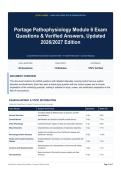
Portage Pathophysiology Module 6 Exam
Questions & Verified Answers, Updated
2026/2027 Edition
Comprehensive Examination Question Bank • In-Depth Rationales • Concept Mapping
TOTAL QUESTIONS EXAM TOPICS RATIONALES
42 Questions 12 Modules 100% Verified
DOCUMENT OVERVIEW
This document contains 42 verified questions with detailed rationales covering central nervous system
disorders and treatments. Each item pairs a board-style question with the correct answer and a concise
explanation of the underlying principle, making it suitable for study, review, and certification preparation in the
field of neuroscience.
EXAM BLUEPRINT & TOPIC DISTRIBUTION
Systematic breakdown of subject domains and exam coverage.
Topic Module Scope & Core Focus Questions Share (%)
Concepts related to different types of seizures and their
Seizure Disorders manifestations. 4 Qs 9.5%
Cranial Nerves Identification and function of specific cranial nerves. 3 Qs 7.1%
Sleep Physiology Understanding the stages of sleep and associated disorders. 4 Qs 9.5%
Mood Disorders Characteristics and classifications of depressive disorders. 3 Qs 7.1%
Insights into conditions such as Parkinson's disease and
Neurodegenerative Diseases Alzheimer's disease. 5 Qs 11.9%
Stroke and Transient Ischemic Understanding the risk factors and symptoms associated with
Attacks strokes. 3 Qs 7.1%
Exploring types and characteristics of insomnia and related
Insomnia and Sleep Disorders conditions. 3 Qs 7.1%
Basic structures of the central nervous system and their
Neuroanatomy functions. 3 Qs 7.1%
Confidential • Student Study Edition • Practice & Review Guide Page 1 of 17
,STUDENT STUDY & MASTERY EDITION PRACTICE & REVIEW GUIDE
Mechanisms of excitatory and inhibitory signaling in the
Synaptic Transmission nervous system. 3 Qs 7.1%
Understanding the effects of aging on cognitive function and
Neurobiology of Aging disorders. 3 Qs 7.1%
Overview of pharmacological treatments affecting
Neurochemical Therapies neurotransmitter systems. 5 Qs 11.9%
Alzheimer's Disease Pathology Characteristics and pathophysiology of Alzheimer's disease. 3 Qs 7.1%
Total Exam Coverage 12 Integrated Topic Modules 42 Qs 100.0%
Confidential • Student Study Edition • Practice & Review Guide Page 2 of 17
, STUDENT STUDY & MASTERY EDITION PRACTICE & REVIEW GUIDE
TOPIC 1: SEIZURE DISORDERS
4 Questions • 9.5% of Exam • Concepts related to different types of seizures and their manifestations.
QUESTION 1
A patient experiences a seizure that manifests with repetitive hand rubbing and reports
of hallucinations right before the seizure occurred. They have experienced which type
of seizure?
Correct Answer: Focal seizure with impairment of consciousness or awareness.
Rationale: The patient's experience of hallucinations before the seizure indicates an aura, a characteristic feature of focal
seizures. Since the seizure also impaired the patient's consciousness or awareness, which is marked by a loss of
responsiveness or confusion, the seizure type is classified as focal seizure with impairment of consciousness or awareness.
QUESTION 2
What type of seizure manifests with a blank stare, lasts only for a few seconds, and
often goes unnoticed?
Correct Answer: Absence seizure.
Rationale: An absence seizure is characterized by a brief, sudden loss of consciousness, often lasting only a few seconds,
which is consistent with the description of a short duration. This type of seizure is also commonly associated with a blank or
glazed expression, making it easy to overlook, which aligns with the notion that it often goes unnoticed.
QUESTION 3
You are babysitting a 7-year-old child with a known history of seizure activity. You
notice they appear flushed and seem unresponsive. You ask if they are feeling alright
and they stare at you blankly. After a few seconds they act as if nothing happened and
return to play. Is this a generalized or focal seizure? Based upon this description, what
specific type of seizure did this individual experience?
Correct Answer: Generalized absence seizure.
Rationale: This individual experienced a generalized seizure because the child's entire brain was affected, as evidenced by
their unresponsiveness and blank stare, indicating a loss of consciousness that is characteristic of generalized seizures.
The lack of any focal symptoms, such as twitching or numbness, and the child's quick return to normal activity also suggests
that the seizure was generalized and not focal, allowing for a rapid recovery without any lingering effects.
Confidential • Student Study Edition • Practice & Review Guide Page 3 of 17
Portage Pathophysiology Module 6 Exam
Questions & Verified Answers, Updated
2026/2027 Edition
Comprehensive Examination Question Bank • In-Depth Rationales • Concept Mapping
TOTAL QUESTIONS EXAM TOPICS RATIONALES
42 Questions 12 Modules 100% Verified
DOCUMENT OVERVIEW
This document contains 42 verified questions with detailed rationales covering central nervous system
disorders and treatments. Each item pairs a board-style question with the correct answer and a concise
explanation of the underlying principle, making it suitable for study, review, and certification preparation in the
field of neuroscience.
EXAM BLUEPRINT & TOPIC DISTRIBUTION
Systematic breakdown of subject domains and exam coverage.
Topic Module Scope & Core Focus Questions Share (%)
Concepts related to different types of seizures and their
Seizure Disorders manifestations. 4 Qs 9.5%
Cranial Nerves Identification and function of specific cranial nerves. 3 Qs 7.1%
Sleep Physiology Understanding the stages of sleep and associated disorders. 4 Qs 9.5%
Mood Disorders Characteristics and classifications of depressive disorders. 3 Qs 7.1%
Insights into conditions such as Parkinson's disease and
Neurodegenerative Diseases Alzheimer's disease. 5 Qs 11.9%
Stroke and Transient Ischemic Understanding the risk factors and symptoms associated with
Attacks strokes. 3 Qs 7.1%
Exploring types and characteristics of insomnia and related
Insomnia and Sleep Disorders conditions. 3 Qs 7.1%
Basic structures of the central nervous system and their
Neuroanatomy functions. 3 Qs 7.1%
Confidential • Student Study Edition • Practice & Review Guide Page 1 of 17
,STUDENT STUDY & MASTERY EDITION PRACTICE & REVIEW GUIDE
Mechanisms of excitatory and inhibitory signaling in the
Synaptic Transmission nervous system. 3 Qs 7.1%
Understanding the effects of aging on cognitive function and
Neurobiology of Aging disorders. 3 Qs 7.1%
Overview of pharmacological treatments affecting
Neurochemical Therapies neurotransmitter systems. 5 Qs 11.9%
Alzheimer's Disease Pathology Characteristics and pathophysiology of Alzheimer's disease. 3 Qs 7.1%
Total Exam Coverage 12 Integrated Topic Modules 42 Qs 100.0%
Confidential • Student Study Edition • Practice & Review Guide Page 2 of 17
, STUDENT STUDY & MASTERY EDITION PRACTICE & REVIEW GUIDE
TOPIC 1: SEIZURE DISORDERS
4 Questions • 9.5% of Exam • Concepts related to different types of seizures and their manifestations.
QUESTION 1
A patient experiences a seizure that manifests with repetitive hand rubbing and reports
of hallucinations right before the seizure occurred. They have experienced which type
of seizure?
Correct Answer: Focal seizure with impairment of consciousness or awareness.
Rationale: The patient's experience of hallucinations before the seizure indicates an aura, a characteristic feature of focal
seizures. Since the seizure also impaired the patient's consciousness or awareness, which is marked by a loss of
responsiveness or confusion, the seizure type is classified as focal seizure with impairment of consciousness or awareness.
QUESTION 2
What type of seizure manifests with a blank stare, lasts only for a few seconds, and
often goes unnoticed?
Correct Answer: Absence seizure.
Rationale: An absence seizure is characterized by a brief, sudden loss of consciousness, often lasting only a few seconds,
which is consistent with the description of a short duration. This type of seizure is also commonly associated with a blank or
glazed expression, making it easy to overlook, which aligns with the notion that it often goes unnoticed.
QUESTION 3
You are babysitting a 7-year-old child with a known history of seizure activity. You
notice they appear flushed and seem unresponsive. You ask if they are feeling alright
and they stare at you blankly. After a few seconds they act as if nothing happened and
return to play. Is this a generalized or focal seizure? Based upon this description, what
specific type of seizure did this individual experience?
Correct Answer: Generalized absence seizure.
Rationale: This individual experienced a generalized seizure because the child's entire brain was affected, as evidenced by
their unresponsiveness and blank stare, indicating a loss of consciousness that is characteristic of generalized seizures.
The lack of any focal symptoms, such as twitching or numbness, and the child's quick return to normal activity also suggests
that the seizure was generalized and not focal, allowing for a rapid recovery without any lingering effects.
Confidential • Student Study Edition • Practice & Review Guide Page 3 of 17