
APEA 3P EXAM 2026/2027 ADVANCED PRACTICE
EDUCATION ASSOCIATES PREDICTOR
EXAMINATION — COMPLETE PREP GUIDE
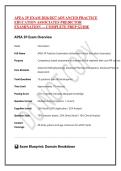
APEA 3P Exam Overview
Detail Information
Full Name APEA 3P Predictor Examination (Advanced Practice Education Associates)
Purpose Competency-based assessment to evaluate clinical readiness after core NP courses
Advanced Pathophysiology, Advanced Pharmacotherapeutics, Advanced Physical
Core Domains
Assessment
Total Questions 75 questions (per official blueprint)
Time Limit Approximately 110 minutes
Passing Score 67% or greater indicates adequate knowledge
Question Format Multiple choice (4 options, 1 correct)
Cognitive Levels 25% Recall / 50% Application / 25% Analysis
Question Style 70% Scenario-based / 20% Direct Recall / 10% Clinical Analysis
Content
All body systems and age continuum for all NP tracks
Coverage
📊 Exam Blueprint: Domain Breakdown
,Testing Domain Number of Questions Percent of Exam
Physical Assessment 25 33%
Pathophysiology 25 33%
Pharmacotherapeutics 25 33%
Total 75 100%
What Each Domain Tests
Physical Assessment: Subjective history gathering, interviewing techniques, chief
complaint, past records, risk factors, objective assessment, and recognizing normal vs.
abnormal findings across all body systems .
Pharmacotherapeutics: Prescribing choices for specific patients, drug side effects,
efficacy, prescribing constraints (cost, insurance), allergies, drug-drug and drug-disease
interactions, mechanisms of action, pharmacokinetics, and patient education .
Pathophysiology: Disease mechanisms, etiology, clinical manifestations, alterations in
body systems, and the signs and symptoms related to specific conditions or diseases .
Section 1: Cardiovascular (Questions 1–15)
1. A 58-year-old male presents with progressive dyspnea on exertion, orthopnea, and
bilateral lower extremity edema. Exam reveals JVD, an S3 gallop, and bibasilar crackles.
BNP is 850 pg/mL. Which diagnosis is most likely?
A. COPD exacerbation
B. Heart failure with reduced ejection fraction
C. Pulmonary embolism
D. Pneumonia
,Correct Answer: B
Rationale: The classic triad of heart failure plus objective findings (JVD, S3 gallop,
crackles, elevated BNP) strongly supports HF.
2. A patient with heart failure has a BNP of 850 pg/mL. What does this indicate?
A. Normal cardiac function
B. Volume overload and heart failure
C. Pulmonary embolism
D. COPD exacerbation
Correct Answer: B
Rationale: BNP >400 pg/mL strongly supports heart failure with volume overload.
3. The compensatory mechanism in early congestive heart failure involves:
A. Decreased preload
B. Increased sympathetic tone
C. Decreased afterload
D. Reduced renin release
Correct Answer: B
Rationale: Early heart failure triggers increased sympathetic tone to maintain cardiac
output, though this eventually becomes maladaptive.
4. A patient with a history of heart failure and hypertension presents with new-onset
dyspnea and bilateral lower extremity edema. Which medication class should be used
with caution?
A. ACE inhibitors
B. Beta-blockers
C. NSAIDs
D. Diuretics
, Correct Answer: C
Rationale: NSAIDs can cause fluid retention, reduce renal function, and decrease the
effectiveness of diuretics and antihypertensives, potentially worsening heart failure.
5. A patient is prescribed warfarin for atrial fibrillation. The INR is 4.5. The patient has no
signs of bleeding. What is the most appropriate management?
A. Administer vitamin K 10 mg IV
B. Hold warfarin and recheck INR in 1–2 days
C. Administer fresh frozen plasma
D. Increase warfarin dose
Correct Answer: B
Rationale: For INR 4.5 without bleeding, warfarin should be held and INR rechecked.
Vitamin K is reserved for serious bleeding or very high INR.
6. The ankle-brachial index is a screening test used to assess a person's risk for:
A. Venous insufficiency
B. Peripheral artery disease
C. Deep vein thrombosis
D. Lymphedema
Correct Answer: B
Rationale: The ABI compares BP in the ankle to the arm and is used to screen for
peripheral artery disease.
7. When auscultating breath sounds in a patient who has left-sided heart failure, the
breath sounds are:
A. Vesicular with late inspiratory crackles in the dependent portions
B. Wheezing throughout all lung fields
C. Absent in the bases
D. Bronchial with expiratory wheezing
EDUCATION ASSOCIATES PREDICTOR
EXAMINATION — COMPLETE PREP GUIDE
APEA 3P Exam Overview
Detail Information
Full Name APEA 3P Predictor Examination (Advanced Practice Education Associates)
Purpose Competency-based assessment to evaluate clinical readiness after core NP courses
Advanced Pathophysiology, Advanced Pharmacotherapeutics, Advanced Physical
Core Domains
Assessment
Total Questions 75 questions (per official blueprint)
Time Limit Approximately 110 minutes
Passing Score 67% or greater indicates adequate knowledge
Question Format Multiple choice (4 options, 1 correct)
Cognitive Levels 25% Recall / 50% Application / 25% Analysis
Question Style 70% Scenario-based / 20% Direct Recall / 10% Clinical Analysis
Content
All body systems and age continuum for all NP tracks
Coverage
📊 Exam Blueprint: Domain Breakdown
,Testing Domain Number of Questions Percent of Exam
Physical Assessment 25 33%
Pathophysiology 25 33%
Pharmacotherapeutics 25 33%
Total 75 100%
What Each Domain Tests
Physical Assessment: Subjective history gathering, interviewing techniques, chief
complaint, past records, risk factors, objective assessment, and recognizing normal vs.
abnormal findings across all body systems .
Pharmacotherapeutics: Prescribing choices for specific patients, drug side effects,
efficacy, prescribing constraints (cost, insurance), allergies, drug-drug and drug-disease
interactions, mechanisms of action, pharmacokinetics, and patient education .
Pathophysiology: Disease mechanisms, etiology, clinical manifestations, alterations in
body systems, and the signs and symptoms related to specific conditions or diseases .
Section 1: Cardiovascular (Questions 1–15)
1. A 58-year-old male presents with progressive dyspnea on exertion, orthopnea, and
bilateral lower extremity edema. Exam reveals JVD, an S3 gallop, and bibasilar crackles.
BNP is 850 pg/mL. Which diagnosis is most likely?
A. COPD exacerbation
B. Heart failure with reduced ejection fraction
C. Pulmonary embolism
D. Pneumonia
,Correct Answer: B
Rationale: The classic triad of heart failure plus objective findings (JVD, S3 gallop,
crackles, elevated BNP) strongly supports HF.
2. A patient with heart failure has a BNP of 850 pg/mL. What does this indicate?
A. Normal cardiac function
B. Volume overload and heart failure
C. Pulmonary embolism
D. COPD exacerbation
Correct Answer: B
Rationale: BNP >400 pg/mL strongly supports heart failure with volume overload.
3. The compensatory mechanism in early congestive heart failure involves:
A. Decreased preload
B. Increased sympathetic tone
C. Decreased afterload
D. Reduced renin release
Correct Answer: B
Rationale: Early heart failure triggers increased sympathetic tone to maintain cardiac
output, though this eventually becomes maladaptive.
4. A patient with a history of heart failure and hypertension presents with new-onset
dyspnea and bilateral lower extremity edema. Which medication class should be used
with caution?
A. ACE inhibitors
B. Beta-blockers
C. NSAIDs
D. Diuretics
, Correct Answer: C
Rationale: NSAIDs can cause fluid retention, reduce renal function, and decrease the
effectiveness of diuretics and antihypertensives, potentially worsening heart failure.
5. A patient is prescribed warfarin for atrial fibrillation. The INR is 4.5. The patient has no
signs of bleeding. What is the most appropriate management?
A. Administer vitamin K 10 mg IV
B. Hold warfarin and recheck INR in 1–2 days
C. Administer fresh frozen plasma
D. Increase warfarin dose
Correct Answer: B
Rationale: For INR 4.5 without bleeding, warfarin should be held and INR rechecked.
Vitamin K is reserved for serious bleeding or very high INR.
6. The ankle-brachial index is a screening test used to assess a person's risk for:
A. Venous insufficiency
B. Peripheral artery disease
C. Deep vein thrombosis
D. Lymphedema
Correct Answer: B
Rationale: The ABI compares BP in the ankle to the arm and is used to screen for
peripheral artery disease.
7. When auscultating breath sounds in a patient who has left-sided heart failure, the
breath sounds are:
A. Vesicular with late inspiratory crackles in the dependent portions
B. Wheezing throughout all lung fields
C. Absent in the bases
D. Bronchial with expiratory wheezing

