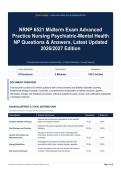
[STUDY GUIDE] • HIGH-YIELD PRACTICE & REVIEW EDITION
NRNP 6521 Midterm Exam Advanced
Practice Nursing Psychiatric-Mental Health
NP Questions & Answers, Latest Updated
2026/2027 Edition
Comprehensive Examination Question Bank • In-Depth Rationales • Concept Mapping
TOTAL QUESTIONS EXAM TOPICS RATIONALES
93 Questions 8 Modules 100% Verified
DOCUMENT OVERVIEW
This document contains 93 verified questions with correct answers and detailed rationales covering
fundamental biology concepts. It provides a comprehensive examination of cellular functions, genetic
information storage, and metabolic processes, making it suitable for study, review, and certification preparation
in biological sciences.
EXAM BLUEPRINT & TOPIC DISTRIBUTION
Systematic breakdown of subject domains and exam coverage.
Topic Module Scope & Core Focus Questions Share (%)
Explores the principles and applications of the scientific
Scientific Method in Biology method in biological research. 12 Qs 12.9%
Examines the various organelles within cells and their specific
Cell Structure and Function functions. 12 Qs 12.9%
Focuses on the role of nucleic acids in storing genetic
Genetic Information and information and the function of macromolecules in cellular
Macromolecules processes. 12 Qs 12.9%
Investigates the processes of energy production and
Energy Metabolism consumption within cells, including cellular respiration. 12 Qs 12.9%
Covers the stages of the cell cycle and the mechanisms
Cell Cycle and Division involved in DNA replication and cell division. 12 Qs 12.9%
Confidential • Student Study Edition • Practice & Review Guide Page 1 of 39
,STUDENT STUDY & MASTERY EDITION PRACTICE & REVIEW GUIDE
Discusses the principles of evolution and natural selection
Evolutionary Biology and their implications for species adaptation. 11 Qs 11.8%
Examines the relationships between organisms and their
Ecological Interactions environments, including conservation strategies. 11 Qs 11.8%
Explores various biochemical pathways, including catabolism
Biochemical Pathways and anabolism, within cellular metabolism. 11 Qs 11.8%
Total Exam Coverage 8 Integrated Topic Modules 93 Qs 100.0%
Confidential • Student Study Edition • Practice & Review Guide Page 2 of 39
,STUDENT STUDY & MASTERY EDITION PRACTICE & REVIEW GUIDE
TOPIC 1: SCIENTIFIC METHOD IN BIOLOGY
12 Questions • 12.9% of Exam • Explores the principles and applications of the scientific method in biological research.
QUESTION 1
What is the primary function of the scientific method in biology?
[A] To provide a theoretical framework for understanding biological phenomena
[B] To develop new technologies for biological research
[C] To test hypotheses and explain biological observations
[D] To describe the structure and function of living organisms
Correct Answer: To test hypotheses and explain biological observations.
Rationale: The scientific method is a systematic process used to develop and test scientific knowledge, and in biology, it is
used to test hypotheses and explain biological observations.
QUESTION 2
Which of the following is an example of a scientific principle in biology?
[A] The theory of evolution
[B] The law of conservation of energy
[C] The concept of homeostasis
[D] The process of photosynthesis
Correct Answer: The concept of homeostasis.
Rationale: Homeostasis is a scientific principle in biology that refers to the ability of living organisms to maintain a stable
internal environment despite changes in the external environment.
Confidential • Student Study Edition • Practice & Review Guide Page 3 of 39
, STUDENT STUDY & MASTERY EDITION PRACTICE & REVIEW GUIDE
QUESTION 3
What is the role of scientific analysis in the biological sciences?
[A] To collect data and make observations
[B] To develop and test hypotheses
[C] To interpret data and draw conclusions
[D] To communicate results to others
Correct Answer: To interpret data and draw conclusions.
Rationale: Scientific analysis is the process of interpreting data and drawing conclusions based on that data, and it is a
critical
step in the scientific method.
QUESTION 4
What is the purpose of scientific evaluation in the biological sciences?
[A] To collect data and make observations
[B] To develop and test hypotheses
[C] To assess the validity and reliability of scientific knowledge
[D] To communicate results to others
Correct Answer: To assess the validity and reliability of scientific knowledge.
Rationale: Scientific evaluation is the process of assessing the validity and reliability of scientific knowledge, and it is an
essential step in the scientific method.
Confidential • Student Study Edition • Practice & Review Guide Page 4 of 39
NRNP 6521 Midterm Exam Advanced
Practice Nursing Psychiatric-Mental Health
NP Questions & Answers, Latest Updated
2026/2027 Edition
Comprehensive Examination Question Bank • In-Depth Rationales • Concept Mapping
TOTAL QUESTIONS EXAM TOPICS RATIONALES
93 Questions 8 Modules 100% Verified
DOCUMENT OVERVIEW
This document contains 93 verified questions with correct answers and detailed rationales covering
fundamental biology concepts. It provides a comprehensive examination of cellular functions, genetic
information storage, and metabolic processes, making it suitable for study, review, and certification preparation
in biological sciences.
EXAM BLUEPRINT & TOPIC DISTRIBUTION
Systematic breakdown of subject domains and exam coverage.
Topic Module Scope & Core Focus Questions Share (%)
Explores the principles and applications of the scientific
Scientific Method in Biology method in biological research. 12 Qs 12.9%
Examines the various organelles within cells and their specific
Cell Structure and Function functions. 12 Qs 12.9%
Focuses on the role of nucleic acids in storing genetic
Genetic Information and information and the function of macromolecules in cellular
Macromolecules processes. 12 Qs 12.9%
Investigates the processes of energy production and
Energy Metabolism consumption within cells, including cellular respiration. 12 Qs 12.9%
Covers the stages of the cell cycle and the mechanisms
Cell Cycle and Division involved in DNA replication and cell division. 12 Qs 12.9%
Confidential • Student Study Edition • Practice & Review Guide Page 1 of 39
,STUDENT STUDY & MASTERY EDITION PRACTICE & REVIEW GUIDE
Discusses the principles of evolution and natural selection
Evolutionary Biology and their implications for species adaptation. 11 Qs 11.8%
Examines the relationships between organisms and their
Ecological Interactions environments, including conservation strategies. 11 Qs 11.8%
Explores various biochemical pathways, including catabolism
Biochemical Pathways and anabolism, within cellular metabolism. 11 Qs 11.8%
Total Exam Coverage 8 Integrated Topic Modules 93 Qs 100.0%
Confidential • Student Study Edition • Practice & Review Guide Page 2 of 39
,STUDENT STUDY & MASTERY EDITION PRACTICE & REVIEW GUIDE
TOPIC 1: SCIENTIFIC METHOD IN BIOLOGY
12 Questions • 12.9% of Exam • Explores the principles and applications of the scientific method in biological research.
QUESTION 1
What is the primary function of the scientific method in biology?
[A] To provide a theoretical framework for understanding biological phenomena
[B] To develop new technologies for biological research
[C] To test hypotheses and explain biological observations
[D] To describe the structure and function of living organisms
Correct Answer: To test hypotheses and explain biological observations.
Rationale: The scientific method is a systematic process used to develop and test scientific knowledge, and in biology, it is
used to test hypotheses and explain biological observations.
QUESTION 2
Which of the following is an example of a scientific principle in biology?
[A] The theory of evolution
[B] The law of conservation of energy
[C] The concept of homeostasis
[D] The process of photosynthesis
Correct Answer: The concept of homeostasis.
Rationale: Homeostasis is a scientific principle in biology that refers to the ability of living organisms to maintain a stable
internal environment despite changes in the external environment.
Confidential • Student Study Edition • Practice & Review Guide Page 3 of 39
, STUDENT STUDY & MASTERY EDITION PRACTICE & REVIEW GUIDE
QUESTION 3
What is the role of scientific analysis in the biological sciences?
[A] To collect data and make observations
[B] To develop and test hypotheses
[C] To interpret data and draw conclusions
[D] To communicate results to others
Correct Answer: To interpret data and draw conclusions.
Rationale: Scientific analysis is the process of interpreting data and drawing conclusions based on that data, and it is a
critical
step in the scientific method.
QUESTION 4
What is the purpose of scientific evaluation in the biological sciences?
[A] To collect data and make observations
[B] To develop and test hypotheses
[C] To assess the validity and reliability of scientific knowledge
[D] To communicate results to others
Correct Answer: To assess the validity and reliability of scientific knowledge.
Rationale: Scientific evaluation is the process of assessing the validity and reliability of scientific knowledge, and it is an
essential step in the scientific method.
Confidential • Student Study Edition • Practice & Review Guide Page 4 of 39