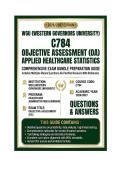
,WGU C784 OA Applied Healthcare Statistics 2026/2027 Questions
And Answers
Q1. Which value is a whole number?
A) −7
B) 3.6
C) −2.5
D) 0
Correct Answer: D) 0
Rationale: Whole numbers are the nonnegative integers 0, 1, 2, 3, and so
forth.
Q2. What is the product of −6 and 8?
A) 48
B) −48
C) −14
D) 14
Correct Answer: B) −48
Rationale: Multiplying numbers with opposite signs produces a negative
result, so −6 × 8 = −48.
Q3. Evaluate 5+3 ( 42−6 ).
A) 29
B) 35
C) 35
D) 53
Correct Answer: C) 35
Rationale: Evaluate the exponent first: 4² = 16. Then 16 − 6 = 10, 3 × 10 =
30, and 30 + 5 = 35.
Q4. What is the greatest common factor of 24 and 36?
A) 12
B) 6
C) 18
D) 72
Correct Answer: A) 12
, Rationale: The largest number that divides both 24 and 36 evenly is 12.
Q5. What are the real square roots of 81?
A) 81 and −81
B) 9 only
C) 40.5 and −40.5
D) 9 and −9
Correct Answer: D) 9 and −9
Rationale: Both 9² and (−9)² equal 81, so 81 has two real square roots: ±9.
Q6. Which number is prime?
A) 21
B) 29
C) 33
D) 39
Correct Answer: B) 29
Rationale: A prime number has exactly two positive factors, 1 and itself.
Twenty-nine has no other positive factors.
Q7. Evaluate 25.
A) 10
B) 16
C) 25
D) 32
Correct Answer: D) 32
Rationale: 25means 2 × 2 × 2 × 2 × 2, which equals 32.
Q8. What is the absolute value of −17?
A) −17
B) 17
C) 0
D) 34
Correct Answer: B) 17
Rationale: Absolute value represents distance from zero, so the absolute
value of −17 is 17.
And Answers
Q1. Which value is a whole number?
A) −7
B) 3.6
C) −2.5
D) 0
Correct Answer: D) 0
Rationale: Whole numbers are the nonnegative integers 0, 1, 2, 3, and so
forth.
Q2. What is the product of −6 and 8?
A) 48
B) −48
C) −14
D) 14
Correct Answer: B) −48
Rationale: Multiplying numbers with opposite signs produces a negative
result, so −6 × 8 = −48.
Q3. Evaluate 5+3 ( 42−6 ).
A) 29
B) 35
C) 35
D) 53
Correct Answer: C) 35
Rationale: Evaluate the exponent first: 4² = 16. Then 16 − 6 = 10, 3 × 10 =
30, and 30 + 5 = 35.
Q4. What is the greatest common factor of 24 and 36?
A) 12
B) 6
C) 18
D) 72
Correct Answer: A) 12
, Rationale: The largest number that divides both 24 and 36 evenly is 12.
Q5. What are the real square roots of 81?
A) 81 and −81
B) 9 only
C) 40.5 and −40.5
D) 9 and −9
Correct Answer: D) 9 and −9
Rationale: Both 9² and (−9)² equal 81, so 81 has two real square roots: ±9.
Q6. Which number is prime?
A) 21
B) 29
C) 33
D) 39
Correct Answer: B) 29
Rationale: A prime number has exactly two positive factors, 1 and itself.
Twenty-nine has no other positive factors.
Q7. Evaluate 25.
A) 10
B) 16
C) 25
D) 32
Correct Answer: D) 32
Rationale: 25means 2 × 2 × 2 × 2 × 2, which equals 32.
Q8. What is the absolute value of −17?
A) −17
B) 17
C) 0
D) 34
Correct Answer: B) 17
Rationale: Absolute value represents distance from zero, so the absolute
value of −17 is 17.