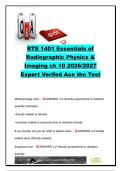
This RTE 1401 Essentials of Radiographic Physics & Imaging Chapter 10 2026/2027 study resource contains 40+ questions, answers and key review points focused on radiographic exposure factors and image production. Across 9 pages, the document covers milliampereage (mA), exposure time, mAs, kilovoltage peak (kVp), the 15% rule, patient dose, digital image receptor exposure, focal-spot size, source-to-image distance (SID), object-to-image receptor distance (OID), magnification, grids, beam restriction, filtration, film-screen speed, patient body habitus and part thickness. The cover page specifically identifies the material as Chapter 10 of RTE 1401 Essentials of Radiographic Physics & Imaging for 2026/2027.
The opening section concentrates on mA, exposure time and mAs. According to the document, mA is directly proportional to radiation quantity and image density, while doubling mA doubles patient dose. Exposure time is likewise presented as directly proportional to radiation quantity, with mA and exposure time adjusted inversely when maintaining density. For film-screen imaging, the material identifies mAs as the primary controlling factor for film density and discusses substantial mAs adjustments when an image must be repeated.
The kVp and 15% rule material examines how kilovoltage affects x-ray beam quantity, penetrating ability, scatter, transmission, absorption and radiographic contrast. The document states that increasing kVp increases photon penetration and scatter while decreasing contrast. It repeatedly reinforces the 15% rule, explaining that a 15% change in kVp can have an effect comparable to doubling mAs or reducing mAs by 50%. The digital-imaging section also distinguishes excessive receptor exposure, which may still produce acceptable displayed brightness after computer processing but increase patient exposure, from insufficient receptor exposure associated with quantum noise.
The resource then reviews focal-spot size, SID, OID and radiographic geometry. Focal-spot size is linked to image sharpness, with the material recommending the smallest practical focal spot while noting its heat-loading limitations. Standard SID values of 40 and 72 inches are included, together with the relationship between SID, spatial resolution and image distortion. Students also review the inverse-square relationship, OID effects on magnification and recorded detail, and magnification-factor concepts.
The scatter-control and grid section defines a grid as a device positioned between the patient and image receptor to absorb scatter exiting the patient. It reviews grid-use criteria, technique adjustments associated with grids, the relationship between grid use and patient dose, and the effects of beam restriction. The material emphasizes that larger radiation fields generate more scatter, whereas increased collimation reduces the irradiated field and is associated in the document with reduced fog and patient dose.
The final pages address generator output, tube filtration, compensating filters, film-screen speed, body habitus and tissue attenuation. The document states that x-ray tubes operating above 70 kVp require a minimum of 2.5 mm aluminum filtration and discusses how filtration changes the proportion of penetrating photons. It also distinguishes sthenic, hypersthenic and hyposthenic/asthenic body types and explains how part thickness affects attenuation and contrast. The final review point connects changes in kVp with changes in absorption and transmission within anatomic tissues.
Relevant Students: This document is particularly relevant to students enrolled in RTE 1401 Essentials of Radiographic Physics & Imaging who are preparing for Chapter 10 quizzes, unit tests or comprehensive examinations during 2026/2027. It is also useful for radiography and radiologic technology students reviewing exposure-factor selection, x-ray beam characteristics, patient dose, image quality, radiographic geometry, grids, collimation and filtration. The uploaded document does not identify a specific college or university, so an institution has not been attributed without supporting information.
Keywords: RTE 1401 Chapter 10, RTE , RTE 1401 questions and answers, RTE 1401 Essentials of Radiographic Physics and Imaging, radiographic physics Chapter 10, radiographic physics exam questions, radiography exposure factors, mA radiography, mAs radiography, kVp radiography, 15 percent rule radiography, kVp and mAs relationship, patient radiation dose, digital image receptor exposure, quantum noise radiography, radiographic contrast, focal spot size, source to image distance, SID radiography, object to image receptor distance, OID radiography, inverse square law radiography, magnification factor, radiographic grids, scatter radiation, beam restriction, x ray collimation, tube filtration, compensating filters, film screen speed, radiographic attenuation, radiographic image quality, radiologic technology study guide
Vista previa del contenido
RTE 1401 Essentials of
Radiographic Physics &
Imaging ch 10 2026/2027
Expert Verifed Ace the Test
Milliampreage (mA) - ANSWER ✔✔-directly proportional to radiation
quantity (intensity)
-directly related to density
-inversely related to exposure time to maintain density
If you double mA you do what to patient dose - ANSWER ✔✔double
patient dose (directly related)
Exposure time - ANSWER ✔✔-directly proportional to radiation
quantity
, -directly related to density
-inversly related to mA to maintain dneisty
Film-Screen Image receptors - ANSWER ✔✔-mAs controls the
density produced in the image
-film characteristics, speed, and chemical processing determine optical
density for a mAs
What is the primary controlling factor for film density - ANSWER
✔✔mAs
When you repeate an image what must do the mAs - ANSWER
✔✔either doubl or half (about a 30% change) to see improvement on the
image
-make adjustments by a factor of two
Kilovoltage (kVp) - ANSWER ✔✔alters the amount and penetrating
ability of the x-beam
-important for quality image
-effects contrast but with DR it is auto adjusted during computer
processing
Relationship: