
ATI RN Capstone Proctored Pre-Assessment | Ultimate NCLEX-RN Review Complete Questions with Verified Correct Answers
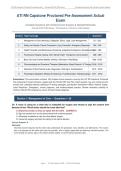
ATI RN Capstone Proctored Pre-Assessment Actual
Exam
Complete Questions with Verified Correct Answers & Detailed Rationales
Ultimate NCLEX-RN Review | 180 Questions | 8 Sections | 2026 Updated
Section Topic Coverage Questions
1 Management of Care (Advocacy, Delegation, Ethics, Legal, Case Management) Q1 - Q25
2 Safety and Infection Control (Precautions, Injury Prevention, Emergency Response) Q26 - Q45
3 Health Promotion and Maintenance (Screening, Antepartum/Intrapartum, Developmental)
Q46 - Q65
4 Psychosocial Integrity (Coping, Grief, Mental Health, Therapeutic Communication) Q66 - Q85
5 Basic Care and Comfort (Mobility, Nutrition, Elimination, Rest/Sleep) Q86 - Q105
6 Pharmacological and Parenteral Therapies (Medications, Blood Products, IV Therapy) Q106 - Q130
7 Reduction of Risk Potential (Labs, Diagnostics, Vital Signs, Complications) Q131 - Q150
8 Physiological Adaptation (Medical Emergencies, Fluid/Electrolytes, Pathophysiology) Q151 - Q180
Instructions: This examination contains 180 multiple-choice questions covering the ATI RN Capstone Proctored
Pre-Assessment content domains, aligned with the NCLEX-RN Test Plan. Each question has one verified correct
answer with a detailed rationale reflecting ATI testing strategies, prioritization frameworks (ABCs, Maslow, Safety,
Least Restrictive, Delegation), clinical judgment, and evidence-based practice. Review rationales carefully to
reinforce NCLEX-RN competency across all Client Need categories.
Section 1: Management of Care — Questions 1–25
Q1: A nurse is caring for a client who is scheduled for surgery and refuses to sign the consent form
because of fear. Which action should the nurse take first?
A. Notify the provider so they can speak with the client. [CORRECT]
B. Sign the consent form on the client's behalf with a witness present.
C. Administer a sedative to calm the client before surgery.
D. Cancel the surgery and notify the family of the client's decision.
Correct Answer: A
Rationale:
Informed consent requires that the client fully understands the procedure, risks, benefits, and alternatives. The nurse's
role is to advocate for the client and notify the provider, who is legally responsible for obtaining informed consent. The
nurse should not coerce, sign on the client's behalf, sedate, or cancel without provider input.
Page 1 | ATI RN Capstone 2026 | NCLEX-RN Review
,ATI RN Capstone Proctored Pre-Assessment | Ultimate NCLEX-RN Review Complete Questions with Verified Correct Answers
Q2: A nurse on a medical-surgical unit is caring for four clients. Which client should the nurse assess
first?
A. A client who is 2 days postoperative with a temperature of 100.4°F (38°C)
B. A client with chronic heart failure reporting dyspnea after walking to the bathroom [CORRECT]
C. A client receiving IV antibiotics with a scheduled dose due in 30 minutes
D. A client with type 1 diabetes mellitus whose lunch tray has just arrived
Correct Answer: B
Rationale:
Using the ABC prioritization framework and the concept of acute versus chronic, dyspnea in a heart failure client
suggests potential acute decompensation and possible pulmonary edema. The nurse must assess this client first to
prevent respiratory compromise. The other clients' needs, while important, are not immediately life-threatening.
Q3: A registered nurse (RN) is delegating tasks to a licensed practical nurse (LPN) and an unlicensed
assistive personnel (UAP). Which of the following tasks is appropriate to delegate to the LPN?
A. Ambulating a stable client for the first time postoperatively
B. Administering oral medications to a stable client [CORRECT]
C. Teaching a newly diagnosed diabetic client about insulin administration
D. Performing an initial admission assessment on a new client
Correct Answer: B
Rationale:
The RN should use the Five Rights of Delegation: right task, right circumstance, right person, right direction, and right
supervision. LPNs can administer oral medications to stable clients because this falls within their scope of practice. Initial
assessments, complex teaching, and first-time postoperative ambulation require the RN's scope.
Q4: A nurse is caring for a client who has a living will and is now unconscious. The family wants the client
to receive a blood transfusion that the client previously refused in the living will. What should the nurse
do?
A. Administer the transfusion because the family is requesting it
B. Honor the living will and do not administer the transfusion [CORRECT]
C. Contact the provider for clarification on the living will
D. Transfer the client to another facility that does not honor living wills
Correct Answer: B
Rationale:
A living will is an advance directive that specifies the client's wishes regarding medical treatment when they are unable
to communicate. The nurse is ethically and legally obligated to honor the client's autonomous decision. The family's
request does not override the client's documented wishes.
Q5: A nurse manager is reviewing ethical principles with staff. Which scenario best demonstrates the
ethical principle of justice?
A. A nurse ensures all clients receive the same quality of care regardless of insurance status [CORRECT]
B. A nurse respects a client's decision to refuse a blood transfusion
C. A nurse administers pain medication to relieve suffering
D. A nurse does not share a client's diagnosis with the client's employer
Correct Answer: A
Rationale:
Justice is the ethical principle of fairness and equal treatment. Ensuring all clients receive equal care regardless of their
insurance status demonstrates justice. Option B demonstrates autonomy, Option C demonstrates beneficence, and
Option D demonstrates confidentiality.
Page 2 | ATI RN Capstone 2026 | NCLEX-RN Review
,ATI RN Capstone Proctored Pre-Assessment | Ultimate NCLEX-RN Review Complete Questions with Verified Correct Answers
Q6: A nurse is preparing to administer a medication when the client states, 'That's not the pill I usually
take.' What should the nurse do first?
A. Encourage the client to take the medication because it is the correct dose
B. Verify the medication order and check the client's allergy band [CORRECT]
C. Document the client's refusal in the medical record
D. Notify the pharmacist of a medication error
Correct Answer: B
Rationale:
Patient safety is paramount. The nurse should verify the medication order, check the client's identification and allergy
band, and confirm the medication is correct before administration. The nurse should not coerce, document refusal
prematurely, or assume an error has occurred before verification.
Q7: A nurse is caring for a client who is HIV-positive and overhears a colleague discussing the client's
diagnosis in the cafeteria. Which action should the nurse take?
A. Report the colleague to the nurse manager for breach of confidentiality [CORRECT]
B. Confront the colleague privately about HIPAA violations
C. Document the incident in the client's medical record
D. Ignore the situation since the colleague did not name the client directly
Correct Answer: A
Rationale:
Discussing a client's diagnosis in a public area violates HIPAA confidentiality protections. The nurse has an ethical and
legal obligation to report the breach to the appropriate authority (nurse manager). The nurse manager can investigate
and ensure corrective action. Documentation in the medical record is inappropriate, and ignoring is unethical.
Q8: A nurse case manager is coordinating care for a client who is being discharged home with complex
medical needs. Which action should the nurse take first?
A. Arrange for home health services to visit the client
B. Assess the client's home environment and support system [CORRECT]
C. Provide written discharge instructions to the client
D. Schedule a follow-up appointment with the provider
Correct Answer: B
Rationale:
Case management requires a thorough assessment before planning interventions. Assessing the home environment
and support system is the first step to identify barriers, resources, and specific needs. The other actions (home health,
instructions, follow-up) are appropriate but must be based on assessment findings.
Q9: A nurse is assigned to care for a client whose religious beliefs prohibit blood transfusions. The client
is experiencing hemorrhage. What is the nurse's priority action?
A. Administer the transfusion to save the client's life
B. Respect the client's religious beliefs and document the refusal
C. Contact the ethics committee immediately
D. Notify the provider and explore alternative treatments [CORRECT]
Correct Answer: D
Rationale:
The nurse should respect the client's autonomy and religious beliefs while advocating for their safety. Notifying the
provider allows the healthcare team to explore alternative treatments such as volume expanders, erythropoietin, or other
bloodless options. Administering against the client's wishes is battery.
Page 3 | ATI RN Capstone 2026 | NCLEX-RN Review
, ATI RN Capstone Proctored Pre-Assessment | Ultimate NCLEX-RN Review Complete Questions with Verified Correct Answers
Q10: A new graduate nurse is caring for a client with a complex cardiac condition. Which situation
requires the new nurse to consult the charge nurse or provider immediately?
A. The client's heart rate decreases from 88 to 72 bpm
B. The client develops new-onset atrial fibrillation with a rapid ventricular response [CORRECT]
C. The client requests additional pain medication beyond the prescribed dose
D. The client's family asks for an update on the client's condition
Correct Answer: B
Rationale:
New-onset atrial fibrillation with rapid ventricular response is a potentially life-threatening dysrhythmia that requires
immediate intervention. New graduates should escalate complex or unstable situations to experienced staff. The other
options can be addressed through standard nursing protocols without immediate escalation.
Q11: A nurse is caring for a client who is scheduled for an elective surgery. The client is deaf and uses
sign language. How should the nurse ensure effective communication during the informed consent
process?
A. Ask a family member to interpret for the client
B. Use a qualified medical interpreter who is proficient in sign language [CORRECT]
C. Provide written materials for the client to read and sign
D. Proceed with consent and document the client's disability
Correct Answer: B
Rationale:
Effective communication during informed consent requires a qualified medical interpreter to ensure the client fully
understands the procedure. Family members should not interpret due to potential bias and HIPAA concerns. Written
materials alone may not address questions, and proceeding without effective communication violates informed consent.
Q12: A nurse is caring for four clients. Which client should the nurse evaluate first?
A. A client receiving IV heparin with a scheduled PTT
B. A client who received morphine 30 minutes ago and is now somnolent [CORRECT]
C. A client with a new onset of a low-grade fever
D. A client requesting assistance to the bathroom
Correct Answer: B
Rationale:
Using the safety framework and ABC prioritization, a somnolent client after morphine administration may be
experiencing opioid-induced respiratory depression. The nurse must evaluate airway, breathing, and circulation first. The
other clients' needs are important but not immediately life-threatening.
Q13: A nurse is delegating tasks to a UAP. Which task is appropriate to assign?
A. Measuring intake and output for a stable client [CORRECT]
B. Performing a comprehensive head-to-toe assessment
C. Administering a scheduled oral medication
D. Teaching a client about wound care
Correct Answer: A
Rationale:
Per the Five Rights of Delegation, UAPs can perform routine, non-invasive tasks such as measuring intake and output
for stable clients. Assessments, medication administration, and client teaching require the RN's scope of practice and
clinical judgment.
Page 4 | ATI RN Capstone 2026 | NCLEX-RN Review
ATI RN Capstone Proctored Pre-Assessment Actual
Exam
Complete Questions with Verified Correct Answers & Detailed Rationales
Ultimate NCLEX-RN Review | 180 Questions | 8 Sections | 2026 Updated
Section Topic Coverage Questions
1 Management of Care (Advocacy, Delegation, Ethics, Legal, Case Management) Q1 - Q25
2 Safety and Infection Control (Precautions, Injury Prevention, Emergency Response) Q26 - Q45
3 Health Promotion and Maintenance (Screening, Antepartum/Intrapartum, Developmental)
Q46 - Q65
4 Psychosocial Integrity (Coping, Grief, Mental Health, Therapeutic Communication) Q66 - Q85
5 Basic Care and Comfort (Mobility, Nutrition, Elimination, Rest/Sleep) Q86 - Q105
6 Pharmacological and Parenteral Therapies (Medications, Blood Products, IV Therapy) Q106 - Q130
7 Reduction of Risk Potential (Labs, Diagnostics, Vital Signs, Complications) Q131 - Q150
8 Physiological Adaptation (Medical Emergencies, Fluid/Electrolytes, Pathophysiology) Q151 - Q180
Instructions: This examination contains 180 multiple-choice questions covering the ATI RN Capstone Proctored
Pre-Assessment content domains, aligned with the NCLEX-RN Test Plan. Each question has one verified correct
answer with a detailed rationale reflecting ATI testing strategies, prioritization frameworks (ABCs, Maslow, Safety,
Least Restrictive, Delegation), clinical judgment, and evidence-based practice. Review rationales carefully to
reinforce NCLEX-RN competency across all Client Need categories.
Section 1: Management of Care — Questions 1–25
Q1: A nurse is caring for a client who is scheduled for surgery and refuses to sign the consent form
because of fear. Which action should the nurse take first?
A. Notify the provider so they can speak with the client. [CORRECT]
B. Sign the consent form on the client's behalf with a witness present.
C. Administer a sedative to calm the client before surgery.
D. Cancel the surgery and notify the family of the client's decision.
Correct Answer: A
Rationale:
Informed consent requires that the client fully understands the procedure, risks, benefits, and alternatives. The nurse's
role is to advocate for the client and notify the provider, who is legally responsible for obtaining informed consent. The
nurse should not coerce, sign on the client's behalf, sedate, or cancel without provider input.
Page 1 | ATI RN Capstone 2026 | NCLEX-RN Review
,ATI RN Capstone Proctored Pre-Assessment | Ultimate NCLEX-RN Review Complete Questions with Verified Correct Answers
Q2: A nurse on a medical-surgical unit is caring for four clients. Which client should the nurse assess
first?
A. A client who is 2 days postoperative with a temperature of 100.4°F (38°C)
B. A client with chronic heart failure reporting dyspnea after walking to the bathroom [CORRECT]
C. A client receiving IV antibiotics with a scheduled dose due in 30 minutes
D. A client with type 1 diabetes mellitus whose lunch tray has just arrived
Correct Answer: B
Rationale:
Using the ABC prioritization framework and the concept of acute versus chronic, dyspnea in a heart failure client
suggests potential acute decompensation and possible pulmonary edema. The nurse must assess this client first to
prevent respiratory compromise. The other clients' needs, while important, are not immediately life-threatening.
Q3: A registered nurse (RN) is delegating tasks to a licensed practical nurse (LPN) and an unlicensed
assistive personnel (UAP). Which of the following tasks is appropriate to delegate to the LPN?
A. Ambulating a stable client for the first time postoperatively
B. Administering oral medications to a stable client [CORRECT]
C. Teaching a newly diagnosed diabetic client about insulin administration
D. Performing an initial admission assessment on a new client
Correct Answer: B
Rationale:
The RN should use the Five Rights of Delegation: right task, right circumstance, right person, right direction, and right
supervision. LPNs can administer oral medications to stable clients because this falls within their scope of practice. Initial
assessments, complex teaching, and first-time postoperative ambulation require the RN's scope.
Q4: A nurse is caring for a client who has a living will and is now unconscious. The family wants the client
to receive a blood transfusion that the client previously refused in the living will. What should the nurse
do?
A. Administer the transfusion because the family is requesting it
B. Honor the living will and do not administer the transfusion [CORRECT]
C. Contact the provider for clarification on the living will
D. Transfer the client to another facility that does not honor living wills
Correct Answer: B
Rationale:
A living will is an advance directive that specifies the client's wishes regarding medical treatment when they are unable
to communicate. The nurse is ethically and legally obligated to honor the client's autonomous decision. The family's
request does not override the client's documented wishes.
Q5: A nurse manager is reviewing ethical principles with staff. Which scenario best demonstrates the
ethical principle of justice?
A. A nurse ensures all clients receive the same quality of care regardless of insurance status [CORRECT]
B. A nurse respects a client's decision to refuse a blood transfusion
C. A nurse administers pain medication to relieve suffering
D. A nurse does not share a client's diagnosis with the client's employer
Correct Answer: A
Rationale:
Justice is the ethical principle of fairness and equal treatment. Ensuring all clients receive equal care regardless of their
insurance status demonstrates justice. Option B demonstrates autonomy, Option C demonstrates beneficence, and
Option D demonstrates confidentiality.
Page 2 | ATI RN Capstone 2026 | NCLEX-RN Review
,ATI RN Capstone Proctored Pre-Assessment | Ultimate NCLEX-RN Review Complete Questions with Verified Correct Answers
Q6: A nurse is preparing to administer a medication when the client states, 'That's not the pill I usually
take.' What should the nurse do first?
A. Encourage the client to take the medication because it is the correct dose
B. Verify the medication order and check the client's allergy band [CORRECT]
C. Document the client's refusal in the medical record
D. Notify the pharmacist of a medication error
Correct Answer: B
Rationale:
Patient safety is paramount. The nurse should verify the medication order, check the client's identification and allergy
band, and confirm the medication is correct before administration. The nurse should not coerce, document refusal
prematurely, or assume an error has occurred before verification.
Q7: A nurse is caring for a client who is HIV-positive and overhears a colleague discussing the client's
diagnosis in the cafeteria. Which action should the nurse take?
A. Report the colleague to the nurse manager for breach of confidentiality [CORRECT]
B. Confront the colleague privately about HIPAA violations
C. Document the incident in the client's medical record
D. Ignore the situation since the colleague did not name the client directly
Correct Answer: A
Rationale:
Discussing a client's diagnosis in a public area violates HIPAA confidentiality protections. The nurse has an ethical and
legal obligation to report the breach to the appropriate authority (nurse manager). The nurse manager can investigate
and ensure corrective action. Documentation in the medical record is inappropriate, and ignoring is unethical.
Q8: A nurse case manager is coordinating care for a client who is being discharged home with complex
medical needs. Which action should the nurse take first?
A. Arrange for home health services to visit the client
B. Assess the client's home environment and support system [CORRECT]
C. Provide written discharge instructions to the client
D. Schedule a follow-up appointment with the provider
Correct Answer: B
Rationale:
Case management requires a thorough assessment before planning interventions. Assessing the home environment
and support system is the first step to identify barriers, resources, and specific needs. The other actions (home health,
instructions, follow-up) are appropriate but must be based on assessment findings.
Q9: A nurse is assigned to care for a client whose religious beliefs prohibit blood transfusions. The client
is experiencing hemorrhage. What is the nurse's priority action?
A. Administer the transfusion to save the client's life
B. Respect the client's religious beliefs and document the refusal
C. Contact the ethics committee immediately
D. Notify the provider and explore alternative treatments [CORRECT]
Correct Answer: D
Rationale:
The nurse should respect the client's autonomy and religious beliefs while advocating for their safety. Notifying the
provider allows the healthcare team to explore alternative treatments such as volume expanders, erythropoietin, or other
bloodless options. Administering against the client's wishes is battery.
Page 3 | ATI RN Capstone 2026 | NCLEX-RN Review
, ATI RN Capstone Proctored Pre-Assessment | Ultimate NCLEX-RN Review Complete Questions with Verified Correct Answers
Q10: A new graduate nurse is caring for a client with a complex cardiac condition. Which situation
requires the new nurse to consult the charge nurse or provider immediately?
A. The client's heart rate decreases from 88 to 72 bpm
B. The client develops new-onset atrial fibrillation with a rapid ventricular response [CORRECT]
C. The client requests additional pain medication beyond the prescribed dose
D. The client's family asks for an update on the client's condition
Correct Answer: B
Rationale:
New-onset atrial fibrillation with rapid ventricular response is a potentially life-threatening dysrhythmia that requires
immediate intervention. New graduates should escalate complex or unstable situations to experienced staff. The other
options can be addressed through standard nursing protocols without immediate escalation.
Q11: A nurse is caring for a client who is scheduled for an elective surgery. The client is deaf and uses
sign language. How should the nurse ensure effective communication during the informed consent
process?
A. Ask a family member to interpret for the client
B. Use a qualified medical interpreter who is proficient in sign language [CORRECT]
C. Provide written materials for the client to read and sign
D. Proceed with consent and document the client's disability
Correct Answer: B
Rationale:
Effective communication during informed consent requires a qualified medical interpreter to ensure the client fully
understands the procedure. Family members should not interpret due to potential bias and HIPAA concerns. Written
materials alone may not address questions, and proceeding without effective communication violates informed consent.
Q12: A nurse is caring for four clients. Which client should the nurse evaluate first?
A. A client receiving IV heparin with a scheduled PTT
B. A client who received morphine 30 minutes ago and is now somnolent [CORRECT]
C. A client with a new onset of a low-grade fever
D. A client requesting assistance to the bathroom
Correct Answer: B
Rationale:
Using the safety framework and ABC prioritization, a somnolent client after morphine administration may be
experiencing opioid-induced respiratory depression. The nurse must evaluate airway, breathing, and circulation first. The
other clients' needs are important but not immediately life-threatening.
Q13: A nurse is delegating tasks to a UAP. Which task is appropriate to assign?
A. Measuring intake and output for a stable client [CORRECT]
B. Performing a comprehensive head-to-toe assessment
C. Administering a scheduled oral medication
D. Teaching a client about wound care
Correct Answer: A
Rationale:
Per the Five Rights of Delegation, UAPs can perform routine, non-invasive tasks such as measuring intake and output
for stable clients. Assessments, medication administration, and client teaching require the RN's scope of practice and
clinical judgment.
Page 4 | ATI RN Capstone 2026 | NCLEX-RN Review

