Neurological Assessment NURS 101
Neurological Assessment NURS 101.pdf
Study online at https://quizlet.com/_f22dqv
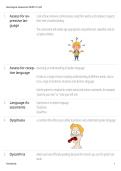
1. Assess for ex- Look at how someone communicates using their words, and compare it against
pressive lan- their level of understanding.
guage
The assessment will involve age-appropriate comprehension, repetition and de-
scriptive activities.
2. Assess for recep- Assessing an understanding of spoken language.
tive language
It looks at a range of areas including understanding of different words, instruc-
tions, range of sentences structures and abstract language.
Ask the patient to respond to simple verbal and written commands, for example,
"point to your toes" or "raise your left arm.
3. Language As- Expressive vs receptive language
sessments Dysphasia
Dysarthria
4. Dysphasia a condition that affects your ability to produce and understand spoken language
5. Dysarthria where you have difficulty speaking because the muscles you use for speech are
weak
Actualstudy 1
, Neurological Assessment NURS 101
Neurological Assessment NURS 101.pdf
Study online at https://quizlet.com/_f22dqv
6. Assess for orien- Determine the patient's orientation to time, place, and person by tactful question-
tation ing.
7. To assess memo- Ask the patient to recall recent events, such as how they got to the clinic.
ry
Ask the patient to recall information given early in the interview
Provide the patient with three facts to recall (e.g., a color, an object, and an
address), and ask the patient to repeat all three. Later in the interview, ask the
patient to recall all three items.
8. Assess remote ask the patient to describe a previous illness or surgery (e.g., 5 years ago) or a
memory birthday or anniversary.
Generally remote memory will be intact until late in neurological pathology. It is
least useful to assess acute neurological problems.
9. Assess concen- Test the ability to concentrate or maintain attention span by asking the patient to
tration or calcula- recite the alphabet or to count backward from 100.
tion ability
Test the ability to calculate by asking the patient to subtract 7 or 3 progressively
from 100, that is, 100, 93, 86, 79, or 100, 97, 94, 91.
10. Assess level of Apply the Glasgow Coma Scale: eye response, motor response, and verbal re-
consciousness sponse.
Actualstudy 2
, Neurological Assessment NURS 101
Neurological Assessment NURS 101.pdf
Study online at https://quizlet.com/_f22dqv
An assessment totaling 15 points indicates the patient is alert and completely
oriented.
A comatose patient scores 8 or less
11. Glasgow Coma EYE OPENING
Scale 4 - Spontaneous
3 - To speech
2 - To pain
0 - None
VERBAL RESPONSE
5 - Oriented - time, person, & place
4 - Confused
3 - Inappropriate Words
2 - In comprehensible Sounds
1 - No response
MOTOR RESPONSE
6 - Obey commands
5 - Moves to Localized Pain
4 - Normal flexion to withdraw from pain
3 - Abnormal flexion
2 - Abnormal Extension
Actualstudy 3
Neurological Assessment NURS 101.pdf
Study online at https://quizlet.com/_f22dqv
1. Assess for ex- Look at how someone communicates using their words, and compare it against
pressive lan- their level of understanding.
guage
The assessment will involve age-appropriate comprehension, repetition and de-
scriptive activities.
2. Assess for recep- Assessing an understanding of spoken language.
tive language
It looks at a range of areas including understanding of different words, instruc-
tions, range of sentences structures and abstract language.
Ask the patient to respond to simple verbal and written commands, for example,
"point to your toes" or "raise your left arm.
3. Language As- Expressive vs receptive language
sessments Dysphasia
Dysarthria
4. Dysphasia a condition that affects your ability to produce and understand spoken language
5. Dysarthria where you have difficulty speaking because the muscles you use for speech are
weak
Actualstudy 1
, Neurological Assessment NURS 101
Neurological Assessment NURS 101.pdf
Study online at https://quizlet.com/_f22dqv
6. Assess for orien- Determine the patient's orientation to time, place, and person by tactful question-
tation ing.
7. To assess memo- Ask the patient to recall recent events, such as how they got to the clinic.
ry
Ask the patient to recall information given early in the interview
Provide the patient with three facts to recall (e.g., a color, an object, and an
address), and ask the patient to repeat all three. Later in the interview, ask the
patient to recall all three items.
8. Assess remote ask the patient to describe a previous illness or surgery (e.g., 5 years ago) or a
memory birthday or anniversary.
Generally remote memory will be intact until late in neurological pathology. It is
least useful to assess acute neurological problems.
9. Assess concen- Test the ability to concentrate or maintain attention span by asking the patient to
tration or calcula- recite the alphabet or to count backward from 100.
tion ability
Test the ability to calculate by asking the patient to subtract 7 or 3 progressively
from 100, that is, 100, 93, 86, 79, or 100, 97, 94, 91.
10. Assess level of Apply the Glasgow Coma Scale: eye response, motor response, and verbal re-
consciousness sponse.
Actualstudy 2
, Neurological Assessment NURS 101
Neurological Assessment NURS 101.pdf
Study online at https://quizlet.com/_f22dqv
An assessment totaling 15 points indicates the patient is alert and completely
oriented.
A comatose patient scores 8 or less
11. Glasgow Coma EYE OPENING
Scale 4 - Spontaneous
3 - To speech
2 - To pain
0 - None
VERBAL RESPONSE
5 - Oriented - time, person, & place
4 - Confused
3 - Inappropriate Words
2 - In comprehensible Sounds
1 - No response
MOTOR RESPONSE
6 - Obey commands
5 - Moves to Localized Pain
4 - Normal flexion to withdraw from pain
3 - Abnormal flexion
2 - Abnormal Extension
Actualstudy 3