
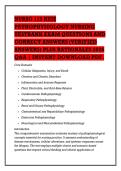
NURSG 125 HESI
PATHOPHYSIOLOGY NURSING
TESTBANK EXAM QUESTIONS AND
CORRECT ANSWERS (VERIFIED
ANSWERS) PLUS RATIONALES 2026
Q&A | INSTANT DOWNLOAD PDF.
Core Domains
• Cellular Adaptation, Injury, and Death
• Genetics and Genetic Disorders
• Inflammation and Immune Response
• Fluid, Electrolyte, and Acid-Base Balance
• Cardiovascular Pathophysiology
• Respiratory Pathophysiology
• Renal and Urinary Pathophysiology
• Gastrointestinal and Hepatobiliary Pathophysiology
• Endocrine Pathophysiology
• Neurological and Musculoskeletal Pathophysiology
Introduction
This comprehensive examination evaluates mastery of pathophysiological
concepts essential for nursing practice. It assesses understanding of
disease mechanisms, cellular alterations, and systemic responses across
the lifespan. The test employs multiple-choice and scenario-based
questions that require critical thinking and clinical application of
,pathophysiological principles. Emphasis is placed on linking underlying
mechanisms to clinical manifestations, diagnostic findings, and treatment
rationale. This assessment serves as a critical measure of readiness for
professional nursing practice and evidence-based clinical decision-
making.
Section One: Questions 1–100
1. A patient with chronic bronchitis presents with a chronic
productive cough and significant peripheral edema. Which
pathophysiological mechanism is the primary contributor to the
development of peripheral edema in this patient?
A. Increased capillary hydrostatic pressure secondary to right-sided
heart failure
B. Decreased plasma oncotic pressure due to liver dysfunction
C. Increased capillary permeability caused by systemic inflammation
D. Lymphatic obstruction due to chronic infection
A. Increased capillary hydrostatic pressure secondary to right-sided
heart failure
RATIONALE: Chronic bronchitis leads to pulmonary hypertension,
which increases the workload on the right ventricle, leading to right-
sided heart failure (cor pulmonale). This failure causes a backup of
blood in the systemic venous system, increasing capillary hydrostatic
pressure and resulting in peripheral edema. Option B is more
characteristic of liver failure or malnutrition. Option C is associated with
inflammatory conditions, not chronic bronchitis. Option D is not a typical
consequence of bronchitis.
2. A nurse is assessing a patient with a suspected diagnosis of
myasthenia gravis. Which finding is a classic pathophysiological
feature of this autoimmune disorder?
A. Demyelination of axons in the central nervous system
B. Degeneration of dopamine-producing neurons in the substantia nigra
,C. Destruction of acetylcholine receptors at the neuromuscular junction
D. Impaired conduction of action potentials due to a loss of myelin in
peripheral nerves
C. Destruction of acetylcholine receptors at the neuromuscular
junction
RATIONALE: Myasthenia gravis is an autoimmune disorder
characterized by the production of antibodies that block, alter, or
destroy acetylcholine receptors at the neuromuscular junction. This
prevents normal muscle contraction, leading to weakness. Option A
describes multiple sclerosis. Option B is characteristic of Parkinson's
disease. Option D describes a demyelinating polyneuropathy like
Guillain-Barré syndrome.
3. A patient is admitted with severe, crushing chest pain radiating to
the jaw and left arm. An ECG shows ST-segment elevation. Which
pathophysiological process is occurring in the myocardium?
A. Reversible ischemia without cell death
B. Complete coronary artery occlusion leading to full-thickness
myocardial necrosis
C. Partial coronary artery occlusion with subendocardial damage
D. Pericardial inflammation without myocardial involvement
B. Complete coronary artery occlusion leading to full-thickness
myocardial necrosis
RATIONALE: ST-elevation myocardial infarction (STEMI) results from
complete occlusion of a coronary artery, leading to transmural (full-
thickness) myocardial necrosis. Option A describes angina. Option C
describes NSTEMI. Option D describes pericarditis.
4. A patient with a history of heart failure is prescribed furosemide.
Which electrolyte imbalance is the nurse most concerned about
monitoring?
, A. Hypernatremia
B. Hyperkalemia
C. Hypokalemia
D. Hypercalcemia
C. Hypokalemia
RATIONALE: Furosemide is a loop diuretic that promotes the
excretion of water and electrolytes, particularly potassium. A common
and significant adverse effect is hypokalemia, which can lead to
dysrhythmias.
5. A patient with a suspected pulmonary embolism has an arterial
blood gas showing pH 7.48, PaCO₂ 30 mm Hg, and HCO₃ 24
mEq/L. This is:
A. Respiratory acidosis
B. Respiratory alkalosis
C. Metabolic acidosis
D. Metabolic alkalosis
B. Respiratory alkalosis
RATIONALE: A high pH with low PaCO₂ indicates respiratory
alkalosis, caused by hyperventilation. Pulmonary embolism causes
hypoxemia, triggering an increased respiratory rate and excessive CO₂
elimination.
6. A patient with chronic kidney disease has a serum potassium level
of 6.2 mEq/L. Which finding is most concerning?
A. Muscle weakness
B. Cardiac dysrhythmias
C. Nausea and vomiting
D. Paresthesias
B. Cardiac dysrhythmias
PATHOPHYSIOLOGY NURSING
TESTBANK EXAM QUESTIONS AND
CORRECT ANSWERS (VERIFIED
ANSWERS) PLUS RATIONALES 2026
Q&A | INSTANT DOWNLOAD PDF.
Core Domains
• Cellular Adaptation, Injury, and Death
• Genetics and Genetic Disorders
• Inflammation and Immune Response
• Fluid, Electrolyte, and Acid-Base Balance
• Cardiovascular Pathophysiology
• Respiratory Pathophysiology
• Renal and Urinary Pathophysiology
• Gastrointestinal and Hepatobiliary Pathophysiology
• Endocrine Pathophysiology
• Neurological and Musculoskeletal Pathophysiology
Introduction
This comprehensive examination evaluates mastery of pathophysiological
concepts essential for nursing practice. It assesses understanding of
disease mechanisms, cellular alterations, and systemic responses across
the lifespan. The test employs multiple-choice and scenario-based
questions that require critical thinking and clinical application of
,pathophysiological principles. Emphasis is placed on linking underlying
mechanisms to clinical manifestations, diagnostic findings, and treatment
rationale. This assessment serves as a critical measure of readiness for
professional nursing practice and evidence-based clinical decision-
making.
Section One: Questions 1–100
1. A patient with chronic bronchitis presents with a chronic
productive cough and significant peripheral edema. Which
pathophysiological mechanism is the primary contributor to the
development of peripheral edema in this patient?
A. Increased capillary hydrostatic pressure secondary to right-sided
heart failure
B. Decreased plasma oncotic pressure due to liver dysfunction
C. Increased capillary permeability caused by systemic inflammation
D. Lymphatic obstruction due to chronic infection
A. Increased capillary hydrostatic pressure secondary to right-sided
heart failure
RATIONALE: Chronic bronchitis leads to pulmonary hypertension,
which increases the workload on the right ventricle, leading to right-
sided heart failure (cor pulmonale). This failure causes a backup of
blood in the systemic venous system, increasing capillary hydrostatic
pressure and resulting in peripheral edema. Option B is more
characteristic of liver failure or malnutrition. Option C is associated with
inflammatory conditions, not chronic bronchitis. Option D is not a typical
consequence of bronchitis.
2. A nurse is assessing a patient with a suspected diagnosis of
myasthenia gravis. Which finding is a classic pathophysiological
feature of this autoimmune disorder?
A. Demyelination of axons in the central nervous system
B. Degeneration of dopamine-producing neurons in the substantia nigra
,C. Destruction of acetylcholine receptors at the neuromuscular junction
D. Impaired conduction of action potentials due to a loss of myelin in
peripheral nerves
C. Destruction of acetylcholine receptors at the neuromuscular
junction
RATIONALE: Myasthenia gravis is an autoimmune disorder
characterized by the production of antibodies that block, alter, or
destroy acetylcholine receptors at the neuromuscular junction. This
prevents normal muscle contraction, leading to weakness. Option A
describes multiple sclerosis. Option B is characteristic of Parkinson's
disease. Option D describes a demyelinating polyneuropathy like
Guillain-Barré syndrome.
3. A patient is admitted with severe, crushing chest pain radiating to
the jaw and left arm. An ECG shows ST-segment elevation. Which
pathophysiological process is occurring in the myocardium?
A. Reversible ischemia without cell death
B. Complete coronary artery occlusion leading to full-thickness
myocardial necrosis
C. Partial coronary artery occlusion with subendocardial damage
D. Pericardial inflammation without myocardial involvement
B. Complete coronary artery occlusion leading to full-thickness
myocardial necrosis
RATIONALE: ST-elevation myocardial infarction (STEMI) results from
complete occlusion of a coronary artery, leading to transmural (full-
thickness) myocardial necrosis. Option A describes angina. Option C
describes NSTEMI. Option D describes pericarditis.
4. A patient with a history of heart failure is prescribed furosemide.
Which electrolyte imbalance is the nurse most concerned about
monitoring?
, A. Hypernatremia
B. Hyperkalemia
C. Hypokalemia
D. Hypercalcemia
C. Hypokalemia
RATIONALE: Furosemide is a loop diuretic that promotes the
excretion of water and electrolytes, particularly potassium. A common
and significant adverse effect is hypokalemia, which can lead to
dysrhythmias.
5. A patient with a suspected pulmonary embolism has an arterial
blood gas showing pH 7.48, PaCO₂ 30 mm Hg, and HCO₃ 24
mEq/L. This is:
A. Respiratory acidosis
B. Respiratory alkalosis
C. Metabolic acidosis
D. Metabolic alkalosis
B. Respiratory alkalosis
RATIONALE: A high pH with low PaCO₂ indicates respiratory
alkalosis, caused by hyperventilation. Pulmonary embolism causes
hypoxemia, triggering an increased respiratory rate and excessive CO₂
elimination.
6. A patient with chronic kidney disease has a serum potassium level
of 6.2 mEq/L. Which finding is most concerning?
A. Muscle weakness
B. Cardiac dysrhythmias
C. Nausea and vomiting
D. Paresthesias
B. Cardiac dysrhythmias

