

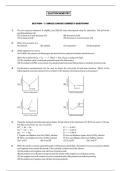
SECTION - 1 : SINGLE CHOICE CORRECT QUESTIONS
1. The two aqueous solutions; A (AgNO3) and B(LiCl) were electrolysed using Pt. electrodes. The pH of the
resulting solutions will
(A) increase in A and decrease in B (B) decrease in both
(C) increase in both (D) decrease in A and increase in B.
2. When iron is rusted, it is :
(A) reduced (B) oxidised (C) evaporated (D) decomposed
3. Which statement is correct.
(A) In SHE, the pressure of dihydrogen gas should be low and pH of solution should be zero.
(B) In the reaction H2O2 + O3 2H2O + 2O2, H2O2 is oxidised to H2O..
(C) The absolute value of electrode potential cannot be determined.
(D) According to IUPAC conventions, the standard electrode potential pertains to oxidation reactions only.
4. Conductance measurements can be used to detect the end point of acid-base titrations. Which of the
following plots correctly represent the end point of the titration of strong acid and a strong base ?
Conductance
Conductance
(A) (B)
end point end point
Volume of base added Volume of base added
Conductance
Conductance
(C) (D) end point
end point
Volume of base added Volume of base added
5. Using the standard potential values given below, decide which of the statements I, II, III, IV are correct. Choose
the right answer from (a), (b), (c) and (d)
Fe2+ + 2e– = Fe, Eº = – 0.44 V
Cu2+ + 2e– = Cu, Eº = + 0.34 V
Ag+ + e– = Ag, Eº = + 0.80 V
I. Copper can displace iron from FeSO4 solution II. Iron can displace copper from CuSO4 solution
III. Silver can displace Cu from CuSO4 solution IV. Iron can displace silver from AgNO3 solution
(A) I and II (B) II and III (C) II and IV (D) I and IV
6. When the electric current is passed through a cell having an electrolyte, the positive ions move towards cathode
and negative ions towards the anode. If the cathode is pulled out of the solution
(A) the positive and negative ions will move towards anode
(B) the positive ions will start moving towards the anode while negative ions will stop moving
(C) the negative ions will continue to move towards anode while positive ions will stop moving
(D) the positive and negative ions will start moving randomly
, 7. Which one of the following will increase the voltage of the cell ? (T = 298 K)
Sn + 2Ag+ Sn2+ + 2Ag
(A) increase in the size of silver rod (B) increase in the concentration of Sn+2 ions
(C) increase in the concentration of Ag+ ions (D) none of the above
8. In a H2 – O2 fuel cell, 6.72 L of hydrogen at NTP reacts in 15 minutes, the average current produced in amperes
is
(A) 64.3 amp (B) 643.3 amp (C) 6.43 amp (D) 0.643 amp
9. Four moles of electrons were transferred from anode to cathode in an experiment on electrolysis of water. The
total volume of the two gases (dry and at STP) produced will be approximately (in litres)
(A) 22.4 (B) 44.8 (C) 67.2 (D) 89.4
10. The standard reduction potential of a silver chloride electrode is 0.2 V and that of a silver electrode is 0.79 V.
The maximum amount of AgCl that can dissolve in 10 6 L of a 0.1 M AgNO3 solution is
(A) 0.5 mmol (B) 1.0 mmol (C) 2.0 mmol (D) 2.5 mmol
11. A cell Cu | Cu++ || Ag+ | Ag initially contains 2M Ag+ and 2M Cu++ ions in 1L electrolyte. The change in cell
potential after the passage of 10 amp current for 4825 sec is :
(A) – 0.00738 V (B) – 1.00738 V (C) – 0.0038 V (D) none
12. With t taken in seconds and taken in Amp, the variation of follows the equation
t2 + 2 = 25
what amount of Ag will be electrodeposited with this current flowing in the interval 0–5 second ? (Ag – 108)
(A) 22 mg (B) 66 mg (C) 77 mg (D) 88 mg
HCl( aq.) H2 ( g)
13. You are given the following cell at 298 K, Zn Zn ( aq.) Pt with Ecell = 0.701 and
0.01 M 1.0 lit 1.0 atm
E 0Zn2 / Zn = – 0.76 V. Which of the following amounts of NaOH (equivalent weight = 40) will just make the pH
of cathodic compartment to be equal to 7.0 :
(A) 0.4 gms (B) 4 gms (C) 10 gms (D) 2 gms.
14. If at 298 K, the solubility of AgCl in 0.05 M BaCl2(completely dissociated) is found to be very nearly 10–9 M and
E 0 Ag / Ag 0.80 V . Then the value of E 0 Cl / AgCl / Ag at the same temperature will be
(A) 1.39 V (B) 0.8295 V (C) –0.7705 V (D) 0.21 V
15. Saturated solution of KNO3 is used to make ‘salt–bridge’ because
(A) velocity of K+ is greater than that of NO3–
(B) velocity of NO3– is greater than that of K+
(C) velocities of both K+ and NO3– are nearly the same
(D) KNO3 is highly soluble in water
16. The correct order of equivalent conductance at infinite dilution of LiCl, NaCl and KCl is
(A) LiCl > NaCl > KCl (B) KCl > NaCl > LiCl (C) NaCl > KCl > LiCl (D) LiCl > KCl > NaCl
17. Standard electrode potential data are useful for understanding the suitability of an oxidant in a redox titration.
Some half cell reactions and their standard potentials are given below :
MnO4– (aq.) + 8H+ (aq.) + 5e– Mn2+ (aq.) + 4H2O( ) E0 = 1.51 V
Cr2O72– (aq.) + 14H+ (aq.) + 6e– 2Cr3+ (aq.) + 7H2O( ) E0 = 1.38 V
Fe3+ (aq.) + e– Fe2+ (aq.) E0 = 0.77 V
Cl2(g) + 2e– 2Cl– (aq.) E0 = 1.40 V
Identify the only incorrect statement regarding the quantitative estimation of aqueous Fe(NO3)2
(A) MnO4– can be used in aqueous HCl (B) Cr2O72– can be used in aqueous HCl
(C) MnO4 can be used in aqueous H2SO4
–
(D) Cr2O72– can be used in aqueous H2SO4
1. The two aqueous solutions; A (AgNO3) and B(LiCl) were electrolysed using Pt. electrodes. The pH of the
resulting solutions will
(A) increase in A and decrease in B (B) decrease in both
(C) increase in both (D) decrease in A and increase in B.
2. When iron is rusted, it is :
(A) reduced (B) oxidised (C) evaporated (D) decomposed
3. Which statement is correct.
(A) In SHE, the pressure of dihydrogen gas should be low and pH of solution should be zero.
(B) In the reaction H2O2 + O3 2H2O + 2O2, H2O2 is oxidised to H2O..
(C) The absolute value of electrode potential cannot be determined.
(D) According to IUPAC conventions, the standard electrode potential pertains to oxidation reactions only.
4. Conductance measurements can be used to detect the end point of acid-base titrations. Which of the
following plots correctly represent the end point of the titration of strong acid and a strong base ?
Conductance
Conductance
(A) (B)
end point end point
Volume of base added Volume of base added
Conductance
Conductance
(C) (D) end point
end point
Volume of base added Volume of base added
5. Using the standard potential values given below, decide which of the statements I, II, III, IV are correct. Choose
the right answer from (a), (b), (c) and (d)
Fe2+ + 2e– = Fe, Eº = – 0.44 V
Cu2+ + 2e– = Cu, Eº = + 0.34 V
Ag+ + e– = Ag, Eº = + 0.80 V
I. Copper can displace iron from FeSO4 solution II. Iron can displace copper from CuSO4 solution
III. Silver can displace Cu from CuSO4 solution IV. Iron can displace silver from AgNO3 solution
(A) I and II (B) II and III (C) II and IV (D) I and IV
6. When the electric current is passed through a cell having an electrolyte, the positive ions move towards cathode
and negative ions towards the anode. If the cathode is pulled out of the solution
(A) the positive and negative ions will move towards anode
(B) the positive ions will start moving towards the anode while negative ions will stop moving
(C) the negative ions will continue to move towards anode while positive ions will stop moving
(D) the positive and negative ions will start moving randomly
, 7. Which one of the following will increase the voltage of the cell ? (T = 298 K)
Sn + 2Ag+ Sn2+ + 2Ag
(A) increase in the size of silver rod (B) increase in the concentration of Sn+2 ions
(C) increase in the concentration of Ag+ ions (D) none of the above
8. In a H2 – O2 fuel cell, 6.72 L of hydrogen at NTP reacts in 15 minutes, the average current produced in amperes
is
(A) 64.3 amp (B) 643.3 amp (C) 6.43 amp (D) 0.643 amp
9. Four moles of electrons were transferred from anode to cathode in an experiment on electrolysis of water. The
total volume of the two gases (dry and at STP) produced will be approximately (in litres)
(A) 22.4 (B) 44.8 (C) 67.2 (D) 89.4
10. The standard reduction potential of a silver chloride electrode is 0.2 V and that of a silver electrode is 0.79 V.
The maximum amount of AgCl that can dissolve in 10 6 L of a 0.1 M AgNO3 solution is
(A) 0.5 mmol (B) 1.0 mmol (C) 2.0 mmol (D) 2.5 mmol
11. A cell Cu | Cu++ || Ag+ | Ag initially contains 2M Ag+ and 2M Cu++ ions in 1L electrolyte. The change in cell
potential after the passage of 10 amp current for 4825 sec is :
(A) – 0.00738 V (B) – 1.00738 V (C) – 0.0038 V (D) none
12. With t taken in seconds and taken in Amp, the variation of follows the equation
t2 + 2 = 25
what amount of Ag will be electrodeposited with this current flowing in the interval 0–5 second ? (Ag – 108)
(A) 22 mg (B) 66 mg (C) 77 mg (D) 88 mg
HCl( aq.) H2 ( g)
13. You are given the following cell at 298 K, Zn Zn ( aq.) Pt with Ecell = 0.701 and
0.01 M 1.0 lit 1.0 atm
E 0Zn2 / Zn = – 0.76 V. Which of the following amounts of NaOH (equivalent weight = 40) will just make the pH
of cathodic compartment to be equal to 7.0 :
(A) 0.4 gms (B) 4 gms (C) 10 gms (D) 2 gms.
14. If at 298 K, the solubility of AgCl in 0.05 M BaCl2(completely dissociated) is found to be very nearly 10–9 M and
E 0 Ag / Ag 0.80 V . Then the value of E 0 Cl / AgCl / Ag at the same temperature will be
(A) 1.39 V (B) 0.8295 V (C) –0.7705 V (D) 0.21 V
15. Saturated solution of KNO3 is used to make ‘salt–bridge’ because
(A) velocity of K+ is greater than that of NO3–
(B) velocity of NO3– is greater than that of K+
(C) velocities of both K+ and NO3– are nearly the same
(D) KNO3 is highly soluble in water
16. The correct order of equivalent conductance at infinite dilution of LiCl, NaCl and KCl is
(A) LiCl > NaCl > KCl (B) KCl > NaCl > LiCl (C) NaCl > KCl > LiCl (D) LiCl > KCl > NaCl
17. Standard electrode potential data are useful for understanding the suitability of an oxidant in a redox titration.
Some half cell reactions and their standard potentials are given below :
MnO4– (aq.) + 8H+ (aq.) + 5e– Mn2+ (aq.) + 4H2O( ) E0 = 1.51 V
Cr2O72– (aq.) + 14H+ (aq.) + 6e– 2Cr3+ (aq.) + 7H2O( ) E0 = 1.38 V
Fe3+ (aq.) + e– Fe2+ (aq.) E0 = 0.77 V
Cl2(g) + 2e– 2Cl– (aq.) E0 = 1.40 V
Identify the only incorrect statement regarding the quantitative estimation of aqueous Fe(NO3)2
(A) MnO4– can be used in aqueous HCl (B) Cr2O72– can be used in aqueous HCl
(C) MnO4 can be used in aqueous H2SO4
–
(D) Cr2O72– can be used in aqueous H2SO4


