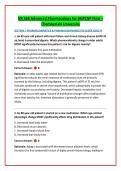
NR 568 Advanced Pharmacology for AGPCNP Final –
Chamberlain University
SECTION I: PHARMACOKINETICS & PHARMACODYNAMICS IN OLDER ADULTS
1. An 82-year-old patient with heart failure and chronic kidney disease (eGFR 35
mL/min) is prescribed digoxin. Which pharmacokinetic change in older adults
MOST significantly increases this patient's risk for digoxin toxicity?
A. Increased hepatic first-pass metabolism
B. Decreased glomerular filtration rate
C. Increased volume of distribution for lipophilic drugs
D. Decreased intestinal absorption
Correct Answer: B
Rationale: In older adults, age-related decline in renal function (decreased GFR)
significantly reduces the renal clearance of medications that are primarily
excreted by the kidneys, including digoxin. This patient's eGFR of 35 mL/min
indicates moderate to severe renal impairment, which substantially increases the
risk of digoxin accumulation and toxicity. Decreased hepatic metabolism (not
increased) occurs with aging. Volume of distribution changes affect loading doses
more than toxicity risk. Intestinal absorption is generally preserved in older
adults.
2. An 88-year-old patient is started on a new medication. Which age-related
physiologic change MOST significantly affects drug distribution in this patient?
A. Increased total body water
B. Decreased serum albumin
C. Increased hepatic blood flow
D. Increased lean body mass
Correct Answer: B
Rationale: Aging is associated with decreased serum albumin levels, which
increases the free (unbound) fraction of highly protein-bound drugs, leading to
,greater pharmacologic effect and increased risk of adverse reactions. Older adults
actually have decreased total body water and decreased lean body mass, not
increased. Hepatic blood flow decreases with age.
3. A 75-year-old patient with chronic pain is prescribed morphine. Which
statement BEST describes age-related changes in opioid pharmacology?
A. Morphine's volume of distribution decreases in older adults
B. Older adults require higher morphine doses due to decreased receptor
sensitivity
C. Morphine's half-life is prolonged in older adults due to decreased renal
clearance
D. Morphine is metabolized by CYP450 enzymes that are induced in aging
Correct Answer: C
Rationale: Morphine's active metabolite (morphine-6-glucuronide) is renally
cleared. In older adults with age-related decline in renal function, the half-life of
morphine and its metabolites is prolonged, increasing the risk of respiratory
depression and sedation. Volume of distribution for morphine may actually
increase. Receptor sensitivity is generally increased, not decreased. Morphine
undergoes glucuronidation, not CYP450 metabolism.
4. A 78-year-old patient with hypertension is prescribed a thiazide diuretic.
Which adverse effect is of GREATEST concern in this older adult population?
A. Hyperkalemia
B. Hyponatremia
C. Hyperglycemia
D. Electrolyte depletion and orthostatic hypotension
Correct Answer: D
Rationale: Older adults are particularly susceptible to electrolyte depletion
(hypokalemia, hyponatremia) and volume depletion from thiazide diuretics, which
can lead to orthostatic hypotension and increased fall risk. Thiazides cause
,hypokalemia, not hyperkalemia. While hyperglycemia can occur, electrolyte
depletion and falls represent the more immediate and clinically significant
concern in the geriatric population.
5. The Beers Criteria identifies potentially inappropriate medications for older
adults. Which medication is INCLUDED on the Beers Criteria list due to high
anticholinergic burden?
A. Metformin
B. Diphenhydramine
C. Lisinopril
D. Levothyroxine
Correct Answer: B
Rationale: First-generation antihistamines like diphenhydramine are included in
the Beers Criteria due to their high anticholinergic properties, which can cause
confusion, falls, constipation, and urinary retention in older adults. Metformin,
lisinopril, and levothyroxine are not on the Beers Criteria for high anticholinergic
burden.
6. An 80-year-old patient taking warfarin is started on amiodarone for atrial
fibrillation. What is the MOST appropriate management strategy?
A. Continue warfarin at the same dose and monitor INR in 1 month
B. Decrease warfarin dose by 30–50% and monitor INR closely
C. Increase warfarin dose to overcome amiodarone-induced resistance
D. Stop warfarin and start aspirin
Correct Answer: B
Rationale: Amiodarone inhibits CYP2C9 and CYP1A2, decreasing warfarin
metabolism and significantly increasing INR. The warfarin dose should be reduced
by 30–50% when amiodarone is initiated, with close INR monitoring. Continuing
the same dose would risk severe bleeding. Amiodarone does not cause warfarin
resistance.
, 7. Which cytochrome P450 enzyme is MOST commonly involved in clinically
significant drug interactions in older adults taking multiple medications?
A. CYP1A2
B. CYP2D6
C. CYP3A4
D. CYP2E1
Correct Answer: C
Rationale: CYP3A4 is responsible for metabolizing approximately 50% of all
medications and is the most commonly involved enzyme in clinically significant
drug interactions. Many medications used in older adults (calcium channel
blockers, statins, benzodiazepines, immunosuppressants) are CYP3A4 substrates,
and inhibitors or inducers of this enzyme can cause serious interactions.
8. A 76-year-old patient with insomnia requests a prescription for zolpidem.
Which statement represents the MOST appropriate prescribing practice for this
patient?
A. Prescribe zolpidem 10 mg nightly as the standard starting dose
B. Prescribe zolpidem 5 mg nightly with instructions to take only as needed
C. Recommend zolpidem CR for sustained sleep throughout the night
D. Avoid zolpidem entirely due to high risk of dependence
Correct Answer: B
Rationale: The Beers Criteria recommends that the dose of zolpidem be reduced
in older adults (maximum 5 mg for women, 5 mg for men) due to increased risk of
confusion, falls, and next-day impairment. The 10 mg dose is standard for younger
adults but is excessive for older adults. Zolpidem CR is also not recommended as
first-line therapy.
Chamberlain University
SECTION I: PHARMACOKINETICS & PHARMACODYNAMICS IN OLDER ADULTS
1. An 82-year-old patient with heart failure and chronic kidney disease (eGFR 35
mL/min) is prescribed digoxin. Which pharmacokinetic change in older adults
MOST significantly increases this patient's risk for digoxin toxicity?
A. Increased hepatic first-pass metabolism
B. Decreased glomerular filtration rate
C. Increased volume of distribution for lipophilic drugs
D. Decreased intestinal absorption
Correct Answer: B
Rationale: In older adults, age-related decline in renal function (decreased GFR)
significantly reduces the renal clearance of medications that are primarily
excreted by the kidneys, including digoxin. This patient's eGFR of 35 mL/min
indicates moderate to severe renal impairment, which substantially increases the
risk of digoxin accumulation and toxicity. Decreased hepatic metabolism (not
increased) occurs with aging. Volume of distribution changes affect loading doses
more than toxicity risk. Intestinal absorption is generally preserved in older
adults.
2. An 88-year-old patient is started on a new medication. Which age-related
physiologic change MOST significantly affects drug distribution in this patient?
A. Increased total body water
B. Decreased serum albumin
C. Increased hepatic blood flow
D. Increased lean body mass
Correct Answer: B
Rationale: Aging is associated with decreased serum albumin levels, which
increases the free (unbound) fraction of highly protein-bound drugs, leading to
,greater pharmacologic effect and increased risk of adverse reactions. Older adults
actually have decreased total body water and decreased lean body mass, not
increased. Hepatic blood flow decreases with age.
3. A 75-year-old patient with chronic pain is prescribed morphine. Which
statement BEST describes age-related changes in opioid pharmacology?
A. Morphine's volume of distribution decreases in older adults
B. Older adults require higher morphine doses due to decreased receptor
sensitivity
C. Morphine's half-life is prolonged in older adults due to decreased renal
clearance
D. Morphine is metabolized by CYP450 enzymes that are induced in aging
Correct Answer: C
Rationale: Morphine's active metabolite (morphine-6-glucuronide) is renally
cleared. In older adults with age-related decline in renal function, the half-life of
morphine and its metabolites is prolonged, increasing the risk of respiratory
depression and sedation. Volume of distribution for morphine may actually
increase. Receptor sensitivity is generally increased, not decreased. Morphine
undergoes glucuronidation, not CYP450 metabolism.
4. A 78-year-old patient with hypertension is prescribed a thiazide diuretic.
Which adverse effect is of GREATEST concern in this older adult population?
A. Hyperkalemia
B. Hyponatremia
C. Hyperglycemia
D. Electrolyte depletion and orthostatic hypotension
Correct Answer: D
Rationale: Older adults are particularly susceptible to electrolyte depletion
(hypokalemia, hyponatremia) and volume depletion from thiazide diuretics, which
can lead to orthostatic hypotension and increased fall risk. Thiazides cause
,hypokalemia, not hyperkalemia. While hyperglycemia can occur, electrolyte
depletion and falls represent the more immediate and clinically significant
concern in the geriatric population.
5. The Beers Criteria identifies potentially inappropriate medications for older
adults. Which medication is INCLUDED on the Beers Criteria list due to high
anticholinergic burden?
A. Metformin
B. Diphenhydramine
C. Lisinopril
D. Levothyroxine
Correct Answer: B
Rationale: First-generation antihistamines like diphenhydramine are included in
the Beers Criteria due to their high anticholinergic properties, which can cause
confusion, falls, constipation, and urinary retention in older adults. Metformin,
lisinopril, and levothyroxine are not on the Beers Criteria for high anticholinergic
burden.
6. An 80-year-old patient taking warfarin is started on amiodarone for atrial
fibrillation. What is the MOST appropriate management strategy?
A. Continue warfarin at the same dose and monitor INR in 1 month
B. Decrease warfarin dose by 30–50% and monitor INR closely
C. Increase warfarin dose to overcome amiodarone-induced resistance
D. Stop warfarin and start aspirin
Correct Answer: B
Rationale: Amiodarone inhibits CYP2C9 and CYP1A2, decreasing warfarin
metabolism and significantly increasing INR. The warfarin dose should be reduced
by 30–50% when amiodarone is initiated, with close INR monitoring. Continuing
the same dose would risk severe bleeding. Amiodarone does not cause warfarin
resistance.
, 7. Which cytochrome P450 enzyme is MOST commonly involved in clinically
significant drug interactions in older adults taking multiple medications?
A. CYP1A2
B. CYP2D6
C. CYP3A4
D. CYP2E1
Correct Answer: C
Rationale: CYP3A4 is responsible for metabolizing approximately 50% of all
medications and is the most commonly involved enzyme in clinically significant
drug interactions. Many medications used in older adults (calcium channel
blockers, statins, benzodiazepines, immunosuppressants) are CYP3A4 substrates,
and inhibitors or inducers of this enzyme can cause serious interactions.
8. A 76-year-old patient with insomnia requests a prescription for zolpidem.
Which statement represents the MOST appropriate prescribing practice for this
patient?
A. Prescribe zolpidem 10 mg nightly as the standard starting dose
B. Prescribe zolpidem 5 mg nightly with instructions to take only as needed
C. Recommend zolpidem CR for sustained sleep throughout the night
D. Avoid zolpidem entirely due to high risk of dependence
Correct Answer: B
Rationale: The Beers Criteria recommends that the dose of zolpidem be reduced
in older adults (maximum 5 mg for women, 5 mg for men) due to increased risk of
confusion, falls, and next-day impairment. The 10 mg dose is standard for younger
adults but is excessive for older adults. Zolpidem CR is also not recommended as
first-line therapy.