
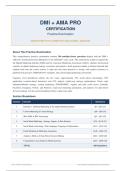
DMI + AMA PRO
CERTIFICATION
Practice Examination
QUESTIONS WITH COMPLETE SOLUTIONS | 2026/2027
About This Practice Examination
This comprehensive practice examination contains 200 multiple-choice questions aligned with the DMI +
AMA Pro Certification Exam Blueprint for the 2026/2027 exam cycle. The certification, jointly recognized by
the Digital Marketing Institute (DMI) and the American Marketing Association (AMA), validates professional
expertise in digital marketing strategy, execution, and analytics. Each question includes a detailed rationale that
explains both why the correct answer is right and why each distractor is wrong, with explicit reference to
platform best practices, DMI/AMA Pro standards, and current digital marketing conventions.
Cognitive level distribution reflects the live exam: approximately 25% recall (direct knowledge), 50%
application (scenario-based decisions), and 25% analysis (multi-step strategy optimization). Topics span
inbound/outbound strategy, content marketing, SEO/SEM/PPC, organic and paid social across LinkedIn,
Facebook, Instagram, Twitter, and Pinterest, email and marketing automation, and analytics for data-driven
decision-making. Use the section breakdown below to plan your study.
Section Breakdown
Section Domain Questions
1 Inbound vs. Outbound Marketing & The Digital Marketing Funnel Q1 - Q25 (25)
2 Content Marketing & Content Strategy Q26 - Q50 (25)
3 SEO, SEM, & PPC Advertising Q51 - Q75 (25)
4 Social Media Marketing - Strategy, Organic, & Best Practices Q76 - Q110 (35)
5 Social Media Advertising - Paid Campaigns, Targeting, & Optimization Q111 - Q145 (35)
6 Email Marketing & Marketing Automation Q146 - Q160 (15)
7 Analytics, Metrics, & Data-Driven Decision Making Q161 - Q180 (20)
8 Comprehensive Case Studies & Mixed Scenarios Q181 - Q200 (20)
TOTAL 200 Questions
DMI + AMA Pro Certification 200-Question Comprehensive Practice Exam
,DMI + AMA Pro Certification Practice Exam | 2026/2027 Page 2
Section 1: Inbound vs. Outbound Marketing & The Digital
Marketing Funnel
Pull vs. push strategy, owned/earned/paid media, and the Awareness-Interest-Consideration-Conversion-Loyalty funnel.
Q1. A B2B SaaS company wants to generate leads for its new project management tool by
publishing educational blog posts, hosting webinars, and offering downloadable templates.
Which strategic approach does this represent?
A. Outbound marketing, because content distribution requires paid promotion
B. Inbound marketing, because the brand attracts leads by providing helpful, relevant content (a
pull strategy) [CORRECT]
C. Direct response advertising, because each asset includes a lead capture form
D. Performance marketing, because ROI is measured per asset
Correct Answer: B
Rationale:
Inbound marketing is defined as a pull strategy that attracts leads by providing helpful, relevant content aligned to
the buyer’s needs at each funnel stage; the brand earns attention rather than buying it. Outbound (A) pushes a brand
message to an audience regardless of consent. Direct response advertising (C) and performance marketing (D)
describe tactics and measurement models, not the strategic philosophy. The educational assets here are textbook
inbound content mapped to the Awareness-Consideration stages.
Q2. A marketer classifies a brand’s website, blog, and owned social media accounts in a
single media category. Which category is correct?
A. Earned media, because the brand cultivates these audiences over time
B. Paid media, because content production carries internal labor costs
C. Owned media, because the brand controls the channel and the content [CORRECT]
D. Shared media, because audiences can comment on the posts
Correct Answer: C
Rationale:
Owned media includes any channel the brand fully controls-websites, blogs, owned social media accounts, email
lists, and mobile apps. Earned media (A) is third-party coverage or shares the brand did not pay for. Paid media (B)
is purchased distribution (ads, sponsorships). Shared media (D) is a PESO-model term for socially distributed
content but does not describe brand-owned channels. DMI/AMA Pro standards treat owned media as the always-on
hub of an inbound program.
DMI + AMA Pro Certification 200-Question Comprehensive Practice Exam
,DMI + AMA Pro Certification Practice Exam | 2026/2027 Page 3
Q3. In the classic consumer journey, a prospect who has just seen a brand awareness video
and begins researching product categories enters which stage next?
A. Conversion, because they have signaled intent
B. Loyalty, because they will compare brands
C. Interest, because awareness has been established and they are seeking more information
[CORRECT]
D. Consideration, because they are evaluating specific vendors
Correct Answer: C
Rationale:
The standard consumer journey is Awareness → Interest → Consideration → Conversion → Loyalty. After
Awareness (the prospect now knows a problem or brand exists), the next stage is Interest-they actively seek more
information about the category or solution. Consideration (D) is the later stage of comparing specific vendors, and
Conversion (A) requires purchase-ready intent. Loyalty (B) follows a successful conversion. Recognizing
stage-appropriate content is a core DMI/AMA Pro competency.
Q4. A consumer electronics brand launches a $250,000 TV and pre-roll YouTube campaign to
announce a new product. This activity is best characterized as:
A. Inbound marketing, because YouTube is a digital channel
B. Outbound marketing, because the brand pushes a message to a target audience to drive
awareness [CORRECT]
C. Earned media, because viewers may choose to skip
D. Owned media, because the brand created the creative assets
Correct Answer: B
Rationale:
Outbound marketing begins with the brand pushing a message to a target audience to drive awareness of a product or
service-precisely what paid TV and pre-roll YouTube campaigns do. The fact that YouTube is digital (A) does not
make the activity inbound; inbound requires the audience to find the brand via helpful content. Earned media (C) is
unpaid third-party distribution, and owned media (D) refers to brand-controlled channels. Many integrated programs
blend inbound and outbound, but a one-way paid announcement is outbound.
DMI + AMA Pro Certification 200-Question Comprehensive Practice Exam
, DMI + AMA Pro Certification Practice Exam | 2026/2027 Page 4
Q5. A nonprofit is mapping its funnel and wants an asset designed for the Consideration
stage. Which asset is most aligned with this stage?
A. A 15-second brand awareness video
B. A vendor comparison guide and case studies that help the prospect evaluate specific solutions
[CORRECT]
C. A homepage hero banner with a “Donate Now” button
D. A loyalty rewards program announcement
Correct Answer: B
Rationale:
The Consideration stage is when prospects compare specific solutions, so vendor comparison guides, case studies,
demos, and detailed product pages are the most aligned assets. Brand awareness videos (A) serve the Awareness
stage. A homepage donate button (C) is a Conversion-stage call to action, not Consideration. Loyalty program
announcements (D) target existing customers in the Loyalty stage. Mapping the right asset to the right stage is
essential to inbound funnel optimization.
Q6. A digital strategist argues that inbound and outbound should be coordinated rather than
treated as opposites. Which argument best supports this position?
A. Outbound campaigns can amplify inbound content to targeted audiences, accelerating
Awareness and feeding the inbound funnel [CORRECT]
B. Outbound is cheaper than inbound, so brands should always prefer it
C. Inbound only works for B2C, while outbound is required for B2B
D. Inbound and outbound target fundamentally different audiences, so coordination is unnecessary
Correct Answer: A
Rationale:
Modern digital strategy treats inbound and outbound as complementary: outbound (paid social, display, search)
amplifies inbound content to the right audiences, accelerating Awareness and feeding the inbound funnel. The other
options are factually incorrect-outbound is typically more expensive per lead than inbound (B), inbound works in
both B2B and B2C (C), and coordinated programs target overlapping audiences across the funnel (D). DMI/AMA
Pro emphasizes integrated planning as the standard approach.
DMI + AMA Pro Certification 200-Question Comprehensive Practice Exam
CERTIFICATION
Practice Examination
QUESTIONS WITH COMPLETE SOLUTIONS | 2026/2027
About This Practice Examination
This comprehensive practice examination contains 200 multiple-choice questions aligned with the DMI +
AMA Pro Certification Exam Blueprint for the 2026/2027 exam cycle. The certification, jointly recognized by
the Digital Marketing Institute (DMI) and the American Marketing Association (AMA), validates professional
expertise in digital marketing strategy, execution, and analytics. Each question includes a detailed rationale that
explains both why the correct answer is right and why each distractor is wrong, with explicit reference to
platform best practices, DMI/AMA Pro standards, and current digital marketing conventions.
Cognitive level distribution reflects the live exam: approximately 25% recall (direct knowledge), 50%
application (scenario-based decisions), and 25% analysis (multi-step strategy optimization). Topics span
inbound/outbound strategy, content marketing, SEO/SEM/PPC, organic and paid social across LinkedIn,
Facebook, Instagram, Twitter, and Pinterest, email and marketing automation, and analytics for data-driven
decision-making. Use the section breakdown below to plan your study.
Section Breakdown
Section Domain Questions
1 Inbound vs. Outbound Marketing & The Digital Marketing Funnel Q1 - Q25 (25)
2 Content Marketing & Content Strategy Q26 - Q50 (25)
3 SEO, SEM, & PPC Advertising Q51 - Q75 (25)
4 Social Media Marketing - Strategy, Organic, & Best Practices Q76 - Q110 (35)
5 Social Media Advertising - Paid Campaigns, Targeting, & Optimization Q111 - Q145 (35)
6 Email Marketing & Marketing Automation Q146 - Q160 (15)
7 Analytics, Metrics, & Data-Driven Decision Making Q161 - Q180 (20)
8 Comprehensive Case Studies & Mixed Scenarios Q181 - Q200 (20)
TOTAL 200 Questions
DMI + AMA Pro Certification 200-Question Comprehensive Practice Exam
,DMI + AMA Pro Certification Practice Exam | 2026/2027 Page 2
Section 1: Inbound vs. Outbound Marketing & The Digital
Marketing Funnel
Pull vs. push strategy, owned/earned/paid media, and the Awareness-Interest-Consideration-Conversion-Loyalty funnel.
Q1. A B2B SaaS company wants to generate leads for its new project management tool by
publishing educational blog posts, hosting webinars, and offering downloadable templates.
Which strategic approach does this represent?
A. Outbound marketing, because content distribution requires paid promotion
B. Inbound marketing, because the brand attracts leads by providing helpful, relevant content (a
pull strategy) [CORRECT]
C. Direct response advertising, because each asset includes a lead capture form
D. Performance marketing, because ROI is measured per asset
Correct Answer: B
Rationale:
Inbound marketing is defined as a pull strategy that attracts leads by providing helpful, relevant content aligned to
the buyer’s needs at each funnel stage; the brand earns attention rather than buying it. Outbound (A) pushes a brand
message to an audience regardless of consent. Direct response advertising (C) and performance marketing (D)
describe tactics and measurement models, not the strategic philosophy. The educational assets here are textbook
inbound content mapped to the Awareness-Consideration stages.
Q2. A marketer classifies a brand’s website, blog, and owned social media accounts in a
single media category. Which category is correct?
A. Earned media, because the brand cultivates these audiences over time
B. Paid media, because content production carries internal labor costs
C. Owned media, because the brand controls the channel and the content [CORRECT]
D. Shared media, because audiences can comment on the posts
Correct Answer: C
Rationale:
Owned media includes any channel the brand fully controls-websites, blogs, owned social media accounts, email
lists, and mobile apps. Earned media (A) is third-party coverage or shares the brand did not pay for. Paid media (B)
is purchased distribution (ads, sponsorships). Shared media (D) is a PESO-model term for socially distributed
content but does not describe brand-owned channels. DMI/AMA Pro standards treat owned media as the always-on
hub of an inbound program.
DMI + AMA Pro Certification 200-Question Comprehensive Practice Exam
,DMI + AMA Pro Certification Practice Exam | 2026/2027 Page 3
Q3. In the classic consumer journey, a prospect who has just seen a brand awareness video
and begins researching product categories enters which stage next?
A. Conversion, because they have signaled intent
B. Loyalty, because they will compare brands
C. Interest, because awareness has been established and they are seeking more information
[CORRECT]
D. Consideration, because they are evaluating specific vendors
Correct Answer: C
Rationale:
The standard consumer journey is Awareness → Interest → Consideration → Conversion → Loyalty. After
Awareness (the prospect now knows a problem or brand exists), the next stage is Interest-they actively seek more
information about the category or solution. Consideration (D) is the later stage of comparing specific vendors, and
Conversion (A) requires purchase-ready intent. Loyalty (B) follows a successful conversion. Recognizing
stage-appropriate content is a core DMI/AMA Pro competency.
Q4. A consumer electronics brand launches a $250,000 TV and pre-roll YouTube campaign to
announce a new product. This activity is best characterized as:
A. Inbound marketing, because YouTube is a digital channel
B. Outbound marketing, because the brand pushes a message to a target audience to drive
awareness [CORRECT]
C. Earned media, because viewers may choose to skip
D. Owned media, because the brand created the creative assets
Correct Answer: B
Rationale:
Outbound marketing begins with the brand pushing a message to a target audience to drive awareness of a product or
service-precisely what paid TV and pre-roll YouTube campaigns do. The fact that YouTube is digital (A) does not
make the activity inbound; inbound requires the audience to find the brand via helpful content. Earned media (C) is
unpaid third-party distribution, and owned media (D) refers to brand-controlled channels. Many integrated programs
blend inbound and outbound, but a one-way paid announcement is outbound.
DMI + AMA Pro Certification 200-Question Comprehensive Practice Exam
, DMI + AMA Pro Certification Practice Exam | 2026/2027 Page 4
Q5. A nonprofit is mapping its funnel and wants an asset designed for the Consideration
stage. Which asset is most aligned with this stage?
A. A 15-second brand awareness video
B. A vendor comparison guide and case studies that help the prospect evaluate specific solutions
[CORRECT]
C. A homepage hero banner with a “Donate Now” button
D. A loyalty rewards program announcement
Correct Answer: B
Rationale:
The Consideration stage is when prospects compare specific solutions, so vendor comparison guides, case studies,
demos, and detailed product pages are the most aligned assets. Brand awareness videos (A) serve the Awareness
stage. A homepage donate button (C) is a Conversion-stage call to action, not Consideration. Loyalty program
announcements (D) target existing customers in the Loyalty stage. Mapping the right asset to the right stage is
essential to inbound funnel optimization.
Q6. A digital strategist argues that inbound and outbound should be coordinated rather than
treated as opposites. Which argument best supports this position?
A. Outbound campaigns can amplify inbound content to targeted audiences, accelerating
Awareness and feeding the inbound funnel [CORRECT]
B. Outbound is cheaper than inbound, so brands should always prefer it
C. Inbound only works for B2C, while outbound is required for B2B
D. Inbound and outbound target fundamentally different audiences, so coordination is unnecessary
Correct Answer: A
Rationale:
Modern digital strategy treats inbound and outbound as complementary: outbound (paid social, display, search)
amplifies inbound content to the right audiences, accelerating Awareness and feeding the inbound funnel. The other
options are factually incorrect-outbound is typically more expensive per lead than inbound (B), inbound works in
both B2B and B2C (C), and coordinated programs target overlapping audiences across the funnel (D). DMI/AMA
Pro emphasizes integrated planning as the standard approach.
DMI + AMA Pro Certification 200-Question Comprehensive Practice Exam

