
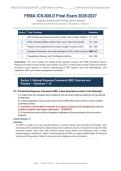
FEMA ICS-800.D Final Exam 2026/2027 | National Response Framework Complete Questions with Verified Correct Answers
FEMA ICS-800.D Final Exam 2026/2027
Complete Questions with Verified Correct Answers
National Response Framework Examination | 50 Questions | 5 Sections
Section Topic Coverage Questions
1 NRF Overview and Purpose (Introduction, Scope, Core Principles, Doctrine) Q1 - Q10
2 Roles and Responsibilities (Federal, State, Local, Tribal, Private Sector) Q11 - Q20
3 Response Core Capabilities and Emergency Support Functions (ESFs) Q21 - Q35
4 Operational Coordination and Incident Management (ICS, Unified Command, MACS)
Q36 - Q45
5 Preparedness, Recovery, and Post-Response Activities Q46 - Q50
Instructions: This exam contains 50 multiple-choice questions covering the FEMA ICS-800.D National
Response Framework course content. Each question has one (1) verified correct answer. Review the rationale
provided for each question to reinforce understanding of NRF doctrine, roles and responsibilities, core
capabilities, ESFs, and incident management coordination.
Section 1: National Response Framework (NRF) Overview and
Purpose — Questions 1–10
Q1: The National Response Framework (NRF) is best described as which of the following?
A. A federal law that mandates state compliance with all-hazard response protocols during declared
emergencies.
B. A tactical operations manual used exclusively by FEMA field teams to direct on-scene incident
command activities.
C. A guide for how the Nation responds to all types of disasters and emergencies, from the
smallest incident to the largest catastrophe. [CORRECT]
D. A classified document outlining interagency intelligence sharing procedures during terrorism
incidents.
Correct Answer: C
Rationale:
The NRF is a guide—not a law, classified directive, or tactical manual—that describes the principles, roles,
and structures for coordinating the national response to incidents of all sizes. Its purpose is to align the entire
community (federal, state, local, tribal, territorial, private sector, NGOs, and individuals) under a unified,
scalable response architecture. Option A mischaracterizes the NRF as a legal mandate; Option B confuses it
with tactical ICS operations; Option D confuses it with intelligence community doctrine.
Page 1 | FEMA ICS-800.D | National Response Framework Examination
,FEMA ICS-800.D Final Exam 2026/2027 | National Response Framework Complete Questions with Verified Correct Answers
Q2: Which statement most accurately reflects the scope of the National Response Framework?
A. It applies only to incidents that result in a Presidential major disaster declaration under the Stafford
Act.
B. It applies to a full spectrum of threats and hazards, including natural, technological, and
human-caused incidents, regardless of size or complexity. [CORRECT]
C. It applies only to incidents involving weapons of mass destruction or acts of terrorism.
D. It applies only to incidents occurring within federal jurisdictions, such as military installations and
national parks.
Correct Answer: B
Rationale:
The NRF is deliberately all-hazards in scope—covering natural, technological, and human-caused incidents of
any size or complexity, whether or not a Stafford Act declaration exists. This broad scope ensures the
Framework can be scaled from localized events to catastrophic incidents requiring a coordinated national
response. Options A, C, and D each artificially narrow the NRF's applicability, which contradicts the
Framework's foundational principle of scalable, flexible application.
Q3: A county emergency manager is coordinating response to a multi-jurisdictional flood. She
ensures voluntary organizations, private utilities, and neighboring jurisdictions are actively
engaged in decision-making. Which NRF core principle is she demonstrating?
A. Scalability
B. Engagement [CORRECT]
C. Flexibility
D. Unity of Effort
Correct Answer: B
Rationale:
Engagement is the NRF principle of involving the whole community—individuals, families, communities,
private and nonprofit sectors, faith-based organizations, and all levels of government—in preparedness and
response. By actively including voluntary organizations, private utilities, and neighboring jurisdictions, the
manager exemplifies engagement. Scalability refers to expanding resources to match incident complexity;
Flexibility refers to adapting procedures to the situation; Unity of Effort refers to coordinating toward common
objectives—each related but distinct principles.
Q4: During Hurricane 'Marisol' response, the Governor's Authorized Representative requests
federal assistance, triggering activation of ESFs and federal coordinating structures. Within
hours, additional federal resources are flowing to the affected state. This rapid escalation of
resources best demonstrates which NRF core principle?
A. Engagement
B. Partnerships
C. Scalability [CORRECT]
D. Unity of Effort through unified command
Correct Answer: C
Rationale:
Scalability is the NRF principle that response resources and structures expand—or contract—in proportion to
the size, scope, and complexity of the incident. The rapid escalation from state to federal coordination,
activation of Emergency Support Functions, and surge of federal resources all illustrate scalability in action.
Engagement involves whole-community participation; Partnerships refers to formal collaborative relationships;
Unity of Effort refers to coordinating toward shared objectives, not the modular surge of resources.
Page 2 | FEMA ICS-800.D | National Response Framework Examination
, FEMA ICS-800.D Final Exam 2026/2027 | National Response Framework Complete Questions with Verified Correct Answers
Q5: An Incident Commander adapts standard ICS procedures to address a unique
cyber-physical incident affecting both a water utility and its SCADA control system, integrating
IT specialists into the Operations Section. This adaptation best reflects which NRF core
principle?
A. Flexibility [CORRECT]
B. Scalability
C. Engagement
D. Partnerships
Correct Answer: A
Rationale:
Flexibility is the NRF principle that allows responders to adapt standard procedures, structures, and tactics to
the unique characteristics of an incident. By modifying the ICS organization to integrate cyber/IT expertise into
Operations, the Incident Commander is exercising flexibility, not abandoning the system. Scalability addresses
the size of the response organization; Engagement addresses whole-community inclusion; Partnerships
addresses formal collaborative relationships across organizations.
Q6: During a complex mass-casualty incident involving three counties, two states, and multiple
federal agencies, response leaders establish unified objectives through a MAC Group while
maintaining their own organizational authorities. This best illustrates which NRF core principle?
A. Scalability
B. Flexibility
C. Unity of Effort [CORRECT]
D. Engagement
Correct Answer: C
Rationale:
Unity of Effort is the NRF principle of coordinating activities among independent organizations toward shared
objectives, while respecting each organization's authorities. The MAC Group model preserves the distinct
authorities of each participating agency while aligning them on common priorities—an exemplar of Unity of
Effort. Scalability involves resource expansion, Flexibility involves procedural adaptation, and Engagement
involves broad community participation, none of which capture the essence of coordinated independent action
toward shared goals.
Page 3 | FEMA ICS-800.D | National Response Framework Examination
FEMA ICS-800.D Final Exam 2026/2027
Complete Questions with Verified Correct Answers
National Response Framework Examination | 50 Questions | 5 Sections
Section Topic Coverage Questions
1 NRF Overview and Purpose (Introduction, Scope, Core Principles, Doctrine) Q1 - Q10
2 Roles and Responsibilities (Federal, State, Local, Tribal, Private Sector) Q11 - Q20
3 Response Core Capabilities and Emergency Support Functions (ESFs) Q21 - Q35
4 Operational Coordination and Incident Management (ICS, Unified Command, MACS)
Q36 - Q45
5 Preparedness, Recovery, and Post-Response Activities Q46 - Q50
Instructions: This exam contains 50 multiple-choice questions covering the FEMA ICS-800.D National
Response Framework course content. Each question has one (1) verified correct answer. Review the rationale
provided for each question to reinforce understanding of NRF doctrine, roles and responsibilities, core
capabilities, ESFs, and incident management coordination.
Section 1: National Response Framework (NRF) Overview and
Purpose — Questions 1–10
Q1: The National Response Framework (NRF) is best described as which of the following?
A. A federal law that mandates state compliance with all-hazard response protocols during declared
emergencies.
B. A tactical operations manual used exclusively by FEMA field teams to direct on-scene incident
command activities.
C. A guide for how the Nation responds to all types of disasters and emergencies, from the
smallest incident to the largest catastrophe. [CORRECT]
D. A classified document outlining interagency intelligence sharing procedures during terrorism
incidents.
Correct Answer: C
Rationale:
The NRF is a guide—not a law, classified directive, or tactical manual—that describes the principles, roles,
and structures for coordinating the national response to incidents of all sizes. Its purpose is to align the entire
community (federal, state, local, tribal, territorial, private sector, NGOs, and individuals) under a unified,
scalable response architecture. Option A mischaracterizes the NRF as a legal mandate; Option B confuses it
with tactical ICS operations; Option D confuses it with intelligence community doctrine.
Page 1 | FEMA ICS-800.D | National Response Framework Examination
,FEMA ICS-800.D Final Exam 2026/2027 | National Response Framework Complete Questions with Verified Correct Answers
Q2: Which statement most accurately reflects the scope of the National Response Framework?
A. It applies only to incidents that result in a Presidential major disaster declaration under the Stafford
Act.
B. It applies to a full spectrum of threats and hazards, including natural, technological, and
human-caused incidents, regardless of size or complexity. [CORRECT]
C. It applies only to incidents involving weapons of mass destruction or acts of terrorism.
D. It applies only to incidents occurring within federal jurisdictions, such as military installations and
national parks.
Correct Answer: B
Rationale:
The NRF is deliberately all-hazards in scope—covering natural, technological, and human-caused incidents of
any size or complexity, whether or not a Stafford Act declaration exists. This broad scope ensures the
Framework can be scaled from localized events to catastrophic incidents requiring a coordinated national
response. Options A, C, and D each artificially narrow the NRF's applicability, which contradicts the
Framework's foundational principle of scalable, flexible application.
Q3: A county emergency manager is coordinating response to a multi-jurisdictional flood. She
ensures voluntary organizations, private utilities, and neighboring jurisdictions are actively
engaged in decision-making. Which NRF core principle is she demonstrating?
A. Scalability
B. Engagement [CORRECT]
C. Flexibility
D. Unity of Effort
Correct Answer: B
Rationale:
Engagement is the NRF principle of involving the whole community—individuals, families, communities,
private and nonprofit sectors, faith-based organizations, and all levels of government—in preparedness and
response. By actively including voluntary organizations, private utilities, and neighboring jurisdictions, the
manager exemplifies engagement. Scalability refers to expanding resources to match incident complexity;
Flexibility refers to adapting procedures to the situation; Unity of Effort refers to coordinating toward common
objectives—each related but distinct principles.
Q4: During Hurricane 'Marisol' response, the Governor's Authorized Representative requests
federal assistance, triggering activation of ESFs and federal coordinating structures. Within
hours, additional federal resources are flowing to the affected state. This rapid escalation of
resources best demonstrates which NRF core principle?
A. Engagement
B. Partnerships
C. Scalability [CORRECT]
D. Unity of Effort through unified command
Correct Answer: C
Rationale:
Scalability is the NRF principle that response resources and structures expand—or contract—in proportion to
the size, scope, and complexity of the incident. The rapid escalation from state to federal coordination,
activation of Emergency Support Functions, and surge of federal resources all illustrate scalability in action.
Engagement involves whole-community participation; Partnerships refers to formal collaborative relationships;
Unity of Effort refers to coordinating toward shared objectives, not the modular surge of resources.
Page 2 | FEMA ICS-800.D | National Response Framework Examination
, FEMA ICS-800.D Final Exam 2026/2027 | National Response Framework Complete Questions with Verified Correct Answers
Q5: An Incident Commander adapts standard ICS procedures to address a unique
cyber-physical incident affecting both a water utility and its SCADA control system, integrating
IT specialists into the Operations Section. This adaptation best reflects which NRF core
principle?
A. Flexibility [CORRECT]
B. Scalability
C. Engagement
D. Partnerships
Correct Answer: A
Rationale:
Flexibility is the NRF principle that allows responders to adapt standard procedures, structures, and tactics to
the unique characteristics of an incident. By modifying the ICS organization to integrate cyber/IT expertise into
Operations, the Incident Commander is exercising flexibility, not abandoning the system. Scalability addresses
the size of the response organization; Engagement addresses whole-community inclusion; Partnerships
addresses formal collaborative relationships across organizations.
Q6: During a complex mass-casualty incident involving three counties, two states, and multiple
federal agencies, response leaders establish unified objectives through a MAC Group while
maintaining their own organizational authorities. This best illustrates which NRF core principle?
A. Scalability
B. Flexibility
C. Unity of Effort [CORRECT]
D. Engagement
Correct Answer: C
Rationale:
Unity of Effort is the NRF principle of coordinating activities among independent organizations toward shared
objectives, while respecting each organization's authorities. The MAC Group model preserves the distinct
authorities of each participating agency while aligning them on common priorities—an exemplar of Unity of
Effort. Scalability involves resource expansion, Flexibility involves procedural adaptation, and Engagement
involves broad community participation, none of which capture the essence of coordinated independent action
toward shared goals.
Page 3 | FEMA ICS-800.D | National Response Framework Examination

