

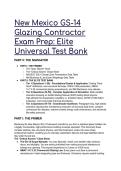
New Mexico GS-14
Glazing Contractor
Exam Prep: Elite
Universal Test Bank
PART 0: THE NAVIGATOR
● PART I: THE PRIMER
○ The "Apex Glazier" Hook
○ The "Critical Axioms" Cheat Sheet
○ NM IECC 2021 Climate Zone Fenestration Data Table
○ NM Business & Law Exam Weightings Data Table
● PART II: THE ELITE TEST BANK
○ Tier 1 (Questions 1–28) - Foundational Syntax & Application: Testing "Hard
Deck" definitions, core structural formulas, OSHA 1926 parameters, NMAC
14.7.2.32 commercial glazing amendments, and NM Mechanics Lien statutes.
○ Tier 2 (Questions 29–58) - Complex Application & Simulation: Multi-variable
scenarios focusing on GANA Glazing Manual (2022) setting block physics,
high-altitude IGU equalization (capillary vs. breather tubes), ASTM C1036 defect
inspection, and cross-trade licensing boundaries.
○ Tier 3 (Questions 59–70) - Grandmaster Synthesis: Paragraph-long, high-stakes
scenarios requiring the simultaneous execution of structural load limits, complex
contractual lien disputes, extreme-climate energy code enforcement, and advanced
life-safety protocols.
PART I: THE PRIMER
Mastering the New Mexico GS-14 framework transforms you from a standard glass installer into
a legally invulnerable, high-performance building envelope specialist. This document fuses
complex statutory law, structural physics, and thermodynamic codes into razor-sharp
professional intuition, enabling you to intercept catastrophic failures and legal liabilities before
they enter the job site.
The "Critical Axioms" Cheat Sheet
● The GS-14 Scope Mandate: You may fabricate, install, and weather-strip windows,
doors, and skylights. You are strictly prohibited from making structural alterations to
enlarge any opening. The required experience is 2 years or 4,000 hours.
● NMAC 14.7.2.32 Commercial Glazing Law: Every pane must bear a permanent
manufacturer’s label designating type and thickness. Omissions require explicit building
, official approval and a sworn affidavit from the glazing contractor.
● New Mexico Lien Timelines (2026): Prime contractors must file within 120 days of
completion. Subcontractors must file within 90 days. For claims exceeding $5,000,
subcontractors must send a Notice of Intent within 60 days of first furnishing
labor/materials.
● The GANA/Altitude Physics Doctrine: For high-altitude installations, use capillary tubes
(left open or sealed depending on dwell time) to equalize pressure; never use
large-diameter breather tubes as they invite rapid moisture/gas exchange. Use 100%
silicone setting blocks (85±5 Shore A).
New Mexico Climate Max Fenestration Max Fenestration Counties Included
Zone (2021 IECC) U-Factor SHGC (Examples)
Zone 3 0.30 0.25 Dona Ana, Eddy, Lea,
(South-Central) Otero
Zone 4 0.30 0.40 Bernalillo, Santa Fe,
(North-Central) Socorro
Zone 5/6/7 (Northern) 0.30 Any Taos, San Juan, Los
Alamos
NM Business & Law Exam Weighting Key Focus Area
Core Topic
Licensing Requirements 20% Scope, Application, Penalties
Federal and State Tax Laws 15% Gross Receipts, Payroll
Labor Laws 11% Workers Comp, Wages
Estimating and Bidding 10% Overhead, Profit, Takeoffs
PART II: THE ELITE TEST BANK
Tier 1: Foundational Syntax & Application
Q1: You are a licensed GS-14 contractor hired to replace an aluminum storefront system. The
client requests that you raise the rough opening height by removing a structural wood header.
Based on the NM CILA GS-14 classification, which action is the MOST ACCURATE? A)
Proceed with the alteration, as storefront framing is encompassed within the GS-14 scope. B)
Proceed, provided the alteration is supervised by a licensed structural engineer. C) Refuse the
alteration, as the GS-14 license expressly prohibits structural alterations to enlarge openings. D)
Refuse the alteration, unless the total project cost remains under the $7,200 handyman
exemption.
● The Answer: C (Refuse the alteration, as the GS-14 license expressly prohibits structural
alterations to enlarge openings.)
● Distractor Analysis:
○ A is incorrect: Storefront glazing falls under GS-14, but structural framing
modifications require a GB-98 (General Building) license.
○ B is incorrect: Engineering supervision does not legally override state licensing
scope boundaries.
○ D is incorrect: The $7,200 exemption applies to unlicensed minor repairs, not
structural modifications requiring permits.
The Mentor's Analysis: The GS-14 license is strictly limited to fabricating and installing within
existing perimeters. When facing rough opening modifications, the immediate priority is halting
,work and deferring to a GB-98 contractor. By utilizing strict scope boundaries, you bypass the
common trap of criminal unlicensed structural liability. Professional/Academic Intuition: A glazier
fills the hole; a general builder makes the hole.
Q2: A commercial glazing subcontractor (GS-14) is owed $12,000 for work on a private project
in Albuquerque. The subcontractor did not sign a direct contract with the property owner. Based
on New Mexico mechanics lien laws, which preliminary action is IMMEDIATELY required to
preserve lien rights? A) File the mechanics lien within 120 days of project completion. B) Send a
Notice of Intent to Lien within 60 days of first furnishing labor or materials. C) Send a Notice of
Intent to Lien within 90 days of project completion. D) File a breach of contract lawsuit before
the 2-year statute of limitations expires.
● The Answer: B (Send a Notice of Intent to Lien within 60 days of first furnishing labor or
materials.)
● Distractor Analysis:
○ A is incorrect: 120 days is the filing deadline for prime contractors, not
subcontractors.
○ C is incorrect: 90 days is the filing deadline for the actual lien for a subcontractor,
not the preliminary notice.
○ D is incorrect: While suit must be filed within 2 years, failing the 60-day preliminary
notice voids the lien right entirely for claims over $5,000.
The Mentor's Analysis: Subcontractors in New Mexico face strict pre-lien statutory hurdles.
When facing payment disputes exceeding $5,000 without a direct owner contract, the immediate
priority is preliminary notification. By utilizing the 60-day Notice of Intent, you bypass the
common trap of forfeiting your legal leverage. Professional/Academic Intuition: No 60-day
pre-lien notice, no $5,000+ subcontractor lien.
Q3: Under NMAC 14.7.2.32 (2021 Commercial Building Code amendments), you are installing
tempered safety glass in a high-traffic lobby. The architect requests you remove the
manufacturer’s identification labels for aesthetic reasons. Based on this code, which conclusion
is MOST ACCURATE? A) The labels may be removed freely once the final inspection is
passed. B) The labels cannot be omitted unless explicitly approved by the building official, who
may require an affidavit from the glazing contractor. C) The labels may be removed if a
registered design professional signs a waiver of liability. D) The labels must be permanently
etched into the center of the pane and cannot be removed under any circumstance.
● The Answer: B (The labels cannot be omitted unless explicitly approved by the building
official, who may require an affidavit from the glazing contractor.)
● Distractor Analysis:
○ A is incorrect: Code dictates identification presence; removal rules are dictated by
the building official, not arbitrary timelines.
○ C is incorrect: A design professional cannot override the statutory authority of the
municipal building official regarding identification labels.
○ D is incorrect: Labels are typically in the corner, not the center, and the code
explicitly provides an avenue for omission via building official approval.
The Mentor's Analysis: Glazing identification is a non-negotiable life-safety verification metric.
When facing aesthetic demands to hide tempering labels, the immediate priority is municipal
authorization. By utilizing the building official's approval and a sworn affidavit, you bypass the
common trap of failing final inspection. Professional/Academic Intuition: Only the Authority
Having Jurisdiction (AHJ) can make safety labels invisible.
Q4: According to the 2021 New Mexico Residential Energy Conservation Code (NMAC 14.7.6),
you are supplying fenestration for a home in Climate Zone 3 (e.g., Dona Ana County). Which
, metric represents the maximum allowable U-factor and Solar Heat Gain Coefficient (SHGC)? A)
U-factor 0.30 / SHGC 0.40 B) U-factor 0.32 / SHGC Any C) U-factor 0.30 / SHGC 0.25 D)
U-factor 0.40 / SHGC 0.30
● The Answer: C (U-factor 0.30 / SHGC 0.25)
● Distractor Analysis:
○ A is incorrect: This is the prescriptive requirement for Climate Zone 4, not Zone 3.
○ B is incorrect: Legacy or alternative compliance values that do not meet the strict
2021 baseline for this specific zone.
○ D is incorrect: This inverses the U-factor and SHGC values commonly seen in older
codes.
The Mentor's Analysis: Zone 3 is characterized by extreme summer heat requiring aggressive
solar shielding. When facing fenestration specification in southern New Mexico, the immediate
priority is verifying a low SHGC. By utilizing the 0.25 SHGC baseline, you bypass the common
trap of installing non-compliant, heat-absorbing glass. Professional/Academic Intuition: Lower
SHGC stops the desert sun; lower U-factor stops the desert cold.
Q5: Based on the GANA Glazing Manual (2022 IYOG Edition), what is the MOST ACCURATE
specification for setting blocks used to support the dead load of an insulating glass unit (IGU)?
A) 100% silicone with a Shore A durometer hardness of 85±5. B) Neoprene with a Shore A
durometer hardness of 60±5. C) 100% silicone with a Shore A durometer hardness of 50±10. D)
EPDM with a minimum length of 2 inches.
● The Answer: A (100% silicone with a Shore A durometer hardness of 85±5.)
● Distractor Analysis:
○ B is incorrect: 60±5 is the specification for edge blocks (anti-walk blocks), not
load-bearing setting blocks.
○ C is incorrect: 50 durometer is too soft to support the dead load of commercial
glass, risking block crush and seal failure.
○ D is incorrect: Setting blocks must be a minimum of 4 inches long, not 2 inches, and
silicone is universally mandated for modern seal compatibility.
The Mentor's Analysis: Setting blocks carry the entire gravitational weight of the glass panel.
When facing framing support requirements, the immediate priority is rigid, chemically compatible
bearing points. By utilizing 85-durometer silicone, you bypass the common trap of block
compression and IGU edge-seal rupture. Professional/Academic Intuition: Setting blocks
demand high hardness (85); edge blocks demand cushioning (60).
Q6: A GS-14 contractor is installing a large curtain wall system. The IBC 2021 (as amended by
NMAC 14.7.2.32) states that if one or more sides of a glass pane are not firmly supported,
specific documentation is required. What is the MOST APPROPRIATE documentation? A) A
standard manufacturer warranty certificate. B) A visual inspection checklist signed by the
foreman. C) Detailed construction documents, shop drawings, and analysis or test data assuring
safe performance. D) A letter of indemnity from the glazing subcontractor to the general
contractor.
● The Answer: C (Detailed construction documents, shop drawings, and analysis or test
data assuring safe performance.)
● Distractor Analysis:
○ A is incorrect: Warranties do not prove structural integrity under wind/seismic loads.
○ B is incorrect: Field visual inspections cannot validate engineering load
mathematics.
○ D is incorrect: Indemnity shifts blame but does not satisfy the statutory life-safety
code requirement.
Glazing Contractor
Exam Prep: Elite
Universal Test Bank
PART 0: THE NAVIGATOR
● PART I: THE PRIMER
○ The "Apex Glazier" Hook
○ The "Critical Axioms" Cheat Sheet
○ NM IECC 2021 Climate Zone Fenestration Data Table
○ NM Business & Law Exam Weightings Data Table
● PART II: THE ELITE TEST BANK
○ Tier 1 (Questions 1–28) - Foundational Syntax & Application: Testing "Hard
Deck" definitions, core structural formulas, OSHA 1926 parameters, NMAC
14.7.2.32 commercial glazing amendments, and NM Mechanics Lien statutes.
○ Tier 2 (Questions 29–58) - Complex Application & Simulation: Multi-variable
scenarios focusing on GANA Glazing Manual (2022) setting block physics,
high-altitude IGU equalization (capillary vs. breather tubes), ASTM C1036 defect
inspection, and cross-trade licensing boundaries.
○ Tier 3 (Questions 59–70) - Grandmaster Synthesis: Paragraph-long, high-stakes
scenarios requiring the simultaneous execution of structural load limits, complex
contractual lien disputes, extreme-climate energy code enforcement, and advanced
life-safety protocols.
PART I: THE PRIMER
Mastering the New Mexico GS-14 framework transforms you from a standard glass installer into
a legally invulnerable, high-performance building envelope specialist. This document fuses
complex statutory law, structural physics, and thermodynamic codes into razor-sharp
professional intuition, enabling you to intercept catastrophic failures and legal liabilities before
they enter the job site.
The "Critical Axioms" Cheat Sheet
● The GS-14 Scope Mandate: You may fabricate, install, and weather-strip windows,
doors, and skylights. You are strictly prohibited from making structural alterations to
enlarge any opening. The required experience is 2 years or 4,000 hours.
● NMAC 14.7.2.32 Commercial Glazing Law: Every pane must bear a permanent
manufacturer’s label designating type and thickness. Omissions require explicit building
, official approval and a sworn affidavit from the glazing contractor.
● New Mexico Lien Timelines (2026): Prime contractors must file within 120 days of
completion. Subcontractors must file within 90 days. For claims exceeding $5,000,
subcontractors must send a Notice of Intent within 60 days of first furnishing
labor/materials.
● The GANA/Altitude Physics Doctrine: For high-altitude installations, use capillary tubes
(left open or sealed depending on dwell time) to equalize pressure; never use
large-diameter breather tubes as they invite rapid moisture/gas exchange. Use 100%
silicone setting blocks (85±5 Shore A).
New Mexico Climate Max Fenestration Max Fenestration Counties Included
Zone (2021 IECC) U-Factor SHGC (Examples)
Zone 3 0.30 0.25 Dona Ana, Eddy, Lea,
(South-Central) Otero
Zone 4 0.30 0.40 Bernalillo, Santa Fe,
(North-Central) Socorro
Zone 5/6/7 (Northern) 0.30 Any Taos, San Juan, Los
Alamos
NM Business & Law Exam Weighting Key Focus Area
Core Topic
Licensing Requirements 20% Scope, Application, Penalties
Federal and State Tax Laws 15% Gross Receipts, Payroll
Labor Laws 11% Workers Comp, Wages
Estimating and Bidding 10% Overhead, Profit, Takeoffs
PART II: THE ELITE TEST BANK
Tier 1: Foundational Syntax & Application
Q1: You are a licensed GS-14 contractor hired to replace an aluminum storefront system. The
client requests that you raise the rough opening height by removing a structural wood header.
Based on the NM CILA GS-14 classification, which action is the MOST ACCURATE? A)
Proceed with the alteration, as storefront framing is encompassed within the GS-14 scope. B)
Proceed, provided the alteration is supervised by a licensed structural engineer. C) Refuse the
alteration, as the GS-14 license expressly prohibits structural alterations to enlarge openings. D)
Refuse the alteration, unless the total project cost remains under the $7,200 handyman
exemption.
● The Answer: C (Refuse the alteration, as the GS-14 license expressly prohibits structural
alterations to enlarge openings.)
● Distractor Analysis:
○ A is incorrect: Storefront glazing falls under GS-14, but structural framing
modifications require a GB-98 (General Building) license.
○ B is incorrect: Engineering supervision does not legally override state licensing
scope boundaries.
○ D is incorrect: The $7,200 exemption applies to unlicensed minor repairs, not
structural modifications requiring permits.
The Mentor's Analysis: The GS-14 license is strictly limited to fabricating and installing within
existing perimeters. When facing rough opening modifications, the immediate priority is halting
,work and deferring to a GB-98 contractor. By utilizing strict scope boundaries, you bypass the
common trap of criminal unlicensed structural liability. Professional/Academic Intuition: A glazier
fills the hole; a general builder makes the hole.
Q2: A commercial glazing subcontractor (GS-14) is owed $12,000 for work on a private project
in Albuquerque. The subcontractor did not sign a direct contract with the property owner. Based
on New Mexico mechanics lien laws, which preliminary action is IMMEDIATELY required to
preserve lien rights? A) File the mechanics lien within 120 days of project completion. B) Send a
Notice of Intent to Lien within 60 days of first furnishing labor or materials. C) Send a Notice of
Intent to Lien within 90 days of project completion. D) File a breach of contract lawsuit before
the 2-year statute of limitations expires.
● The Answer: B (Send a Notice of Intent to Lien within 60 days of first furnishing labor or
materials.)
● Distractor Analysis:
○ A is incorrect: 120 days is the filing deadline for prime contractors, not
subcontractors.
○ C is incorrect: 90 days is the filing deadline for the actual lien for a subcontractor,
not the preliminary notice.
○ D is incorrect: While suit must be filed within 2 years, failing the 60-day preliminary
notice voids the lien right entirely for claims over $5,000.
The Mentor's Analysis: Subcontractors in New Mexico face strict pre-lien statutory hurdles.
When facing payment disputes exceeding $5,000 without a direct owner contract, the immediate
priority is preliminary notification. By utilizing the 60-day Notice of Intent, you bypass the
common trap of forfeiting your legal leverage. Professional/Academic Intuition: No 60-day
pre-lien notice, no $5,000+ subcontractor lien.
Q3: Under NMAC 14.7.2.32 (2021 Commercial Building Code amendments), you are installing
tempered safety glass in a high-traffic lobby. The architect requests you remove the
manufacturer’s identification labels for aesthetic reasons. Based on this code, which conclusion
is MOST ACCURATE? A) The labels may be removed freely once the final inspection is
passed. B) The labels cannot be omitted unless explicitly approved by the building official, who
may require an affidavit from the glazing contractor. C) The labels may be removed if a
registered design professional signs a waiver of liability. D) The labels must be permanently
etched into the center of the pane and cannot be removed under any circumstance.
● The Answer: B (The labels cannot be omitted unless explicitly approved by the building
official, who may require an affidavit from the glazing contractor.)
● Distractor Analysis:
○ A is incorrect: Code dictates identification presence; removal rules are dictated by
the building official, not arbitrary timelines.
○ C is incorrect: A design professional cannot override the statutory authority of the
municipal building official regarding identification labels.
○ D is incorrect: Labels are typically in the corner, not the center, and the code
explicitly provides an avenue for omission via building official approval.
The Mentor's Analysis: Glazing identification is a non-negotiable life-safety verification metric.
When facing aesthetic demands to hide tempering labels, the immediate priority is municipal
authorization. By utilizing the building official's approval and a sworn affidavit, you bypass the
common trap of failing final inspection. Professional/Academic Intuition: Only the Authority
Having Jurisdiction (AHJ) can make safety labels invisible.
Q4: According to the 2021 New Mexico Residential Energy Conservation Code (NMAC 14.7.6),
you are supplying fenestration for a home in Climate Zone 3 (e.g., Dona Ana County). Which
, metric represents the maximum allowable U-factor and Solar Heat Gain Coefficient (SHGC)? A)
U-factor 0.30 / SHGC 0.40 B) U-factor 0.32 / SHGC Any C) U-factor 0.30 / SHGC 0.25 D)
U-factor 0.40 / SHGC 0.30
● The Answer: C (U-factor 0.30 / SHGC 0.25)
● Distractor Analysis:
○ A is incorrect: This is the prescriptive requirement for Climate Zone 4, not Zone 3.
○ B is incorrect: Legacy or alternative compliance values that do not meet the strict
2021 baseline for this specific zone.
○ D is incorrect: This inverses the U-factor and SHGC values commonly seen in older
codes.
The Mentor's Analysis: Zone 3 is characterized by extreme summer heat requiring aggressive
solar shielding. When facing fenestration specification in southern New Mexico, the immediate
priority is verifying a low SHGC. By utilizing the 0.25 SHGC baseline, you bypass the common
trap of installing non-compliant, heat-absorbing glass. Professional/Academic Intuition: Lower
SHGC stops the desert sun; lower U-factor stops the desert cold.
Q5: Based on the GANA Glazing Manual (2022 IYOG Edition), what is the MOST ACCURATE
specification for setting blocks used to support the dead load of an insulating glass unit (IGU)?
A) 100% silicone with a Shore A durometer hardness of 85±5. B) Neoprene with a Shore A
durometer hardness of 60±5. C) 100% silicone with a Shore A durometer hardness of 50±10. D)
EPDM with a minimum length of 2 inches.
● The Answer: A (100% silicone with a Shore A durometer hardness of 85±5.)
● Distractor Analysis:
○ B is incorrect: 60±5 is the specification for edge blocks (anti-walk blocks), not
load-bearing setting blocks.
○ C is incorrect: 50 durometer is too soft to support the dead load of commercial
glass, risking block crush and seal failure.
○ D is incorrect: Setting blocks must be a minimum of 4 inches long, not 2 inches, and
silicone is universally mandated for modern seal compatibility.
The Mentor's Analysis: Setting blocks carry the entire gravitational weight of the glass panel.
When facing framing support requirements, the immediate priority is rigid, chemically compatible
bearing points. By utilizing 85-durometer silicone, you bypass the common trap of block
compression and IGU edge-seal rupture. Professional/Academic Intuition: Setting blocks
demand high hardness (85); edge blocks demand cushioning (60).
Q6: A GS-14 contractor is installing a large curtain wall system. The IBC 2021 (as amended by
NMAC 14.7.2.32) states that if one or more sides of a glass pane are not firmly supported,
specific documentation is required. What is the MOST APPROPRIATE documentation? A) A
standard manufacturer warranty certificate. B) A visual inspection checklist signed by the
foreman. C) Detailed construction documents, shop drawings, and analysis or test data assuring
safe performance. D) A letter of indemnity from the glazing subcontractor to the general
contractor.
● The Answer: C (Detailed construction documents, shop drawings, and analysis or test
data assuring safe performance.)
● Distractor Analysis:
○ A is incorrect: Warranties do not prove structural integrity under wind/seismic loads.
○ B is incorrect: Field visual inspections cannot validate engineering load
mathematics.
○ D is incorrect: Indemnity shifts blame but does not satisfy the statutory life-safety
code requirement.

