
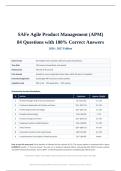
SAFe Agile Product Management (APM)
84 Questions with 100% Correct Answers
Edition
Exam format 60 multiple-choice questions (this prep pack: 84 questions)
Time limit 120 minutes (closed-book, web-based)
Passing score 75% (45 of 60 correct)
First attempt Included in course registration when taken within 60 days of completion
Framework alignment Scaled Agile APM 6.0 Exam Content Outline
Cognitive levels 20% recall · 50% application · 30% analysis
Examination Section Breakdown
# Section Questions Approx. Weight
1 Product Manager Role in the Lean Enterprise Q1–Q10 (10) 11–13%
2 Continuous Exploration of Markets and Users Q11–Q22 (12) 12–14%
3 Market Segmentation Strategies Q23–Q32 (10) 11–13%
4 Empathy-driven Design Q33–Q40 (8) 7–9%
5 Product Strategy and Vision Q41–Q50 (10) 12–14%
6 Roadmap Creation to Build Solutions Q51–Q58 (8) 11–13%
7 Value Delivery Q59–Q68 (10) 14–16%
8 Innovation Creation in the Value Stream Q69–Q76 (8) 12–14%
9 Comprehensive Case Studies & Mixed Scenarios Q77–Q84 (8) Mixed
How to use this prep pack: Each question is followed by four options (A–D). The correct option is annotated with a green
[CORRECT] marker. A "Correct Answer" line and a 2–4 sentence rationale follow, referencing SAFe APM 6.0 exam content
and SAFe framework principles. Aim for 80%+ on this 84-question pack before scheduling the official exam.
Termination Condition: This booklet contains all 84 questions. End-of-exam marker appears after Q84.
Aligned with the Scaled Agile APM 6.0 Exam Content Outline · Closed-book, 120 minutes, 75% pass
,SAFe APM Certification Exam Preparation | 2026/2027 Edition Page 2
Section 1: Product Manager Role in the Lean Enterprise
Questions 1–10 · Total: 10 questions · Reference: Scaled Agile APM 6.0 Exam Content Outline
Q1: In SAFe, which responsibility distinctly belongs to the Product Manager rather than the Product Owner?
A. Accepting user stories during iteration reviews
B. Facilitating iteration retrospectives
C. Defining the product vision and roadmap *[CORRECT]*
D. Writing and prioritizing team backlog user stories
Correct Answer: C
Rationale: SAFe APM 6.0 separates the roles clearly: the Product Manager owns the vision, roadmap, and feature-level
prioritization on the ART backlog, while the Product Owner owns the team backlog, sequences stories, and accepts
increments. Options A and C are PO responsibilities; D is typically the Scrum Master's role.
Q2: During a PI Planning preparation session, a new Product Manager begins writing detailed user stories for
the team backlog. The RTE should coach the PM that:
A. PMs own feature-level priorities, while POs own team backlog stories *[CORRECT]*
B. The PM can override the PO on backlog decisions
C. PMs should write stories to reduce PO workload
D. PMs and POs jointly write stories to ensure alignment
Correct Answer: A
Rationale: SAFe explicitly divides responsibilities to enable scalability: PMs prioritize features in the ART backlog, while POs
decompose those features into stories in the team backlog. Blurring this boundary (B, C) undermines flow, and overriding the
PO (D) violates the Lean-Agile principle of distributed decision-making.
Q3: Which activity is a Product Owner (PO) primarily accountable for in SAFe?
A. Defining customer journey maps
B. Prioritizing features on the ART backlog
C. Managing the team backlog and accepting stories *[CORRECT]*
D. Setting the ART's strategic themes
Correct Answer: C
Rationale: Per SAFe APM 6.0, the PO owns the team backlog, sequences stories, and accepts team increments. Strategic
themes (A) are set at the portfolio level by Lean Business Owners; feature prioritization (B) and journey maps (D) belong to
the Product Manager.
Q4: At PI Planning, the Product Manager's most critical contribution to the agile teams' planning is presenting:
A. Engineering standards and architectural guidance
B. Detailed iteration plans for each team
C. The Product Vision and Roadmap with priority context *[CORRECT]*
D. Team-level user stories for the next iteration
Correct Answer: C
Rationale: SAFe PI Planning expects PMs to bring the vision, roadmap, and priority context so teams understand the 'why'
behind features. Iteration plans (A) and stories (C) belong to teams and POs; engineering guidance (D) is the Solution
Architect's responsibility.
Aligned with the Scaled Agile APM 6.0 Exam Content Outline · Closed-book, 120 minutes, 75% pass
, SAFe APM Certification Exam Preparation | 2026/2027 Edition Page 3
Q5: Design Thinking, as applied in SAFe APM, encourages solutions that are:
A. Customer-tested, Investor-approved, and Compliant
B. Profitable, Scalable, Secure, and Predictable
C. Fast, Cheap, Reliable, and Innovative
D. Desirable, Feasible, Viable, and Sustainable *[CORRECT]*
Correct Answer: D
Rationale: SAFe APM 6.0 defines the four Design Thinking attributes: Desirable (customers want it), Feasible (we can build it),
Viable (it creates business value), and Sustainable (it is long-term viable). The other options mix unrelated operational or
marketing attributes not part of the framework.
Q6: A PM insists on finalizing all 25 features for a PI before any team commits. The Lean-Agile mindset
response is to:
A. Defer all features until customer feedback is collected
B. Reduce the team's velocity to fit the planned scope
C. Finalize all features upfront to ensure predictability
D. Define the vision and key features, allowing learning to evolve the rest *[CORRECT]*
Correct Answer: D
Rationale: The Lean-Agile mindset embraces uncertainty and incremental learning; locking scope violates this principle. SAFe
APM recommends PMs set direction with a vision and a few key features, then adapt based on feedback during PI execution
rather than over-committing upfront.
Q7: A PM and RTE disagree on the ART's top feature priority for the upcoming PI. The SAFe-aligned resolution
approach is to:
A. Escalate to Business Owners for a final ruling
B. Allow the RTE to decide since they own the ART
C. Defer to the PM as the final decision-maker
D. Use WSJF and PI Objectives alignment as the shared prioritization model *[CORRECT]*
Correct Answer: D
Rationale: SAFe uses WSJF and PI Objectives as objective, shared prioritization models. PMs and RTEs collaborate using these
data-driven frameworks rather than relying on authority escalation (B), which undermines the self-organization and
Lean-Agile leadership principles.
Q8: Business Owners want to add three more features to an already-loaded PI. The Product Manager's best
response is to:
A. Refuse the request outright to protect the teams
B. Add the features and reduce quality to meet scope
C. Add the features and let teams figure out the capacity
D. Use WSJF to evaluate trade-offs and prioritize within capacity constraints *[CORRECT]*
Correct Answer: D
Rationale: SAFe APM emphasizes capacity-based prioritization using WSJF. PMs facilitate trade-off conversations with
Business Owners using objective data instead of accepting scope creep (A, D) or arbitrary refusals (C). Respecting capacity is a
core SAFe value delivery principle.
Aligned with the Scaled Agile APM 6.0 Exam Content Outline · Closed-book, 120 minutes, 75% pass
84 Questions with 100% Correct Answers
Edition
Exam format 60 multiple-choice questions (this prep pack: 84 questions)
Time limit 120 minutes (closed-book, web-based)
Passing score 75% (45 of 60 correct)
First attempt Included in course registration when taken within 60 days of completion
Framework alignment Scaled Agile APM 6.0 Exam Content Outline
Cognitive levels 20% recall · 50% application · 30% analysis
Examination Section Breakdown
# Section Questions Approx. Weight
1 Product Manager Role in the Lean Enterprise Q1–Q10 (10) 11–13%
2 Continuous Exploration of Markets and Users Q11–Q22 (12) 12–14%
3 Market Segmentation Strategies Q23–Q32 (10) 11–13%
4 Empathy-driven Design Q33–Q40 (8) 7–9%
5 Product Strategy and Vision Q41–Q50 (10) 12–14%
6 Roadmap Creation to Build Solutions Q51–Q58 (8) 11–13%
7 Value Delivery Q59–Q68 (10) 14–16%
8 Innovation Creation in the Value Stream Q69–Q76 (8) 12–14%
9 Comprehensive Case Studies & Mixed Scenarios Q77–Q84 (8) Mixed
How to use this prep pack: Each question is followed by four options (A–D). The correct option is annotated with a green
[CORRECT] marker. A "Correct Answer" line and a 2–4 sentence rationale follow, referencing SAFe APM 6.0 exam content
and SAFe framework principles. Aim for 80%+ on this 84-question pack before scheduling the official exam.
Termination Condition: This booklet contains all 84 questions. End-of-exam marker appears after Q84.
Aligned with the Scaled Agile APM 6.0 Exam Content Outline · Closed-book, 120 minutes, 75% pass
,SAFe APM Certification Exam Preparation | 2026/2027 Edition Page 2
Section 1: Product Manager Role in the Lean Enterprise
Questions 1–10 · Total: 10 questions · Reference: Scaled Agile APM 6.0 Exam Content Outline
Q1: In SAFe, which responsibility distinctly belongs to the Product Manager rather than the Product Owner?
A. Accepting user stories during iteration reviews
B. Facilitating iteration retrospectives
C. Defining the product vision and roadmap *[CORRECT]*
D. Writing and prioritizing team backlog user stories
Correct Answer: C
Rationale: SAFe APM 6.0 separates the roles clearly: the Product Manager owns the vision, roadmap, and feature-level
prioritization on the ART backlog, while the Product Owner owns the team backlog, sequences stories, and accepts
increments. Options A and C are PO responsibilities; D is typically the Scrum Master's role.
Q2: During a PI Planning preparation session, a new Product Manager begins writing detailed user stories for
the team backlog. The RTE should coach the PM that:
A. PMs own feature-level priorities, while POs own team backlog stories *[CORRECT]*
B. The PM can override the PO on backlog decisions
C. PMs should write stories to reduce PO workload
D. PMs and POs jointly write stories to ensure alignment
Correct Answer: A
Rationale: SAFe explicitly divides responsibilities to enable scalability: PMs prioritize features in the ART backlog, while POs
decompose those features into stories in the team backlog. Blurring this boundary (B, C) undermines flow, and overriding the
PO (D) violates the Lean-Agile principle of distributed decision-making.
Q3: Which activity is a Product Owner (PO) primarily accountable for in SAFe?
A. Defining customer journey maps
B. Prioritizing features on the ART backlog
C. Managing the team backlog and accepting stories *[CORRECT]*
D. Setting the ART's strategic themes
Correct Answer: C
Rationale: Per SAFe APM 6.0, the PO owns the team backlog, sequences stories, and accepts team increments. Strategic
themes (A) are set at the portfolio level by Lean Business Owners; feature prioritization (B) and journey maps (D) belong to
the Product Manager.
Q4: At PI Planning, the Product Manager's most critical contribution to the agile teams' planning is presenting:
A. Engineering standards and architectural guidance
B. Detailed iteration plans for each team
C. The Product Vision and Roadmap with priority context *[CORRECT]*
D. Team-level user stories for the next iteration
Correct Answer: C
Rationale: SAFe PI Planning expects PMs to bring the vision, roadmap, and priority context so teams understand the 'why'
behind features. Iteration plans (A) and stories (C) belong to teams and POs; engineering guidance (D) is the Solution
Architect's responsibility.
Aligned with the Scaled Agile APM 6.0 Exam Content Outline · Closed-book, 120 minutes, 75% pass
, SAFe APM Certification Exam Preparation | 2026/2027 Edition Page 3
Q5: Design Thinking, as applied in SAFe APM, encourages solutions that are:
A. Customer-tested, Investor-approved, and Compliant
B. Profitable, Scalable, Secure, and Predictable
C. Fast, Cheap, Reliable, and Innovative
D. Desirable, Feasible, Viable, and Sustainable *[CORRECT]*
Correct Answer: D
Rationale: SAFe APM 6.0 defines the four Design Thinking attributes: Desirable (customers want it), Feasible (we can build it),
Viable (it creates business value), and Sustainable (it is long-term viable). The other options mix unrelated operational or
marketing attributes not part of the framework.
Q6: A PM insists on finalizing all 25 features for a PI before any team commits. The Lean-Agile mindset
response is to:
A. Defer all features until customer feedback is collected
B. Reduce the team's velocity to fit the planned scope
C. Finalize all features upfront to ensure predictability
D. Define the vision and key features, allowing learning to evolve the rest *[CORRECT]*
Correct Answer: D
Rationale: The Lean-Agile mindset embraces uncertainty and incremental learning; locking scope violates this principle. SAFe
APM recommends PMs set direction with a vision and a few key features, then adapt based on feedback during PI execution
rather than over-committing upfront.
Q7: A PM and RTE disagree on the ART's top feature priority for the upcoming PI. The SAFe-aligned resolution
approach is to:
A. Escalate to Business Owners for a final ruling
B. Allow the RTE to decide since they own the ART
C. Defer to the PM as the final decision-maker
D. Use WSJF and PI Objectives alignment as the shared prioritization model *[CORRECT]*
Correct Answer: D
Rationale: SAFe uses WSJF and PI Objectives as objective, shared prioritization models. PMs and RTEs collaborate using these
data-driven frameworks rather than relying on authority escalation (B), which undermines the self-organization and
Lean-Agile leadership principles.
Q8: Business Owners want to add three more features to an already-loaded PI. The Product Manager's best
response is to:
A. Refuse the request outright to protect the teams
B. Add the features and reduce quality to meet scope
C. Add the features and let teams figure out the capacity
D. Use WSJF to evaluate trade-offs and prioritize within capacity constraints *[CORRECT]*
Correct Answer: D
Rationale: SAFe APM emphasizes capacity-based prioritization using WSJF. PMs facilitate trade-off conversations with
Business Owners using objective data instead of accepting scope creep (A, D) or arbitrary refusals (C). Respecting capacity is a
core SAFe value delivery principle.
Aligned with the Scaled Agile APM 6.0 Exam Content Outline · Closed-book, 120 minutes, 75% pass

