
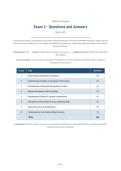
NURS 661 Maryville
Exam 2 - Questions and Answers
Comprehensive Practice Examination for Psychiatric-Mental Health Nurse Practitioner (PMHNP) Preparation aligned with the
Maryville University NURS 661 Course Syllabus, PMHNP Role Competencies, and Evidence-Based Psychiatric-Mental Health
Practice Standards.
Total Questions: 180 | Format: Multiple Choice (4 options, one correct) | Cognitive Levels: 20% Recall, 50% Application,
30% Analysis
Content Coverage: Group Therapy, Psychodrama, Psychodynamic Therapy, Defense Mechanisms, Erikson's Stages &
Therapeutic Communication
Section Topic Questions
1 Group Therapy Foundations & Dynamics 30
2 Psychotherapy Modalities & Therapeutic Interventions 30
3 Psychodynamic Therapy & Psychoanalytic Concepts 25
4 Defense Mechanisms & Ego Psychology 20
5 Developmental Theories & Lifespan Considerations 20
6 Therapeutic Communication & Group Leadership Skills 25
7 Special Topics & Clinical Applications 20
8 Comprehensive Case Studies & Mixed Scenarios 10
TOTAL 180
Instructions: Select the single best answer for each question. Rationales reference the NURS 661 curriculum and PMHNP
evidence-based practice standards.
Page 1
, NURS 661 Maryville Exam 2 - Questions and Answers 2026/2027
Section 1: Group Therapy Foundations & Dynamics
Q1: A PMHNP is establishing a new psychoeducational group for adults with bipolar disorder. The group will
meet weekly for 12 consecutive weeks with the same eight members, after which the group will dissolve.
Which type of group is being described?
A. An open, homogeneous group
B. A closed, homogeneous group *[CORRECT]*
C. An open, heterogeneous group
D. A closed, heterogeneous group
Correct Answer: B
Rationale: A closed group maintains a fixed membership once it begins, with no new members admitted, which is appropriate for
time-limited psychoeducational curricula. Homogeneous groups share a common diagnosis or concern (here, bipolar disorder),
enhancing cohesion and psychoeducational focus. Open groups allow rolling admissions and are not time-limited, while
heterogeneous groups mix diagnoses or concerns, which is less ideal for structured skill-building curricula.
Q2: During the third session of a psychotherapy group, two members begin arguing about whether the group
should allow snacks during sessions. The leader notices other members becoming visibly uncomfortable and
withdrawing. According to Yalom's stages of group development, this group is most likely in which stage?
A. Orientation (Forming)
B. Transition (Storming) *[CORRECT]*
C. Working (Performing)
D. Consolidation (Adjourning)
Correct Answer: B
Rationale: The transition (storming) stage is characterized by conflict, resistance, and power struggles as members test
boundaries and compete for influence. Anxiety and discomfort are hallmark features. Orientation is marked by polite dependency
and information-seeking, the working stage by productive disclosure and mutual support, and consolidation by review and
termination work.
Q3: A group leader is selecting members for a heterogeneous interpersonal process group. Which of the
following member compositions best reflects a heterogeneous group?
A. Eight women ages 30-35 with major depressive disorder
B. Six men ages 40-50 with generalized anxiety disorder
C. Four men and four women, ages 25-65, with varied diagnoses and presenting concerns *[CORRECT]*
D. Five adolescents ages 14-16 with social anxiety disorder
Correct Answer: C
Rationale: Heterogeneous groups deliberately mix gender, age, diagnosis, and presenting concerns to maximize interpersonal
learning, multiple perspectives, and realistic social microcosm effects (Yalom). Homogeneous groups share demographics or
diagnoses, which is preferred for psychoeducational curricula but limits interpersonal learning in process groups.
Page 2
, NURS 661 Maryville Exam 2 - Questions and Answers 2026/2027
Q4: Which of the following is a well-documented advantage of group therapy over individual therapy?
A. Greater confidentiality of disclosed information
B. Lower cost per client and multiple opportunities for transference *[CORRECT]*
C. Faster symptom resolution through one-on-one attention
D. Reduced need for therapist training and supervision
Correct Answer: B
Rationale: Group therapy is more cost-effective than individual therapy and offers multiple transference opportunities as
members relate to one another, not just the therapist. It also provides social support, modeling, and feedback. However,
confidentiality is harder to guarantee in a group, symptom resolution is not necessarily faster, and group therapists require
specialized training.
Q5: A PMHNP is designing a psychoeducational group for parents of adolescents with substance use
disorders. Which focus is most consistent with the goals of a psychoeducational group?
A. Exploring unconscious conflicts from the parents' own childhoods
B. Imparting information, building skills, problem-solving, and providing support *[CORRECT]*
C. Free association and dream analysis
D. Intensive regression to early developmental fixations
Correct Answer: B
Rationale: Psychoeducational groups focus on imparting information, skill building, problem-solving, social skills, and support
rather than insight into unconscious processes. They are structured, didactic, and time-limited. Free association, dream analysis,
and regression are psychodynamic techniques inappropriate for psychoeducational formats.
Q6: A new group member asks the leader, 'How long will this group go on, and can I bring my friend next
week?' The leader explains that the group is closed and time-limited. What is the primary rationale for using a
closed group format?
A. To reduce the therapist's workload
B. To preserve group cohesion, trust, and continuity of interpersonal work *[CORRECT]*
C. To exclude clients with more severe pathology
D. To bill insurance at a higher reimbursement rate
Correct Answer: B
Rationale: Closed groups maintain fixed membership to build trust, cohesion, and psychological safety that deep interpersonal
work requires. Adding new members disrupts established norms and trust. Closed format is not about therapist workload,
excluding severe pathology, or billing; it is a clinical decision based on group process needs.
Q7: In the orientation (formation) stage of group development, which leader behavior is most appropriate?
A. Confronting members about their resistance
B. Establishing norms, structure, and clarifying goals and confidentiality *[CORRECT]*
C. Encouraging deep transference exploration
D. Initiating termination discussion
Correct Answer: B
Rationale: During orientation, the leader's primary task is structuring the group: setting norms, clarifying goals, explaining
confidentiality limits, and establishing safety. Confrontation belongs to the transition stage, deep transference work to the
working stage, and termination to the consolidation stage.
Page 3
, NURS 661 Maryville Exam 2 - Questions and Answers 2026/2027
Q8: A PMHNP is leading a group that has been meeting for six months. Members now openly share struggles,
give each other constructive feedback, and take risks with disclosure. Group cohesion is high. Which stage
best describes this group?
A. Orientation
B. Transition
C. Working *[CORRECT]*
D. Consolidation
Correct Answer: C
Rationale: The working stage is characterized by high cohesion, productive disclosure, mutual feedback, risk-taking, and
goal-directed work. Members function with greater autonomy from the leader. Orientation, transition, and consolidation each
have distinct features that differ from this profile.
Q9: Which of the following is a recognized limitation of group therapy?
A. It is less effective than individual therapy in nearly all cases
B. Confidentiality cannot be guaranteed beyond the leader's own disclosure *[CORRECT]*
C. It eliminates opportunities for interpersonal learning
D. It precludes the use of evidence-based modalities
Correct Answer: B
Rationale: A key limitation of group therapy is that confidentiality depends on each member's adherence to group norms; the
leader cannot guarantee that members will maintain confidentiality outside the group. Group therapy is not categorically less
effective than individual therapy, does not eliminate interpersonal learning, and can incorporate evidence-based modalities such
as CBT, IPT, and DBT.
Q10: A psychoeducational group leader wants to evaluate whether members are acquiring the targeted skills.
Which evaluation strategy is most appropriate for a psychoeducational group?
A. Free association content analysis
B. Pre- and post-tests measuring knowledge and skill demonstration *[CORRECT]*
C. Dream content interpretation
D. Transference pattern documentation
Correct Answer: B
Rationale: Psychoeducational groups are evaluated by measurable knowledge and skill gains, often via pre- and post-tests,
role-play demonstrations, or behavioral checklists. Free association, dream analysis, and transference documentation are
psychodynamic process tools inappropriate for evaluating psychoeducational outcomes.
Q11: In an open psychotherapy group with rolling admissions, a new member joins during the working stage.
Which leader intervention is most important in the first session for the new member?
A. Immediately requiring the new member to disclose personal trauma
B. Reviewing group norms, contracts, and history to integrate the new member *[CORRECT]*
C. Asking the new member to remain silent until trust is established
D. Confronting existing members about their feelings toward the new member
Correct Answer: B
Rationale: When a new member joins an open group, the leader must orient them to established norms, contracts, and group
history to facilitate integration and preserve cohesion. Forcing disclosure or requiring silence is countertherapeutic, and
confronting existing members prematurely can intensify resistance.
Page 4
Exam 2 - Questions and Answers
Comprehensive Practice Examination for Psychiatric-Mental Health Nurse Practitioner (PMHNP) Preparation aligned with the
Maryville University NURS 661 Course Syllabus, PMHNP Role Competencies, and Evidence-Based Psychiatric-Mental Health
Practice Standards.
Total Questions: 180 | Format: Multiple Choice (4 options, one correct) | Cognitive Levels: 20% Recall, 50% Application,
30% Analysis
Content Coverage: Group Therapy, Psychodrama, Psychodynamic Therapy, Defense Mechanisms, Erikson's Stages &
Therapeutic Communication
Section Topic Questions
1 Group Therapy Foundations & Dynamics 30
2 Psychotherapy Modalities & Therapeutic Interventions 30
3 Psychodynamic Therapy & Psychoanalytic Concepts 25
4 Defense Mechanisms & Ego Psychology 20
5 Developmental Theories & Lifespan Considerations 20
6 Therapeutic Communication & Group Leadership Skills 25
7 Special Topics & Clinical Applications 20
8 Comprehensive Case Studies & Mixed Scenarios 10
TOTAL 180
Instructions: Select the single best answer for each question. Rationales reference the NURS 661 curriculum and PMHNP
evidence-based practice standards.
Page 1
, NURS 661 Maryville Exam 2 - Questions and Answers 2026/2027
Section 1: Group Therapy Foundations & Dynamics
Q1: A PMHNP is establishing a new psychoeducational group for adults with bipolar disorder. The group will
meet weekly for 12 consecutive weeks with the same eight members, after which the group will dissolve.
Which type of group is being described?
A. An open, homogeneous group
B. A closed, homogeneous group *[CORRECT]*
C. An open, heterogeneous group
D. A closed, heterogeneous group
Correct Answer: B
Rationale: A closed group maintains a fixed membership once it begins, with no new members admitted, which is appropriate for
time-limited psychoeducational curricula. Homogeneous groups share a common diagnosis or concern (here, bipolar disorder),
enhancing cohesion and psychoeducational focus. Open groups allow rolling admissions and are not time-limited, while
heterogeneous groups mix diagnoses or concerns, which is less ideal for structured skill-building curricula.
Q2: During the third session of a psychotherapy group, two members begin arguing about whether the group
should allow snacks during sessions. The leader notices other members becoming visibly uncomfortable and
withdrawing. According to Yalom's stages of group development, this group is most likely in which stage?
A. Orientation (Forming)
B. Transition (Storming) *[CORRECT]*
C. Working (Performing)
D. Consolidation (Adjourning)
Correct Answer: B
Rationale: The transition (storming) stage is characterized by conflict, resistance, and power struggles as members test
boundaries and compete for influence. Anxiety and discomfort are hallmark features. Orientation is marked by polite dependency
and information-seeking, the working stage by productive disclosure and mutual support, and consolidation by review and
termination work.
Q3: A group leader is selecting members for a heterogeneous interpersonal process group. Which of the
following member compositions best reflects a heterogeneous group?
A. Eight women ages 30-35 with major depressive disorder
B. Six men ages 40-50 with generalized anxiety disorder
C. Four men and four women, ages 25-65, with varied diagnoses and presenting concerns *[CORRECT]*
D. Five adolescents ages 14-16 with social anxiety disorder
Correct Answer: C
Rationale: Heterogeneous groups deliberately mix gender, age, diagnosis, and presenting concerns to maximize interpersonal
learning, multiple perspectives, and realistic social microcosm effects (Yalom). Homogeneous groups share demographics or
diagnoses, which is preferred for psychoeducational curricula but limits interpersonal learning in process groups.
Page 2
, NURS 661 Maryville Exam 2 - Questions and Answers 2026/2027
Q4: Which of the following is a well-documented advantage of group therapy over individual therapy?
A. Greater confidentiality of disclosed information
B. Lower cost per client and multiple opportunities for transference *[CORRECT]*
C. Faster symptom resolution through one-on-one attention
D. Reduced need for therapist training and supervision
Correct Answer: B
Rationale: Group therapy is more cost-effective than individual therapy and offers multiple transference opportunities as
members relate to one another, not just the therapist. It also provides social support, modeling, and feedback. However,
confidentiality is harder to guarantee in a group, symptom resolution is not necessarily faster, and group therapists require
specialized training.
Q5: A PMHNP is designing a psychoeducational group for parents of adolescents with substance use
disorders. Which focus is most consistent with the goals of a psychoeducational group?
A. Exploring unconscious conflicts from the parents' own childhoods
B. Imparting information, building skills, problem-solving, and providing support *[CORRECT]*
C. Free association and dream analysis
D. Intensive regression to early developmental fixations
Correct Answer: B
Rationale: Psychoeducational groups focus on imparting information, skill building, problem-solving, social skills, and support
rather than insight into unconscious processes. They are structured, didactic, and time-limited. Free association, dream analysis,
and regression are psychodynamic techniques inappropriate for psychoeducational formats.
Q6: A new group member asks the leader, 'How long will this group go on, and can I bring my friend next
week?' The leader explains that the group is closed and time-limited. What is the primary rationale for using a
closed group format?
A. To reduce the therapist's workload
B. To preserve group cohesion, trust, and continuity of interpersonal work *[CORRECT]*
C. To exclude clients with more severe pathology
D. To bill insurance at a higher reimbursement rate
Correct Answer: B
Rationale: Closed groups maintain fixed membership to build trust, cohesion, and psychological safety that deep interpersonal
work requires. Adding new members disrupts established norms and trust. Closed format is not about therapist workload,
excluding severe pathology, or billing; it is a clinical decision based on group process needs.
Q7: In the orientation (formation) stage of group development, which leader behavior is most appropriate?
A. Confronting members about their resistance
B. Establishing norms, structure, and clarifying goals and confidentiality *[CORRECT]*
C. Encouraging deep transference exploration
D. Initiating termination discussion
Correct Answer: B
Rationale: During orientation, the leader's primary task is structuring the group: setting norms, clarifying goals, explaining
confidentiality limits, and establishing safety. Confrontation belongs to the transition stage, deep transference work to the
working stage, and termination to the consolidation stage.
Page 3
, NURS 661 Maryville Exam 2 - Questions and Answers 2026/2027
Q8: A PMHNP is leading a group that has been meeting for six months. Members now openly share struggles,
give each other constructive feedback, and take risks with disclosure. Group cohesion is high. Which stage
best describes this group?
A. Orientation
B. Transition
C. Working *[CORRECT]*
D. Consolidation
Correct Answer: C
Rationale: The working stage is characterized by high cohesion, productive disclosure, mutual feedback, risk-taking, and
goal-directed work. Members function with greater autonomy from the leader. Orientation, transition, and consolidation each
have distinct features that differ from this profile.
Q9: Which of the following is a recognized limitation of group therapy?
A. It is less effective than individual therapy in nearly all cases
B. Confidentiality cannot be guaranteed beyond the leader's own disclosure *[CORRECT]*
C. It eliminates opportunities for interpersonal learning
D. It precludes the use of evidence-based modalities
Correct Answer: B
Rationale: A key limitation of group therapy is that confidentiality depends on each member's adherence to group norms; the
leader cannot guarantee that members will maintain confidentiality outside the group. Group therapy is not categorically less
effective than individual therapy, does not eliminate interpersonal learning, and can incorporate evidence-based modalities such
as CBT, IPT, and DBT.
Q10: A psychoeducational group leader wants to evaluate whether members are acquiring the targeted skills.
Which evaluation strategy is most appropriate for a psychoeducational group?
A. Free association content analysis
B. Pre- and post-tests measuring knowledge and skill demonstration *[CORRECT]*
C. Dream content interpretation
D. Transference pattern documentation
Correct Answer: B
Rationale: Psychoeducational groups are evaluated by measurable knowledge and skill gains, often via pre- and post-tests,
role-play demonstrations, or behavioral checklists. Free association, dream analysis, and transference documentation are
psychodynamic process tools inappropriate for evaluating psychoeducational outcomes.
Q11: In an open psychotherapy group with rolling admissions, a new member joins during the working stage.
Which leader intervention is most important in the first session for the new member?
A. Immediately requiring the new member to disclose personal trauma
B. Reviewing group norms, contracts, and history to integrate the new member *[CORRECT]*
C. Asking the new member to remain silent until trust is established
D. Confronting existing members about their feelings toward the new member
Correct Answer: B
Rationale: When a new member joins an open group, the leader must orient them to established norms, contracts, and group
history to facilitate integration and preserve cohesion. Forcing disclosure or requiring silence is countertherapeutic, and
confronting existing members prematurely can intensify resistance.
Page 4

