
FLHSMV-Aligned Practice Exam | 40 Questions | 80% Passing Score Required
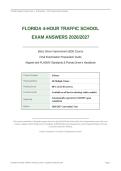
FLORIDA 4-HOUR TRAFFIC SCHOOL
EXAM ANSWERS 2026/2027
Basic Driver Improvement (BDI) Course
Final Examination Preparation Guide
Aligned with FLHSMV Standards & Florida Driver's Handbook
Course Duration 4 Hours
Total Questions 40 Multiple Choice
Passing Score 80% (32 of 40 correct)
Course Format Available on all devices (desktop, tablet, mobile)
Automatically reported to FLHSMV upon
Reporting
completion
Edition 2026/2027 Curriculum Year
This practice examination is designed to prepare drivers for the official Florida 4-Hour Basic Driver Improvement course final exam.
Content is aligned with the Florida Driver's Handbook, FLHSMV BDI Course Requirements, and the Standard Defensive Driving
Curriculum (2026/2027 Edition).
Practice Examination | 5 Sections | 8 Questions per Section
FLORIDA 4-HOUR TRAFFIC SCHOOL EXAM | 2026/2027 BDI EDITION Page 1
, FLHSMV-Aligned Practice Exam | 40 Questions | 80% Passing Score Required
Section 1: Alcohol, Drugs, and Driving
Q1: Alcohol is classified as which type of drug, and how does it affect the central nervous system?
A. A stimulant that speeds up brain activity and reaction time
B. A hallucinogen that distorts perception without slowing reflexes
C. A depressant that slows brain function and impairs coordination *[CORRECT]*
D. A narcotic that blocks pain without affecting judgment
Correct Answer: C — A depressant that slows brain function and impairs coordination
Rationale: Alcohol is a depressant: it slows the central nervous system, degrading judgment, coordination, and
reaction time even at low doses. The Florida BDI curriculum stresses that no amount of alcohol improves driving
performance, contradicting the common myth that small amounts 'stimulate' alertness.
Q2: At approximately what rate does a healthy liver metabolize alcohol, and what practical
implication does this have for drivers?
A. 0.5 drink per hour; spacing drinks restores sobriety quickly
B. 1 drink per hour; coffee, cold showers, and exercise cannot speed up the process *[CORRECT]*
C. 2 drinks per hour; food accelerates metabolism beyond this baseline
D. 3 drinks per hour; only time of day affects processing speed
Correct Answer: B — 1 drink per hour; coffee, cold showers, and exercise cannot speed up the process
Rationale: The healthy liver metabolizes roughly one standard drink per hour, and this rate cannot be accelerated by
coffee, food, cold showers, or exercise—the Florida BDI curriculum explicitly debunks these 'sobering up' myths. Only
time reduces BAC, so a driver who consumed several drinks may still be impaired hours later.
Q3: How does carbonation affect the rate at which alcohol is absorbed into the bloodstream?
A. Carbonation slows absorption, giving the liver more time to process alcohol
B. Carbonation has no measurable effect on absorption rate
C. Carbonation causes alcohol to be absorbed faster than non-carbonated drinks *[CORRECT]*
D. Carbonation eliminates alcohol from the bloodstream entirely
Correct Answer: C — Carbonation causes alcohol to be absorbed faster than non-carbonated drinks
Rationale: Carbonated alcoholic beverages—champagne, beer, and mixed drinks made with soda—irritate the
stomach lining and increase pressure, allowing alcohol to pass more quickly into the small intestine and bloodstream.
The Florida BDI curriculum warns that bubbly drinks often produce a faster, more pronounced impairment than the
same alcohol consumed straight.
FLORIDA 4-HOUR TRAFFIC SCHOOL EXAM | 2026/2027 BDI EDITION Page 2
FLORIDA 4-HOUR TRAFFIC SCHOOL
EXAM ANSWERS 2026/2027
Basic Driver Improvement (BDI) Course
Final Examination Preparation Guide
Aligned with FLHSMV Standards & Florida Driver's Handbook
Course Duration 4 Hours
Total Questions 40 Multiple Choice
Passing Score 80% (32 of 40 correct)
Course Format Available on all devices (desktop, tablet, mobile)
Automatically reported to FLHSMV upon
Reporting
completion
Edition 2026/2027 Curriculum Year
This practice examination is designed to prepare drivers for the official Florida 4-Hour Basic Driver Improvement course final exam.
Content is aligned with the Florida Driver's Handbook, FLHSMV BDI Course Requirements, and the Standard Defensive Driving
Curriculum (2026/2027 Edition).
Practice Examination | 5 Sections | 8 Questions per Section
FLORIDA 4-HOUR TRAFFIC SCHOOL EXAM | 2026/2027 BDI EDITION Page 1
, FLHSMV-Aligned Practice Exam | 40 Questions | 80% Passing Score Required
Section 1: Alcohol, Drugs, and Driving
Q1: Alcohol is classified as which type of drug, and how does it affect the central nervous system?
A. A stimulant that speeds up brain activity and reaction time
B. A hallucinogen that distorts perception without slowing reflexes
C. A depressant that slows brain function and impairs coordination *[CORRECT]*
D. A narcotic that blocks pain without affecting judgment
Correct Answer: C — A depressant that slows brain function and impairs coordination
Rationale: Alcohol is a depressant: it slows the central nervous system, degrading judgment, coordination, and
reaction time even at low doses. The Florida BDI curriculum stresses that no amount of alcohol improves driving
performance, contradicting the common myth that small amounts 'stimulate' alertness.
Q2: At approximately what rate does a healthy liver metabolize alcohol, and what practical
implication does this have for drivers?
A. 0.5 drink per hour; spacing drinks restores sobriety quickly
B. 1 drink per hour; coffee, cold showers, and exercise cannot speed up the process *[CORRECT]*
C. 2 drinks per hour; food accelerates metabolism beyond this baseline
D. 3 drinks per hour; only time of day affects processing speed
Correct Answer: B — 1 drink per hour; coffee, cold showers, and exercise cannot speed up the process
Rationale: The healthy liver metabolizes roughly one standard drink per hour, and this rate cannot be accelerated by
coffee, food, cold showers, or exercise—the Florida BDI curriculum explicitly debunks these 'sobering up' myths. Only
time reduces BAC, so a driver who consumed several drinks may still be impaired hours later.
Q3: How does carbonation affect the rate at which alcohol is absorbed into the bloodstream?
A. Carbonation slows absorption, giving the liver more time to process alcohol
B. Carbonation has no measurable effect on absorption rate
C. Carbonation causes alcohol to be absorbed faster than non-carbonated drinks *[CORRECT]*
D. Carbonation eliminates alcohol from the bloodstream entirely
Correct Answer: C — Carbonation causes alcohol to be absorbed faster than non-carbonated drinks
Rationale: Carbonated alcoholic beverages—champagne, beer, and mixed drinks made with soda—irritate the
stomach lining and increase pressure, allowing alcohol to pass more quickly into the small intestine and bloodstream.
The Florida BDI curriculum warns that bubbly drinks often produce a faster, more pronounced impairment than the
same alcohol consumed straight.
FLORIDA 4-HOUR TRAFFIC SCHOOL EXAM | 2026/2027 BDI EDITION Page 2

