PTA Exam Musculoskeletal with all Correct & 100% Verified
Answers |Actual Complete Update |Already Graded A+
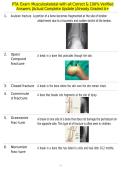
1. Avulsion fracture A portion of a bone becomes fragmented at the site of tendon
attachment due to a traumatic and sudden stretch of the tendon.
2. Open/ A break in a bone that protrudes through the skin.
Compund
fracture
3. Closed fracture A break in the bone where the skin over the site remain intact.
4. Comminute A bone that breaks into fragments at the site of injury.
d fracture
5. Greenstick A break on one side of a bone that does not damage the periosteum on
frac-ture the opposite side. This type of of fracture is often seen in children.
6. Nonunion A break in a bone that has failed to unite and heal after 9-12 months.
frac-ture
, PTA Exam Musculoskeletal with all Correct & 100% Verified
Answers |Actual Complete Update |Already Graded A+
7. Stress fracture A break in a bone due to repeated forces to particular portion of the bone.
8. Spiral fracture A break in a bones shaped like an "S" due to torsion and twisting.
9. Isometric Muscular force is generated w/out change in muscle length. Isometric
exer-cises exercises are often performed against an immovable object. Sub
maximal isometric exer-cises are traditionally used in rehabilitation
programs.
10. Isotonic
exercis-es Muscular contraction is generated with muscle exerting a constant
tension. This can be also thought of as a muscle movement with a
constant load. Isotonic exercises are performed against resistance, often
employing equipment such as handheld weights.
, PTA Exam Musculoskeletal with all Correct & 100% Verified
Answers |Actual Complete Update |Already Graded A+
11. Isokinetic Muscular contraction is generated with a constant maximal speed and
exer-cises variable load. In isokinetic exercise, the reaction force is identical to the
force applied to the equipment. Cyber, Biodex, and Lido are a few of
the companies that make isokinetic machines.
12. ATP-PC - AKA Phosphagen System
-ATP production for short duration (100 m sprint)
-Provides energy tup to 15 seconds
-Anaerobic system
13. Glycolysis - Anaerobic
-Major supplier of ATP for short duration activities (400 or 800 meters)
-Stored glycogen is split into glucose (via glycolysis) and then into
pyretic acid which forms ATP
-Forms lactic acid
-Provides enough energy for 30-40 seconds
14. Aerobic
Metabo-lism
, PTA Exam Musculoskeletal with all Correct & 100% Verified
Answers |Actual Complete Update |Already Graded A+
-Low intensity, long duration exercise
-Yields most ATP
-Uses fatty acids, amino acids, and glucose as energy
15. Anatomical
-Divides body in anterior and posterior
posi-tion
-Motions: Abduction/Adduction
-Axis: sagittal (anterior-post)
16. Fontal
Plane
(Coronal)
17. Sagittal Plane - Divides the body into right and left sections
-Motions: Flexion, extension, hyperextension
-Axis: Frontal (medial-lateral)
Answers |Actual Complete Update |Already Graded A+
1. Avulsion fracture A portion of a bone becomes fragmented at the site of tendon
attachment due to a traumatic and sudden stretch of the tendon.
2. Open/ A break in a bone that protrudes through the skin.
Compund
fracture
3. Closed fracture A break in the bone where the skin over the site remain intact.
4. Comminute A bone that breaks into fragments at the site of injury.
d fracture
5. Greenstick A break on one side of a bone that does not damage the periosteum on
frac-ture the opposite side. This type of of fracture is often seen in children.
6. Nonunion A break in a bone that has failed to unite and heal after 9-12 months.
frac-ture
, PTA Exam Musculoskeletal with all Correct & 100% Verified
Answers |Actual Complete Update |Already Graded A+
7. Stress fracture A break in a bone due to repeated forces to particular portion of the bone.
8. Spiral fracture A break in a bones shaped like an "S" due to torsion and twisting.
9. Isometric Muscular force is generated w/out change in muscle length. Isometric
exer-cises exercises are often performed against an immovable object. Sub
maximal isometric exer-cises are traditionally used in rehabilitation
programs.
10. Isotonic
exercis-es Muscular contraction is generated with muscle exerting a constant
tension. This can be also thought of as a muscle movement with a
constant load. Isotonic exercises are performed against resistance, often
employing equipment such as handheld weights.
, PTA Exam Musculoskeletal with all Correct & 100% Verified
Answers |Actual Complete Update |Already Graded A+
11. Isokinetic Muscular contraction is generated with a constant maximal speed and
exer-cises variable load. In isokinetic exercise, the reaction force is identical to the
force applied to the equipment. Cyber, Biodex, and Lido are a few of
the companies that make isokinetic machines.
12. ATP-PC - AKA Phosphagen System
-ATP production for short duration (100 m sprint)
-Provides energy tup to 15 seconds
-Anaerobic system
13. Glycolysis - Anaerobic
-Major supplier of ATP for short duration activities (400 or 800 meters)
-Stored glycogen is split into glucose (via glycolysis) and then into
pyretic acid which forms ATP
-Forms lactic acid
-Provides enough energy for 30-40 seconds
14. Aerobic
Metabo-lism
, PTA Exam Musculoskeletal with all Correct & 100% Verified
Answers |Actual Complete Update |Already Graded A+
-Low intensity, long duration exercise
-Yields most ATP
-Uses fatty acids, amino acids, and glucose as energy
15. Anatomical
-Divides body in anterior and posterior
posi-tion
-Motions: Abduction/Adduction
-Axis: sagittal (anterior-post)
16. Fontal
Plane
(Coronal)
17. Sagittal Plane - Divides the body into right and left sections
-Motions: Flexion, extension, hyperextension
-Axis: Frontal (medial-lateral)