
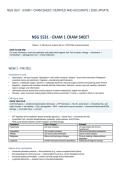
NSG 5531 - EXAM 1 CRAM SHEET| VERIFIED AND ACCURATE | 2026 UPDATE
NSG 5531 - EXAM 1 CRAM SHEET
Weeks 1-4 | McCance & Huether 9th ed. | FNP/APEA-oriented synthesis
HOW TO USE THIS
For every mechanism, cover the explanation and predict what happens next. Aim to explain: etiology -> mechanism ->
manifestation -> lab/diagnostic clue -> clinical implication.
WEEK 1 - THE CELL
Vocabulary to own
• Hypertrophy = cell size increases. Hyperplasia = cell number increases. Atrophy = size/function decreases. Metaplasia =
reversible mature-cell substitution. Dysplasia = disordered growth/maturation.
• Hypoxia = inadequate oxygen. Ischemia = inadequate blood flow, reducing oxygen/nutrients and impairing waste removal.
• Apoptosis = programmed controlled cell death with little inflammation. Necrosis = severe injury with swelling, membrane
rupture, leakage, and inflammation.
• Hydrostatic pressure pushes fluid; oncotic pressure is protein-mediated pull, largely from albumin.
• Osmosis = water movement toward greater effective solute concentration. Tonicity = a solution's effect on cell volume.
Cell injury chain
KNOW THIS COLD
Ischemia/hypoxia -> oxidative phosphorylation decreases -> ATP decreases -> Na+/K+ pump failure -> intracellular Na+ and
water increase -> cell swelling -> Ca2+ dysregulation + ROS -> destructive enzyme activation -> membrane/mitochondrial/DNA
damage -> irreversible injury -> necrosis.
• ATP depletion shifts metabolism toward anaerobic glycolysis -> lactate rises -> intracellular pH falls.
• Intracellular Ca2+ activates phospholipases, proteases, endonucleases, and ATPases.
• ROS cause lipid peroxidation, protein oxidation, and DNA damage.
Adaptation What changes? Example
Hypertrophy Cell size increases LV hypertrophy with chronic
hypertension
Hyperplasia Cell number increases Hormonal endometrial proliferation
Atrophy Cell size/function decreases Disuse muscle atrophy
Metaplasia Mature cell phenotype changes Chronic smoking-related epithelial
adaptation
Dysplasia Growth/maturation becomes disordered Potential premalignant change
Edema: four mechanisms
• Increased hydrostatic pressure -> fluid pushed out (e.g., venous congestion/heart failure).
• Decreased plasma oncotic pressure -> reduced albumin pull (e.g., severe hypoalbuminemia).
• Increased capillary permeability -> protein and fluid escape during inflammation.
• Lymphatic obstruction -> impaired return of interstitial fluid/protein.
, Electrolyte + acid-base logic
• Na+: think water balance and neurologic effects of altered brain-cell volume.
• K+: think membrane excitability and cardiac conduction; both low and high K+ can cause dysrhythmias.
• Ca2+: think contraction, signaling, coagulation, and neuromuscular excitability.
Disorder Primary change Expected compensation
Respiratory acidosis PaCO2 increases Kidneys retain/generate HCO3-
Respiratory alkalosis PaCO2 decreases Kidneys excrete HCO3-
Metabolic acidosis HCO3- decreases / acid increases Hyperventilation -> PaCO2 decreases
Metabolic alkalosis HCO3- increases / H+ loss Hypoventilation -> PaCO2 increases
(limited)
WEEK 2 - GENES, GENE-ENVIRONMENT & CANCER
• Genotype = genetic constitution; phenotype = observable expression of genotype plus environment/regulation.
• Penetrance = whether a genotype manifests; expressivity = degree/pattern of manifestation.
• Germline variants can be inherited; somatic variants are acquired in body cells.
• Epigenetics changes gene expression without changing the DNA sequence.
• Proto-oncogene = normal growth promoter; oncogene = activated growth driver; tumor suppressor = growth/genomic brake.
Inheritance Typical clue Core logic
Autosomal dominant Vertical pattern across generations One pathogenic allele may be sufficient
Autosomal recessive Affected siblings; parents may be Two pathogenic alleles usually required
unaffected carriers
X-linked recessive Often more clinically apparent in males Transmission depends on parental
sex/chromosomes
Multifactorial Family clustering plus environmental Many genes + exposures
effects
Cancer mechanism
CANCER PROGRESSION
Genomic injury/driver alterations -> growth control lost -> clonal expansion -> additional alterations -> apoptosis resistance ->
angiogenesis -> invasion -> circulation -> distant colonization/metastasis.
• Oncogene = accelerator stuck on. Tumor suppressor loss = brake removed. DNA-repair defect = mutations accumulate.
• p53 responds to DNA damage with arrest/repair, senescence, or apoptosis; loss allows damaged cells to continue dividing.
• Grade = microscopic differentiation/aggressiveness. Stage = anatomic extent/spread.
WEEK 3 - INNATE + ADAPTIVE IMMUNITY
Feature Innate Adaptive
Speed Immediate/rapid Slower primary; faster secondary
Recognition Pattern-based Antigen-specific
Memory No classic antigen-specific memory Yes
Cells Neutrophils, macrophages, NK, dendritic B cells, CD4+, CD8+
Tools Barriers, cytokines, complement, Antibodies and T-cell effector responses
phagocytosis
Inflammation chain
TRACE IT
Barrier breach/pathogen -> PRR recognition -> cytokines/chemokines -> vasodilation + permeability increase -> endothelial
activation -> leukocyte recruitment -> chemotaxis -> phagocytosis/killing -> resolution/repair.
• Neutrophils: rapid phagocytes, commonly prominent early in acute bacterial inflammation.
• Macrophages: phagocytosis, cytokines, antigen presentation, repair coordination.
NSG 5531 - EXAM 1 CRAM SHEET
Weeks 1-4 | McCance & Huether 9th ed. | FNP/APEA-oriented synthesis
HOW TO USE THIS
For every mechanism, cover the explanation and predict what happens next. Aim to explain: etiology -> mechanism ->
manifestation -> lab/diagnostic clue -> clinical implication.
WEEK 1 - THE CELL
Vocabulary to own
• Hypertrophy = cell size increases. Hyperplasia = cell number increases. Atrophy = size/function decreases. Metaplasia =
reversible mature-cell substitution. Dysplasia = disordered growth/maturation.
• Hypoxia = inadequate oxygen. Ischemia = inadequate blood flow, reducing oxygen/nutrients and impairing waste removal.
• Apoptosis = programmed controlled cell death with little inflammation. Necrosis = severe injury with swelling, membrane
rupture, leakage, and inflammation.
• Hydrostatic pressure pushes fluid; oncotic pressure is protein-mediated pull, largely from albumin.
• Osmosis = water movement toward greater effective solute concentration. Tonicity = a solution's effect on cell volume.
Cell injury chain
KNOW THIS COLD
Ischemia/hypoxia -> oxidative phosphorylation decreases -> ATP decreases -> Na+/K+ pump failure -> intracellular Na+ and
water increase -> cell swelling -> Ca2+ dysregulation + ROS -> destructive enzyme activation -> membrane/mitochondrial/DNA
damage -> irreversible injury -> necrosis.
• ATP depletion shifts metabolism toward anaerobic glycolysis -> lactate rises -> intracellular pH falls.
• Intracellular Ca2+ activates phospholipases, proteases, endonucleases, and ATPases.
• ROS cause lipid peroxidation, protein oxidation, and DNA damage.
Adaptation What changes? Example
Hypertrophy Cell size increases LV hypertrophy with chronic
hypertension
Hyperplasia Cell number increases Hormonal endometrial proliferation
Atrophy Cell size/function decreases Disuse muscle atrophy
Metaplasia Mature cell phenotype changes Chronic smoking-related epithelial
adaptation
Dysplasia Growth/maturation becomes disordered Potential premalignant change
Edema: four mechanisms
• Increased hydrostatic pressure -> fluid pushed out (e.g., venous congestion/heart failure).
• Decreased plasma oncotic pressure -> reduced albumin pull (e.g., severe hypoalbuminemia).
• Increased capillary permeability -> protein and fluid escape during inflammation.
• Lymphatic obstruction -> impaired return of interstitial fluid/protein.
, Electrolyte + acid-base logic
• Na+: think water balance and neurologic effects of altered brain-cell volume.
• K+: think membrane excitability and cardiac conduction; both low and high K+ can cause dysrhythmias.
• Ca2+: think contraction, signaling, coagulation, and neuromuscular excitability.
Disorder Primary change Expected compensation
Respiratory acidosis PaCO2 increases Kidneys retain/generate HCO3-
Respiratory alkalosis PaCO2 decreases Kidneys excrete HCO3-
Metabolic acidosis HCO3- decreases / acid increases Hyperventilation -> PaCO2 decreases
Metabolic alkalosis HCO3- increases / H+ loss Hypoventilation -> PaCO2 increases
(limited)
WEEK 2 - GENES, GENE-ENVIRONMENT & CANCER
• Genotype = genetic constitution; phenotype = observable expression of genotype plus environment/regulation.
• Penetrance = whether a genotype manifests; expressivity = degree/pattern of manifestation.
• Germline variants can be inherited; somatic variants are acquired in body cells.
• Epigenetics changes gene expression without changing the DNA sequence.
• Proto-oncogene = normal growth promoter; oncogene = activated growth driver; tumor suppressor = growth/genomic brake.
Inheritance Typical clue Core logic
Autosomal dominant Vertical pattern across generations One pathogenic allele may be sufficient
Autosomal recessive Affected siblings; parents may be Two pathogenic alleles usually required
unaffected carriers
X-linked recessive Often more clinically apparent in males Transmission depends on parental
sex/chromosomes
Multifactorial Family clustering plus environmental Many genes + exposures
effects
Cancer mechanism
CANCER PROGRESSION
Genomic injury/driver alterations -> growth control lost -> clonal expansion -> additional alterations -> apoptosis resistance ->
angiogenesis -> invasion -> circulation -> distant colonization/metastasis.
• Oncogene = accelerator stuck on. Tumor suppressor loss = brake removed. DNA-repair defect = mutations accumulate.
• p53 responds to DNA damage with arrest/repair, senescence, or apoptosis; loss allows damaged cells to continue dividing.
• Grade = microscopic differentiation/aggressiveness. Stage = anatomic extent/spread.
WEEK 3 - INNATE + ADAPTIVE IMMUNITY
Feature Innate Adaptive
Speed Immediate/rapid Slower primary; faster secondary
Recognition Pattern-based Antigen-specific
Memory No classic antigen-specific memory Yes
Cells Neutrophils, macrophages, NK, dendritic B cells, CD4+, CD8+
Tools Barriers, cytokines, complement, Antibodies and T-cell effector responses
phagocytosis
Inflammation chain
TRACE IT
Barrier breach/pathogen -> PRR recognition -> cytokines/chemokines -> vasodilation + permeability increase -> endothelial
activation -> leukocyte recruitment -> chemotaxis -> phagocytosis/killing -> resolution/repair.
• Neutrophils: rapid phagocytes, commonly prominent early in acute bacterial inflammation.
• Macrophages: phagocytosis, cytokines, antigen presentation, repair coordination.

