
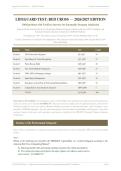
Lifeguard Test: Red Cross — 2026/2027 Edition Paramedic Program Admission
LIFEGUARD TEST: RED CROSS — 2026/2027 EDITION
100 Questions with Verified Answers for Paramedic Program Admission
Aligned with the American Red Cross Lifeguarding Manual, Emergency Cardiovascular Care (ECC) Guidelines, and
Paramedic Program Admission Competencies (2026/2027 Edition).
Total Questions: 100 • Time Limit: 2 hours • Passing Score: 80% • Format: Multiple Choice (A–D)
Cognitive Distribution: 15% Recall • 55% Application • 30% Analysis & Clinical Reasoning • 80% Scenario-Based • 20%
Direct Knowledge
Section Topic Q# Count
Section 1 The Professional Lifeguard Q1–Q10 10
Section 2 Surveillance & Victim Recognition Q11–Q25 15
Section 3 Water Rescue Skills Q26–Q45 20
Section 4 First Aid & Medical Emergencies Q46–Q60 15
Section 5 CPR, AED, & Emergency Oxygen Q61–Q75 15
Section 6 Spinal Injury Management Q76–Q85 10
Section 7 Emergency Action Plans & Professional Responsibilities Q86–Q95 10
Section 8 Comprehensive Case Studies & Scenarios Q96–Q100 5
TOTAL Q1–Q100 100
Instructions to the Candidate: This examination consists of 100 multiple-choice questions across eight sections. Each question has
exactly one correct answer (marked *[CORRECT]*). Read each scenario carefully, select the single best response, and review the
rationale provided for each correct answer. Questions emphasize prevention of drowning and injury, victim recognition, rescue
procedures, CPR/AED application, first aid, spinal management, legal and ethical responsibilities, and Emergency Action Plan
execution. Cognitive levels span recall, application, and analysis as defined by the 2026/2027 Paramedic Program Admission
Competencies.
Section 1: The Professional Lifeguard
Scope: Primary responsibility of a lifeguard, professional characteristics, pre-service preparation, PPE, expressed and implied
consent.
*Q1:*
Which of the following best describes the PRIMARY responsibility of a certified lifeguard according to the
American Red Cross Lifeguarding Manual?
A. Enforcing facility rules and issuing warnings to patrons who violate pool policies.
B. Preventing drowning and injuries through vigilant surveillance and proactive
intervention. *[CORRECT]*
© 2026/2027 Edition • Aligned with American Red Cross Lifeguarding Manual & ECC Guidelines Page 1
,Lifeguard Test: Red Cross — 2026/2027 Edition Paramedic Program Admission
C. Maintaining water chemistry, cleaning the deck, and performing equipment checks on a scheduled
rotation.
D. Conducting swim tests for new patrons and assigning them to appropriate aquatic zones.
Correct Answer: B
Rationale: The American Red Cross Lifeguarding Manual states that the primary responsibility of a lifeguard is the
prevention of drowning and injuries through vigilant surveillance. Secondary duties such as maintenance, rule
enforcement, and swim tests must never compete with this primary mission; when such tasks distract from scanning, they
must be suspended immediately.
*Q2:*
A lifeguard is midway through testing a new patron's swimming ability when they notice a child in the shallow end
begin to struggle. What is the correct action?
A. Complete the swim test quickly, then turn back to evaluate the struggling child.
B. Signal another guard with the whistle to watch the child while finishing the swim test.
C. Immediately discontinue the swim test, activate the Emergency Action Plan (EAP) if needed, and
respond to the child. *[CORRECT]*
D. Verbally direct the child to stand up in the shallow water and continue the test.
Correct Answer: C
Rationale: Primary surveillance must never be interrupted for a secondary duty such as a swim test. The Red Cross
requires the lifeguard to immediately resume scanning or respond to the victim; if a rescue is necessary, the EAP must be
activated. Postponing intervention to complete an administrative task reflects a failure of prioritization and is a leading
cause of delayed rescue.
*Q3:*
Which set of characteristics does the American Red Cross identify as essential for a professional lifeguard?
A. Knowledgeable, reliable, mature, positive, and courteous. *[CORRECT]*
B. Assertive, athletic, vocal, dominant, and detail-oriented.
C. Competitive, extroverted, disciplined, fearless, and punctual.
D. Knowledgeable, athletic, friendly, soft-spoken, and flexible.
Correct Answer: A
Rationale: The Red Cross Lifeguarding Manual explicitly lists knowledgeable, reliable, mature, positive, and courteous as
the defining characteristics of a professional lifeguard. These traits support prevention, patron trust, and team function;
traits such as dominance or competitiveness are not part of the professional lifeguard profile and may impair team
communication during emergencies.
*Q4:*
Before beginning a shift, a lifeguard notices the rescue tube at their assigned station has a small tear in the strap.
What is the most appropriate action?
A. Use it for the shift and report the tear at the end of the rotation.
B. Replace the tube with a serviceable one and report the damaged equipment before going on
station. *[CORRECT]*
C. Tie a knot in the strap to reinforce it and continue the shift.
D. Notify the facility manager by email and continue scanning with the damaged tube.
Correct Answer: B
© 2026/2027 Edition • Aligned with American Red Cross Lifeguarding Manual & ECC Guidelines Page 2
,Lifeguard Test: Red Cross — 2026/2027 Edition Paramedic Program Admission
Rationale: Pre-service equipment checks are mandatory under Red Cross standards; a damaged rescue tube compromises
the lifeguard's ability to perform a rescue and must be replaced before assuming a surveillance post. Using damaged
equipment, knotting straps, or deferring the report creates unacceptable risk for both the lifeguard and patrons.
*Q5:*
A patron approaches a lifeguard on station and begins complaining loudly about another patron's behavior. The
activity in the water is at peak capacity. What is the best response?
A. Engage the patron in a calm dialogue to resolve the issue on the spot.
B. Briefly acknowledge the patron, direct them to facility management, and immediately return
attention to surveillance. *[CORRECT]*
C. Step down from the stand to escort the patron to the manager's office.
D. Use the whistle to call all swimmers out of the water while the complaint is addressed.
Correct Answer: B
Rationale: While customer service matters, a lifeguard on station cannot break surveillance during peak capacity. The
Red Cross instructs guards to acknowledge patron concerns briefly, redirect them to management, and immediately return
focus to scanning. Stepping down or engaging in extended dialogue removes the protective scan layer from the water.
*Q6:*
Which of the following best reflects appropriate pre-shift preparation for a lifeguard working an outdoor summer
assignment?
A. Drink caffeinated energy drinks, perform a brief stretching routine, and apply sunscreen only once at the
start of the shift.
B. Hydrate adequately before the shift, eat a light meal, apply broad-spectrum sunscreen, and
complete a physical readiness check. *[CORRECT]*
C. Eat a heavy meal for sustained energy, skip sunscreen on overcast days, and rely on the rotation for
hydration breaks.
D. Consume a high-protein meal immediately before going on station and use a baseball cap instead of
sunscreen.
Correct Answer: B
Rationale: Red Cross preparation standards emphasize sustained hydration, light nutrition, broad-spectrum sunscreen
reapplied every two hours, and a brief physical readiness check. Heavy meals impair reaction time, caffeine contributes to
dehydration, and skipping sunscreen on overcast days is unsafe because UV radiation penetrates clouds.
*Q7:*
During a pre-service inspection, a lifeguard identifies that the backboard straps are missing from the spinal
management kit. What is the most appropriate response?
A. Begin the shift; backboard straps are rarely used and can be ordered later.
B. Notify the head lifeguard or facility manager, obtain replacement straps before opening the
facility to patrons, and document the deficiency. *[CORRECT]*
C. Use rope from the maintenance closet as a temporary substitute.
D. Open the facility and rely on nearby EMS to bring a backboard if an emergency occurs.
Correct Answer: B
Rationale: Spinal injury management requires complete, functioning equipment; missing straps render the backboarding
protocol unexecutable. The Red Cross requires the lifeguard to escalate to management, retrieve replacement straps,
© 2026/2027 Edition • Aligned with American Red Cross Lifeguarding Manual & ECC Guidelines Page 3
, Lifeguard Test: Red Cross — 2026/2027 Edition Paramedic Program Admission
document the deficiency, and not open the facility to patrons until the kit is complete. Substitutes such as rope do not meet
standards of care.
*Q8:*
Which combination of personal protective equipment (PPE) represents the MINIMUM standard for a lifeguard
responding to a rescue where blood or body fluids may be present?
A. Sunglasses and a rescue tube.
B. Disposable gloves and a resuscitation mask with a one-way valve. *[CORRECT]*
C. Disposable gloves only; a resuscitation mask is optional during in-water rescue.
D. A pocket mask and a face shield without gloves.
Correct Answer: B
Rationale: Standard precautions under OSHA Bloodborne Pathogens Standard and Red Cross guidelines require
disposable gloves and a resuscitation mask with one-way valve whenever contact with blood or body fluids is anticipated.
A resuscitation mask protects against exposure during ventilations; gloves protect during contact with mucous membranes
or open wounds. Either alone is insufficient.
*Q9:*
An adult patron collapses in the locker room hallway. The patron is responsive, breathing, and complains of chest
pain. What is the correct sequence for obtaining consent before providing care?
A. State your name, identify yourself as a trained lifeguard, ask permission to help, and explain the
care you intend to provide. *[CORRECT]*
B. Begin care immediately; consent is implied for any responsive adult in a medical emergency.
C. Ask the patron to sign a liability waiver before any assessment is performed.
D. Call 911 first, then ask permission; emergency dispatch supersedes direct consent.
Correct Answer: A
Rationale: Expressed consent must be obtained from any responsive adult before care begins. The Red Cross specifies that
the rescuer states their name and level of training, explains the intended care, and asks permission. Implied consent applies
only when the victim is unresponsive, unable to consent, or a minor without a parent present. Waivers are not part of
emergency consent.
*Q10:*
A patron is pulled from the water unconscious and not breathing. No family member or witness can provide
medical history. Under what legal doctrine does the lifeguard proceed with care?
A. Good Samaritan doctrine, which exempts the rescuer from consent requirements entirely.
B. Expressed consent, on the assumption that the patron previously agreed to facility emergency protocols.
C. Implied consent, because a reasonable person in the same situation would consent to life-saving
care. *[CORRECT]*
D. No consent is required when an AED is available and the victim is unresponsive.
Correct Answer: C
Rationale: Implied consent applies when a victim is unresponsive, incapacitated, or unable to communicate and a
reasonable person would consent to the emergency care being offered. The Red Cross and paramedic-level standards
confirm that implied consent authorizes CPR, AED use, and rescue breathing without explicit permission. Good Samaritan
laws limit liability but do not replace the consent framework.
© 2026/2027 Edition • Aligned with American Red Cross Lifeguarding Manual & ECC Guidelines Page 4
LIFEGUARD TEST: RED CROSS — 2026/2027 EDITION
100 Questions with Verified Answers for Paramedic Program Admission
Aligned with the American Red Cross Lifeguarding Manual, Emergency Cardiovascular Care (ECC) Guidelines, and
Paramedic Program Admission Competencies (2026/2027 Edition).
Total Questions: 100 • Time Limit: 2 hours • Passing Score: 80% • Format: Multiple Choice (A–D)
Cognitive Distribution: 15% Recall • 55% Application • 30% Analysis & Clinical Reasoning • 80% Scenario-Based • 20%
Direct Knowledge
Section Topic Q# Count
Section 1 The Professional Lifeguard Q1–Q10 10
Section 2 Surveillance & Victim Recognition Q11–Q25 15
Section 3 Water Rescue Skills Q26–Q45 20
Section 4 First Aid & Medical Emergencies Q46–Q60 15
Section 5 CPR, AED, & Emergency Oxygen Q61–Q75 15
Section 6 Spinal Injury Management Q76–Q85 10
Section 7 Emergency Action Plans & Professional Responsibilities Q86–Q95 10
Section 8 Comprehensive Case Studies & Scenarios Q96–Q100 5
TOTAL Q1–Q100 100
Instructions to the Candidate: This examination consists of 100 multiple-choice questions across eight sections. Each question has
exactly one correct answer (marked *[CORRECT]*). Read each scenario carefully, select the single best response, and review the
rationale provided for each correct answer. Questions emphasize prevention of drowning and injury, victim recognition, rescue
procedures, CPR/AED application, first aid, spinal management, legal and ethical responsibilities, and Emergency Action Plan
execution. Cognitive levels span recall, application, and analysis as defined by the 2026/2027 Paramedic Program Admission
Competencies.
Section 1: The Professional Lifeguard
Scope: Primary responsibility of a lifeguard, professional characteristics, pre-service preparation, PPE, expressed and implied
consent.
*Q1:*
Which of the following best describes the PRIMARY responsibility of a certified lifeguard according to the
American Red Cross Lifeguarding Manual?
A. Enforcing facility rules and issuing warnings to patrons who violate pool policies.
B. Preventing drowning and injuries through vigilant surveillance and proactive
intervention. *[CORRECT]*
© 2026/2027 Edition • Aligned with American Red Cross Lifeguarding Manual & ECC Guidelines Page 1
,Lifeguard Test: Red Cross — 2026/2027 Edition Paramedic Program Admission
C. Maintaining water chemistry, cleaning the deck, and performing equipment checks on a scheduled
rotation.
D. Conducting swim tests for new patrons and assigning them to appropriate aquatic zones.
Correct Answer: B
Rationale: The American Red Cross Lifeguarding Manual states that the primary responsibility of a lifeguard is the
prevention of drowning and injuries through vigilant surveillance. Secondary duties such as maintenance, rule
enforcement, and swim tests must never compete with this primary mission; when such tasks distract from scanning, they
must be suspended immediately.
*Q2:*
A lifeguard is midway through testing a new patron's swimming ability when they notice a child in the shallow end
begin to struggle. What is the correct action?
A. Complete the swim test quickly, then turn back to evaluate the struggling child.
B. Signal another guard with the whistle to watch the child while finishing the swim test.
C. Immediately discontinue the swim test, activate the Emergency Action Plan (EAP) if needed, and
respond to the child. *[CORRECT]*
D. Verbally direct the child to stand up in the shallow water and continue the test.
Correct Answer: C
Rationale: Primary surveillance must never be interrupted for a secondary duty such as a swim test. The Red Cross
requires the lifeguard to immediately resume scanning or respond to the victim; if a rescue is necessary, the EAP must be
activated. Postponing intervention to complete an administrative task reflects a failure of prioritization and is a leading
cause of delayed rescue.
*Q3:*
Which set of characteristics does the American Red Cross identify as essential for a professional lifeguard?
A. Knowledgeable, reliable, mature, positive, and courteous. *[CORRECT]*
B. Assertive, athletic, vocal, dominant, and detail-oriented.
C. Competitive, extroverted, disciplined, fearless, and punctual.
D. Knowledgeable, athletic, friendly, soft-spoken, and flexible.
Correct Answer: A
Rationale: The Red Cross Lifeguarding Manual explicitly lists knowledgeable, reliable, mature, positive, and courteous as
the defining characteristics of a professional lifeguard. These traits support prevention, patron trust, and team function;
traits such as dominance or competitiveness are not part of the professional lifeguard profile and may impair team
communication during emergencies.
*Q4:*
Before beginning a shift, a lifeguard notices the rescue tube at their assigned station has a small tear in the strap.
What is the most appropriate action?
A. Use it for the shift and report the tear at the end of the rotation.
B. Replace the tube with a serviceable one and report the damaged equipment before going on
station. *[CORRECT]*
C. Tie a knot in the strap to reinforce it and continue the shift.
D. Notify the facility manager by email and continue scanning with the damaged tube.
Correct Answer: B
© 2026/2027 Edition • Aligned with American Red Cross Lifeguarding Manual & ECC Guidelines Page 2
,Lifeguard Test: Red Cross — 2026/2027 Edition Paramedic Program Admission
Rationale: Pre-service equipment checks are mandatory under Red Cross standards; a damaged rescue tube compromises
the lifeguard's ability to perform a rescue and must be replaced before assuming a surveillance post. Using damaged
equipment, knotting straps, or deferring the report creates unacceptable risk for both the lifeguard and patrons.
*Q5:*
A patron approaches a lifeguard on station and begins complaining loudly about another patron's behavior. The
activity in the water is at peak capacity. What is the best response?
A. Engage the patron in a calm dialogue to resolve the issue on the spot.
B. Briefly acknowledge the patron, direct them to facility management, and immediately return
attention to surveillance. *[CORRECT]*
C. Step down from the stand to escort the patron to the manager's office.
D. Use the whistle to call all swimmers out of the water while the complaint is addressed.
Correct Answer: B
Rationale: While customer service matters, a lifeguard on station cannot break surveillance during peak capacity. The
Red Cross instructs guards to acknowledge patron concerns briefly, redirect them to management, and immediately return
focus to scanning. Stepping down or engaging in extended dialogue removes the protective scan layer from the water.
*Q6:*
Which of the following best reflects appropriate pre-shift preparation for a lifeguard working an outdoor summer
assignment?
A. Drink caffeinated energy drinks, perform a brief stretching routine, and apply sunscreen only once at the
start of the shift.
B. Hydrate adequately before the shift, eat a light meal, apply broad-spectrum sunscreen, and
complete a physical readiness check. *[CORRECT]*
C. Eat a heavy meal for sustained energy, skip sunscreen on overcast days, and rely on the rotation for
hydration breaks.
D. Consume a high-protein meal immediately before going on station and use a baseball cap instead of
sunscreen.
Correct Answer: B
Rationale: Red Cross preparation standards emphasize sustained hydration, light nutrition, broad-spectrum sunscreen
reapplied every two hours, and a brief physical readiness check. Heavy meals impair reaction time, caffeine contributes to
dehydration, and skipping sunscreen on overcast days is unsafe because UV radiation penetrates clouds.
*Q7:*
During a pre-service inspection, a lifeguard identifies that the backboard straps are missing from the spinal
management kit. What is the most appropriate response?
A. Begin the shift; backboard straps are rarely used and can be ordered later.
B. Notify the head lifeguard or facility manager, obtain replacement straps before opening the
facility to patrons, and document the deficiency. *[CORRECT]*
C. Use rope from the maintenance closet as a temporary substitute.
D. Open the facility and rely on nearby EMS to bring a backboard if an emergency occurs.
Correct Answer: B
Rationale: Spinal injury management requires complete, functioning equipment; missing straps render the backboarding
protocol unexecutable. The Red Cross requires the lifeguard to escalate to management, retrieve replacement straps,
© 2026/2027 Edition • Aligned with American Red Cross Lifeguarding Manual & ECC Guidelines Page 3
, Lifeguard Test: Red Cross — 2026/2027 Edition Paramedic Program Admission
document the deficiency, and not open the facility to patrons until the kit is complete. Substitutes such as rope do not meet
standards of care.
*Q8:*
Which combination of personal protective equipment (PPE) represents the MINIMUM standard for a lifeguard
responding to a rescue where blood or body fluids may be present?
A. Sunglasses and a rescue tube.
B. Disposable gloves and a resuscitation mask with a one-way valve. *[CORRECT]*
C. Disposable gloves only; a resuscitation mask is optional during in-water rescue.
D. A pocket mask and a face shield without gloves.
Correct Answer: B
Rationale: Standard precautions under OSHA Bloodborne Pathogens Standard and Red Cross guidelines require
disposable gloves and a resuscitation mask with one-way valve whenever contact with blood or body fluids is anticipated.
A resuscitation mask protects against exposure during ventilations; gloves protect during contact with mucous membranes
or open wounds. Either alone is insufficient.
*Q9:*
An adult patron collapses in the locker room hallway. The patron is responsive, breathing, and complains of chest
pain. What is the correct sequence for obtaining consent before providing care?
A. State your name, identify yourself as a trained lifeguard, ask permission to help, and explain the
care you intend to provide. *[CORRECT]*
B. Begin care immediately; consent is implied for any responsive adult in a medical emergency.
C. Ask the patron to sign a liability waiver before any assessment is performed.
D. Call 911 first, then ask permission; emergency dispatch supersedes direct consent.
Correct Answer: A
Rationale: Expressed consent must be obtained from any responsive adult before care begins. The Red Cross specifies that
the rescuer states their name and level of training, explains the intended care, and asks permission. Implied consent applies
only when the victim is unresponsive, unable to consent, or a minor without a parent present. Waivers are not part of
emergency consent.
*Q10:*
A patron is pulled from the water unconscious and not breathing. No family member or witness can provide
medical history. Under what legal doctrine does the lifeguard proceed with care?
A. Good Samaritan doctrine, which exempts the rescuer from consent requirements entirely.
B. Expressed consent, on the assumption that the patron previously agreed to facility emergency protocols.
C. Implied consent, because a reasonable person in the same situation would consent to life-saving
care. *[CORRECT]*
D. No consent is required when an AED is available and the victim is unresponsive.
Correct Answer: C
Rationale: Implied consent applies when a victim is unresponsive, incapacitated, or unable to communicate and a
reasonable person would consent to the emergency care being offered. The Red Cross and paramedic-level standards
confirm that implied consent authorizes CPR, AED use, and rescue breathing without explicit permission. Good Samaritan
laws limit liability but do not replace the consent framework.
© 2026/2027 Edition • Aligned with American Red Cross Lifeguarding Manual & ECC Guidelines Page 4

